
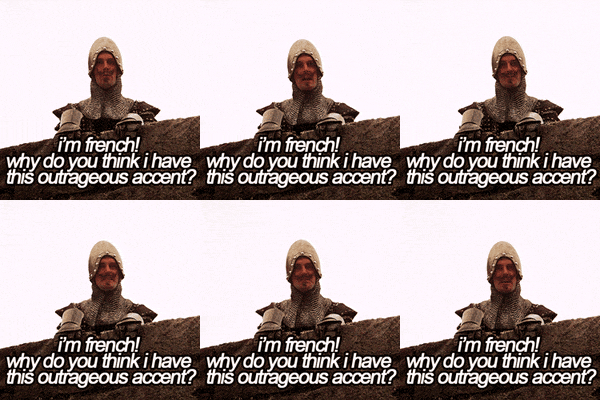
Crikey, we were on a right old tour with this week’s setter, weren’t we? Reading out all the countries referenced would be like reciting the lyrics to Yakko’s World. (I’ll let you YouTube that one.) And then there was the French. So. Much. French! It seemed barely an opportunity was missed by the setter in crowbarring un petit morceau de français into clues and solutions. I found it funny, truth be told, though it is still a massive Times crossword cliché for me. It was not for nothing that I was ragging all the Times setters for this stuff a few years ago. Not that any of that matters now, of course. 3 Jumbos to go.
Now the competition deadline has long passed you can find my completed grid below along with explanations of my solutions where I have them. I hope you find them helpful. If a recent Jumbo has given you the slip then you might find my Just For Fun page of use, where you’ll find links to solutions for hundreds of the things. 351 of them, if I’m not mistaken.
Thanks for your patience and input. Till next time, stay safe out there kids.
LP
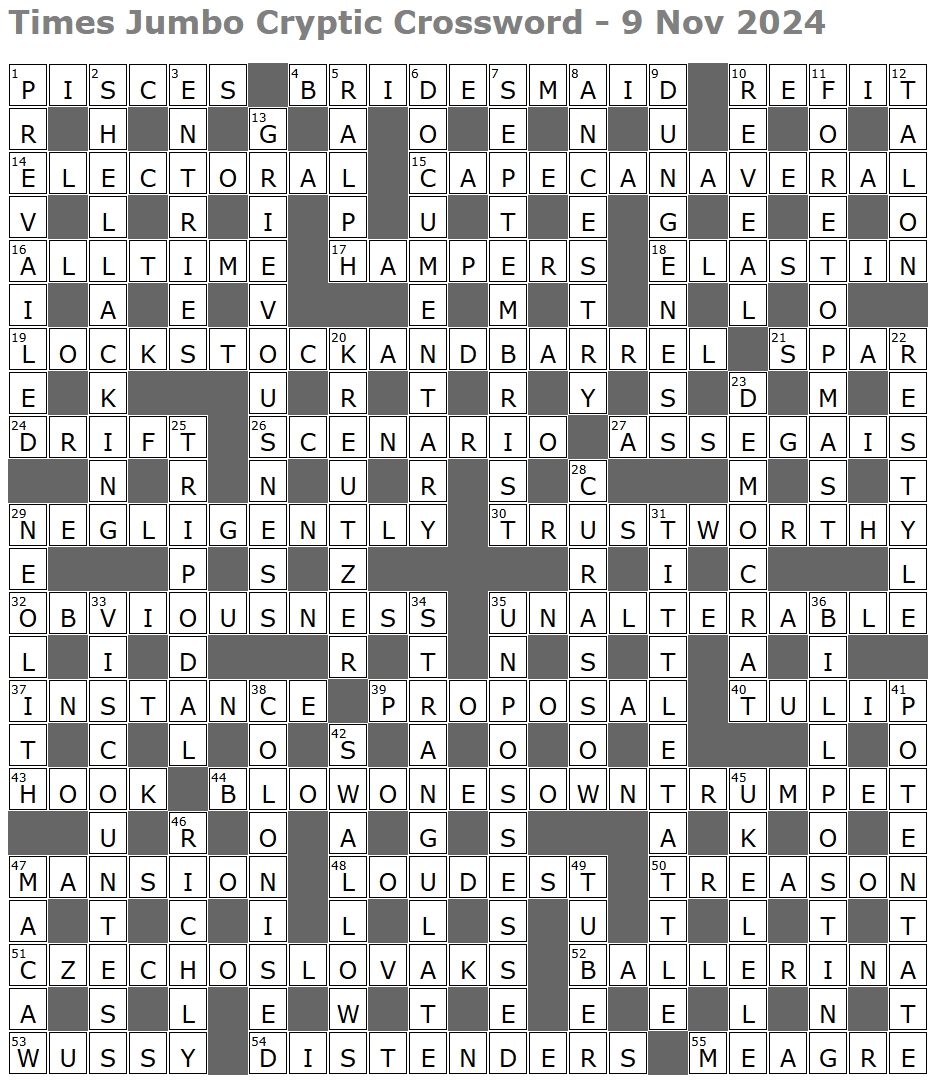
The case for the prosecution

Across clues
- Fish Swedish chefs originally served in pastry dishes (6)
Answer: PISCES (i.e. “fish” in zoology). Solution is S and C (i.e. “Swedish chefs originally”, i.e. the first letters of “Swedish” and “chefs”) both placed “in” PIES (i.e. “pastry dishes”), like so: PI(SC)ES.
- Wedding attendant married on fateful day in interwoven fabric (10)
Answer: BRIDESMAID (i.e. “wedding attendant”). Solution is M (a recognised abbreviation of “married”) placed “on” or after IDES (i.e. “fateful day” in March for Julius Caesar). These are then placed “in” BRAID (i.e. “interwoven fabric”), like so: BR(IDES-M)AID.
- Engineers attack renovation of vessel, say (5)
Answer: REFIT (i.e. “renovation of vessel, say”). Solution is RE (i.e. “engineers”, specifically the Royal Engineers of the British Army) followed by FIT (i.e. an “attack”).
- English reader, a Liberal, concerned with voting (9)
Answer: ELECTORAL (i.e. “concerned with voting”). Solution is E (a recognised abbreviation of “English”) followed by LECTOR (i.e. “reader”), then A and L (a recognised abbreviation of “Liberal”).
- Top European is able to maintain a large missile launching site (4,9)
Answer: CAPE CANAVERAL (i.e. “missile launching site” – I guess this is a historic reference as I don’t think one could accurately describe spacecraft as missiles). Solution is CAP (i.e. to “top” or better someone or something) followed by E (a recognised abbreviation of “European”), then CAN (i.e. “is able to”), then AVER (i.e. to declare to be true or to “maintain”), then A and L (a recognised abbreviation of “large”).
- Unsurpassed junior officer hiding in a tree (3-4)
Answer: ALL-TIME (i.e. “unsurpassed”). Solution is LT (i.e. “junior officer”, in this case short for “lieutenant”) placed or “hiding in” A and LIME (i.e. “tree”), like so: A-L(LT)IME.
- Baskets of celebratory wine Charlie left out (7)
Answer: HAMPERS (i.e. “baskets”). Solution is CHAMPERS (i.e. “celebratory wine”) with the C removed (indicated by “Charlie left out” – “Charlie” being C in the phonetic alphabet).
- Protein in connective tissue finally introduced to a German (7)
Answer: ELASTIN (i.e. “protein in connective tissue”). Solution is LAST (i.e. “finally”) placed in or “introduced to” EIN (i.e. “a German”, i.e. the German for “a”), like so: E(LAST)IN.
- Bar, merchandise and beer container – the whole lot! (4,5,3,6)
Answer: LOCK STOCK AND BARREL (i.e. “the whole lot”). Solution is LOCK (i.e. “bar”) followed by STOCK (i.e. “merchandise”), then AND, then BARREL (i.e. “beer container”).
- Short extra box? (4)
Answer: SPAR (i.e. “box” practise). Solution is SPARE (i.e. “extra”) with the last letter removed (indicated by “short”).
- Tenor ultimately associated with estrangement (5)
Answer: DRIFT (i.e. gist or “tenor”). Solution is D (i.e. “ultimately associated”, i.e. the last letter of “associated”) followed by RIFT (i.e. “estrangement”).
- Plot involving girl in South Carolina port (8)
Answer: SCENARIO (i.e. “plot”). Solution is ENA (i.e. “girl’s” name) placed “in” SC (US state abbreviation of “South Carolina”) and RIO (i.e. Brazilian “port”, Rio De Janeiro), like so: SC-(ENA)-RIO.
- Beasts of burden carrying good, first-class light spears (8)
Answer: ASSEGAIS (i.e. “light spears”). Solution is ASSES (i.e. “beasts of burden”) wrapped around or “carrying” G (a recognised abbreviation of “good”) and AI (i.e. excellent or “first-class”, i.e. A1 with the 1 replaced by its Roman numeral equivalent), like so: ASSE(G-AI)S.
- Abandoned Nigel calmly, though with lack of care (11)
Answer: NEGLIGENTLY (i.e. “with lack of care”). Solution is an anagram (indicated by “abandoned”) of NIGEL followed by GENTLY (i.e. “calmly”), like so: NEGLI-GENTLY.
- Dependable NHS management of unknown value? (11)
Answer: TRUSTWORTHY (i.e. “dependable”). Solution is TRUST (i.e. “NHS management”) followed by WORTH Y (playfully satisfying “of unknown value” – setters love referring to X, Y or Z in solutions as “unknowns”).
- Blatancy of old boy and girl initially outraging American head (11)
Answer: OBVIOUSNESS (i.e. “blatancy”). Solution is OB (a recognised abbreviation of “old boy”) followed by VI (i.e. another “girl’s” name), then O (i.e. “initially outraging”, i.e. the first letter of “outraging”), then US (i.e. “American”) and NESS (i.e. promontory or “head”).
- Lacking capacity to carry table reportedly set in stone? (11)
Answer: UNALTERABLE (i.e. “set in stone”). Solution is UNABLE (i.e. “lacking capacity”) wrapped around or “carrying” a homophone (indicated by “reportedly”) of ALTAR (i.e. “table”), like so: UN(ALTER)ABLE.
- Example of popular fellow, civil engineer (8)
Answer: INSTANCE (i.e. “example”). Solution is IN (i.e. “popular”) followed by STAN (i.e. “fellow”, a man’s name this time), then CE (a recognised abbreviation of “civil engineer”).
- Pertinent, rejecting a gang leader’s suggestion (8)
Answer: PROPOSAL (i.e. “suggestion”). Solution is APROPOS (i.e. “pertinent”) with the A removed (indicated by “rejecting a”) and the remainder followed by AL Capone (i.e. “gang leader”), like so: PROPOS-AL.
- Flower starts to look inferior, nibbled by sheep (5)
Answer: TULIP (i.e. “flower”). Solution is LI (i.e. “starts to look inferior”, i.e. the first letters of “look” and “inferior”) placed in or “nibbled by” TUP (i.e. a ram or “sheep” – we’ve seen this loads of times in recent Jumbos), like so: TU(LI)P.
- House acceptable for a literary pirate (4)
Answer: HOOK (i.e. “literary pirate” from JM Barrie’s Peter Pan). Solution is HO (a recognised abbreviation of “house”) followed by OK (i.e. “acceptable”).
- Glorify oneself – with a fanfare, perhaps? (4,4,3,7)
Answer: BLOW ONE’S OWN TRUMPET. Solution satisfies “glorify oneself”. The remainder of the clue plays on “fanfares” of TRUMPETS. You get the idea.
- Imposing building, or small one in opera? (7)
Answer: MANSION (i.e. “imposing building”). Solution is S (a recognised abbreviation of “small”) and I (i.e. “[Roman numeral] one”) both placed “in” MANON (i.e. an “opera”) like so: MAN(SI)ON. I must say Wikipedia’s overview of MANON quickly decided which demerit ought to apply here: “Manon is an opéra comique in five acts by Jules Massenet to a French libretto by Henri Meilhac and Philippe Gille, based on the 1731 novel L’histoire du chevalier des Grieux et de Manon Lescaut by the Abbé Prévost.” Mon dieu!
- Most obtrusive yobbo taking in some of the French (7)
Answer: LOUDEST (i.e. “most obtrusive”). Solution is LOUT (i.e. “yobbo”) wrapped around or “taking in” DES (i.e. “some of the French”, i.e. the French for “some”), like so: LOU(DES)T. Another look-in for the French, I see.
- Time and motive for lese-majesty (7)
Answer: TREASON (i.e. “lese-majesty” – a French phrase, eh? Noted). Solution is T (a recognised abbreviation of “time”) followed by REASON (i.e. “motive”).
- Old Europeans vet hols, we hear, touring capital city (13)
Answer: CZECHOSLOVAKS (i.e. “old Europeans” – Czechoslovakia was dissolved following the Velvet Revolution of 1989, eventually splitting into the Czech Republic and the Slovak Republic at the start of 1993). Solution is homophones of CHECK (i.e. to “vet” or screen) and VACS (i.e. “hols” – I was sceptical of this given the pronunciation of “vacation”, but Chambers seems to back it up. I’m still not convinced) wrapped around or “touring” OSLO (i.e. “capital city” of Norway), like so: CZECH-(OSLO)-VAKS.
- Frenchman’s to go inside container to meet a dancer (9)
Answer: BALLERINA (i.e. “dancer”). Solution is ALLER (i.e. “Frenchman’s to go”, i.e. the French for “to go”) placed “inside” BIN (i.e. “container”) and A, like so: B(ALLER)IN-A. French again? Pining for Provence, eh, setter?
- Feeble wife quietly dislodged by cat (5)
Answer: WUSSY (i.e. “feeble”). Solution is W (a recognised abbreviation of “wife”) followed by PUSSY (i.e. “cat”) once the P has been removed (indicated by “quietly dislodged” – P being a recognised abbreviation of “piano” or quiet in musical lingo), like so: W-USSY.
- They expand a detective’s offers (10)
Answer: DISTENDERS (i.e. “they expand”). Solution is DI’S (i.e. “detective’s”, specifically a Detective Inspector made possessive) followed by TENDERS (i.e. “offers”).
- Thin and emaciated male bore (6)
Answer: MEAGRE (i.e. “thin and emaciated”). Solution is M (a recognised abbreviation of “male” followed by EAGRE (i.e. a “bore” or sudden rise in a river tide – not seen this in Jumbos for a few months).
Down clues
- Quiet cleric was unwell, but gained mastery (9)
Answer: PREVAILED (i.e. “gained mastery”). Solution is P (a recognised abbreviation of “piano”, already covered in 53a) followed by REV (i.e. “cleric”, short for reverend) and AILED (i.e. “was unwell”).
- That woman left without applying glossy coat (11)
Answer: SHELLACKING (i.e. “applying glossy coat”). Solution is SHE (i.e. “that woman”) followed by L (a recognised abbreviation of “left”) and LACKING (i.e. “without”).
- Guards dismissing first of such registered competitors (7)
Answer: ENTRIES (i.e. “registered competitors”). Solution is SENTRIES (i.e. “guards”) with the first S removed (indicated by “dismissing first of such”, i.e. the first letter of “such”).
- Fellow encountered in rural pharmacy (5)
Answer: RALPH (i.e. “fellow’s” name, another one). “Encountered in” indicates the solution has been hidden in the clue, like so: RU(RAL PH)ARMACY.
- Study Latin with new intake, penning a factual film (11)
Answer: DOCUMENTARY (i.e. “factual film”). Solution is DO (i.e. “study”, as in “I’m having to do French because of this week’s setter”) followed by CUM (i.e. “Latin with”, i.e. the Latin for “with”) and ENTRY (i.e. “new intake”) once wrapped around or “penning” A, like so: DO-CUM-ENT(A)RY. There’s an entire crossword in the main paper for Latin wonks, for goodness sake. Have a classics demerit.
- Boss regularly met priest reforming a participant in massacre (11)
Answer: SEPTEMBRIST (i.e. “participant in massacre”, referring to “a participant in the September massacres of royalist prisoners in Paris, 2-7 September 1792”. French again, eh, setter? This is getting to be rather funny now). Solution is an anagram (indicated by “reforming”) of BS (i.e. “boss regularly”, i.e. every other letter of BOSS) and MET PRIEST.
- A northern church’s attempt to establish roots (8)
Answer: ANCESTRY (i.e. “roots”). Solution is A followed by N (a recognised abbreviation of “northern”), then CE’S (i.e. “church’s”, specifically Church of England made possessive), then TRY (i.e. “attempt”).
- Information found in sandhills on south Kent headland (9)
Answer: DUNGENESS (i.e. “Kent headland”). Solution is GEN (i.e. “information”) placed or “found in” DUNES (i.e. “sandhills”) and S (a recognised abbreviation of “south”), like so: DUN(GEN)ES-S.
- Expose girl with article in both hands (6)
Answer: REVEAL (i.e. “expose”). Solution is EVE (i.e. yet another “girl’s” name) and A (an “article”, being a word like a, an or the) both placed “in” R and L (i.e. “both hands”, being recognised abbreviations of “right” and “left” respectively), like so: R-(EVE-A)-L.
- Warning to top politician – a way to get supporter on board (11)
Answer: FORETOPMAST (i.e. “supporter on board” a ship). Solution is FORE (i.e. “warning” on a golf course) followed by TO, then PM (i.e. “top politician”, specifically a Prime Minister), then A and ST (i.e. “way”, specifically a recognised abbreviation of a “street”).
- Heavyweight holding almost all remaining cards (5)
Answer: TALON (i.e. “remaining cards” or those not dealt, sometimes called the “stock” – one I remembered from its previous appearance in an age-old Jumbo. Weird how some things stick). Solution is TON (i.e. “heavyweight”) wrapped around ALL once its last letter has been removed (indicated by “almost”), like so: T(AL)ON.
- Severity of poor European singers entertaining you in Paris (12)
Answer: GRIEVOUSNESS (i.e. “severity”). Solution is an anagram (indicated by “poor”) of E (a recognised abbreviation of “European”) and SINGERS all wrapped around or “entertaining” VOUS (i.e. “you in Paris”, i.e. the French for “you”), like so: GRIE(VOUS)NESS. Oh-la-la, yet more French!
- King meets newsman bringing in unknown old coin (8)
Answer: KREUTZER (i.e. “old coin”, specifically “any of various former copper coins of Austria, S Germany, etc, one hundredth of the florin or gulden” (Chambers), apparently derived from the German for “cross”, as such coins were stamped with them). Solution is K (a recognised abbreviation of “king” used in chess) followed by Paul REUTER (i.e. “newsman”, founder of the Reuters news agency) once wrapped around or “bringing in” Z (i.e. “unknown” – setters love calling X, Y or Z in solutions as unknowns), like so: K-REUT(Z)ER. Well, at least it wasn’t French, eh?
- Change form of extremely rare historical writing implement (7)
Answer: RESTYLE (i.e. “change form”). Solution is RE (i.e. “extremely rare”, i.e. the first and last letters of “rare”) followed by STYLE (i.e. “historical writing implement” used for writing on wax tablets).
- US politician in rally runs into moggy (8)
Answer: DEMOCRAT (i.e. “US politician”). Solution is DEMO (i.e. “rally”, short for demonstration) followed by R (a recognised abbreviation of “runs” used in a number of ball games) once placed “into” CAT (i.e. “moggy”), like so: DEMO-C(R)AT.
- Stumble over young chap climbing, having three feet (8)
Answer: TRIPODAL (i.e. “having three feet”). Solution is TRIP (i.e. “stumble”) followed by O (a recognised abbreviation of “over” used in cricket) and LAD (i.e. “young chap”) once reversed (indicated by “climbing” – this being a down clue), like so: TRIP-O-DAL.
- Dog and donkey primarily obsessed with crested bird (8)
Answer: CURASSOW (i.e. a turkey-like “crested bird” from South America). Solution is CUR (i.e. “dog”) followed by ASS (i.e. “donkey”), then O (i.e. “primarily obsessed”, i.e. the first letter of “obsessed”) and W (a recognised abbreviation of “with”).
- Characters in Borneo lithographing stone implement (7)
Answer: NEOLITH (i.e. “stone implement” from the later Stone Age). “Characters in” indicates the solution has been hidden in the clue, like so: BOR(NEO LITH)OGRAPHING.
- Chitchat of abstainer in old hat story Times breaks (6-6)
Answer: TITTLE-TATTLE (i.e. “chitchat”). Solution is TT (i.e. “abstainer”, specifically a recognised abbreviation of a teetotaller) placed “in” TILE (i.e. “old hat”, specifically a slang term for a hat – I guess “old” infers this is an archaic slang word, but Chambers doesn’t back this up). This is then followed by TALE once wrapped around or “broken” by T and T (i.e. both “times”, ignoring the misleading capitalisation – T is a recognised abbreviation of “time”), like so: TI(TT)LE-TA(TT)LE.
- Noblewoman representing vet’s cousins (11)
Answer: VISCOUNTESS (i.e. “noblewoman”). Solution is an anagram (indicated by “representing”) of VET’S COUSINS.
- Constrict great aunts travelling across lake (11)
Answer: STRANGULATE (i.e. “constrict”). Solution is an anagram (indicated by “travelling”) of GREAT AUNTS wrapped around or placed “across” L (a recognised abbreviation of “lake”), like so: STRANGU(L)ATE.
- Owned by no one – but not crazed (11)
Answer: UNPOSSESSED. Solution satisfies “owned by no one” and “not crazed”. Chambers doesn’t really back up the latter, but another dictionary might.
- Fellow given appointment working for advertisers (11)
Answer: BILLPOSTING (i.e. being in the employment of or “working for advertisers”). Solution is BILL (i.e. “fellow’s” name) followed by POSTING (i.e. “appointment”).
- Stop one’s free land eventually being occupied (9)
Answer: COLONISED (i.e. “occupied”). Solution is COLON (i.e. punctuation “stop”) followed by I’S (i.e. “[Roman numeral] one” made possessive), then E and D (i.e. “free land eventually”, i.e. the last letters of “free” and “land”).
- Ruler’s earthenware vessel in French gallery (9)
Answer: POTENTATE (i.e. “ruler”). Solution is POT (i.e. “earthenware”) followed by EN (i.e. “in French”, i.e. the French for “in”) and TATE (i.e. famous art “gallery”). Blimey, I’d nearly forgotten this week’s setter’s bonk-on for the French it had been so long.
- Birds farm animals observed crossing barrier (8)
Answer: SWALLOWS (i.e. “birds”). Solution is SOWS (i.e. “farm animals”, female pigs) wrapped around or “crossing” WALL (i.e. “barrier”), like so: S(WALL)OWS.
- Stringed instrument from our country the Spanish at last gave the French (7)
Answer: UKELELE (i.e. “stringed instrument”). Solution is UK (i.e. “our country”, the United Kingdom, The Times being a British newspaper) followed by EL (i.e. “the Spanish”, i.e. the Spanish for “the”), then E (i.e. “at last gave”, i.e. the last letter of “gave”) and LE (i.e. “the French”, i.e. the “French” for “the”). I know there’s Spanish in there too, but I’m having too much fun picking up the setter’s comical predilection for our Gallic chums.
- In Berlin I invested in trains – lavishly! (6)
Answer: RICHLY (i.e. “lavishly”). Solution is ICH (i.e. “in Berlin I”, i.e. the German for “I”) placed “in” RLY (i.e. “trains”, specifically a recognised abbreviation of a “railway”), like so: R(ICH)LY.
- Parrot beginning to make a crow’s sound (5)
Answer: MACAW (i.e. “parrot”). Solution is M (i.e. “beginning to make”, i.e. the first letter of “make”) followed by A and CAW (i.e. “crow’s sound”).
- Container finally made for King Edward? (5)
Answer: TUBER (i.e. “King Edward”, a TUBER being a potato). Solution is TUB (i.e. “container”) followed by E and R (i.e. “finally made for”, i.e. the last letters of “made” and “for”).
 Lucian Poll's Web Ramblings
i liked 11 and 12d, and the various fr references are, overall, helpful, I think.
ill miss the Cleesian french memes when this run is over though .
Regards Graham
We thought this one was okay – no particular objections, but no outstandingly good clues. Although like Graham, I did rather like Fore to PM.
We still wince on your behalf every time we come across some French en route, even though we are reasonably au fait and understand the rationale.
A few obscurities meant that I did not complete this – elastin, curassow, that specific meaning of ‘talon’. Also had not heard of the opera, and didn’t know that ‘distenders’ was a word. Other than that, fairly mundane.
I hope you’re around for a blog of this weekend’s puzzle, 1704, I’d like to know what you think – I found it a joyless stinker.
Hi Lucien,
Since I can’t make the new comment system work, I’m trying this way. I strongly suspect that the compilers read your comments and have a competition among themselves to see who can rile you the most. They’ll stop doing it once you stop sending solutions! Anyway, many thanks for your help for the couple of years since I discovered you. In particular, you introduced me to the two Bradford books which I find most helpful.
Best wishes (for Christmas?)
George Hart
By 1705 I expect Lucian will have given up. Having just done this, (unfortunately) it is not the case that they want to rile him alone. They like to rile anyone without a classics education or who has not read Dickens.
Shame because he would have had a field day adding all of those lovely images to tell us how many cliches there are.
As the author of the comment to which Anthony is replying, may I say I partially agree with him. I didn’t do any classics at school or later but still enjoy learning about them. As for Dickens, I inherited a complete set from my parents. Although I no loner have them and have only read one right through, happily I do still remember most of the tiles, including the one in 1705. Or I’d have been completely stuck. Incidentally, I still can’t make the comment system work because it says the email address I am using “is used by an account you are not logged into now” and I don’t know what that means.
George
Incidentally, I am 88 and when they mention pop music, etc I get completely lost!
Yes, rockets are missiles.
Woomera is a rocket launch site in Australia.
The word means ‘missile launcher’ an ancient Aboriginal device to send spears further and faster.