
Another of those Jumbos that was trundling along nicely until it was killed off by an egregious act of convenience from the setter. French corn, FFS. Also History’s Only Playwright is shoehorned in because of course he is. Ugh. 7 Jumbos to go.
Now the competition deadline has passed you can find my completed grid below along with explanations of my solutions where I have them. I hope you find them helpful. If a recent Jumbo has pulled your pants down then you might find my Just For Fun page of use, where you’ll find links to solutions for hundreds of the things.
Thanks again for your patience and input. Till next time, stay safe out there kids.
LP
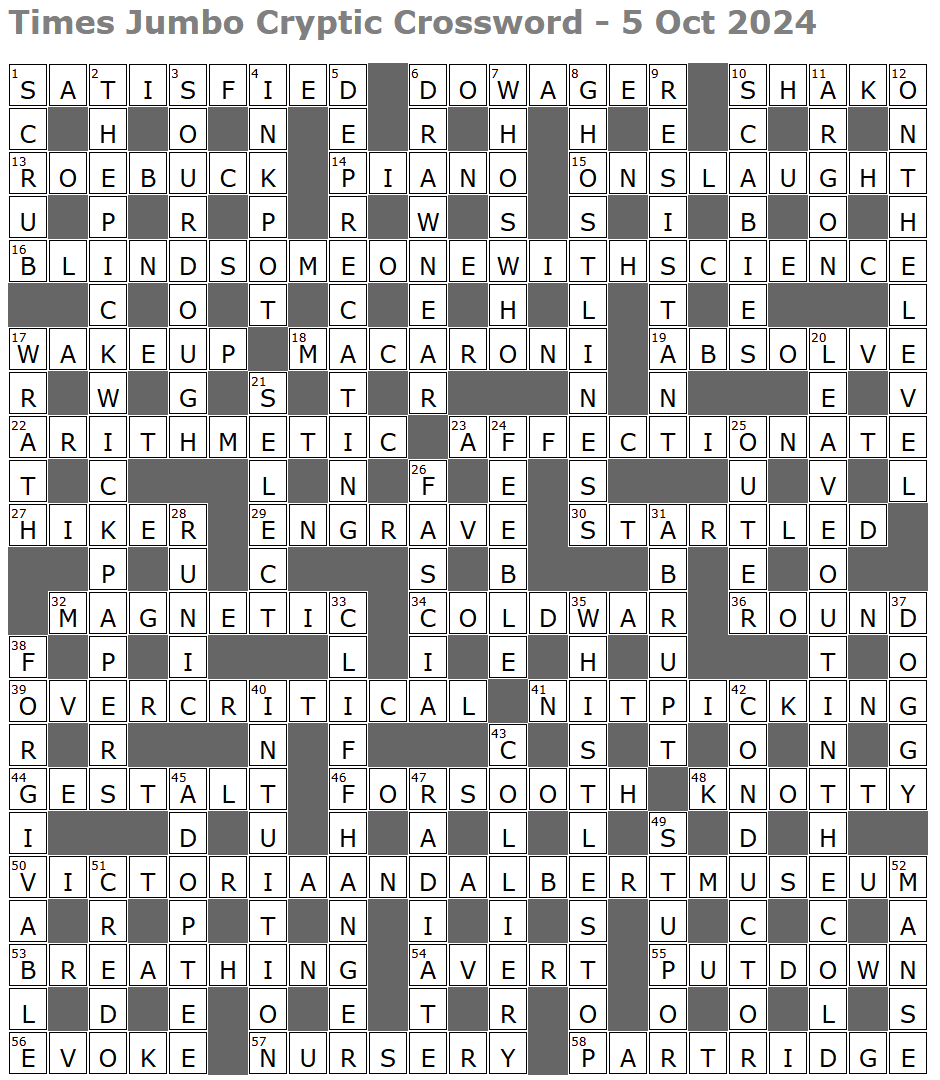
The case for the prosecution


Across clues
- Seated, is given food around one, making one this? (9)
Answer: SATISFIED. Solution satisfies the clue as a whole, but is also SAT (i.e. “seated”) followed by IS and FED (i.e. “given food”) once wrapped “around” I (i.e. “[Roman numeral] one”), like so: SAT-IS-F(I)ED.
- Funny man embraced by achiever’s widow (7)
Answer: DOWAGER (i.e. “widow”). Solution is WAG (i.e. “funny man”) placed in or “embraced by” DOER (i.e. “achiever”), like so: DO(WAG)ER.
- Timeless photo capturing a king in military headgear (5)
Answer: SHAKO (i.e. “military headgear”, specifically a tall cylindrical cap with a visor that was all the rage across nineteenth century Europe). Solution is SHOT (i.e. “photo”) with the T removed (indicated by “timeless” – T being a recognised abbreviation of “time”) and the remainder wrapped around or “capturing” A and K (a recognised abbreviation of “king” used in chess), like so: SH(A-K)O. Made. To. Fit.
- Take over a thousand solid gold deer (7)
Answer: ROEBUCK (i.e. “deer”). Solution is K (a recognised abbreviation of “a thousand”), CUBE (i.e. a “solid” regular figure) and OR (i.e. “gold” in heraldry) all reversed (indicated by “take over”), like so: RO-EBUC-K.
- Joanna has quiet man round (5)
Answer: PIANO (i.e. “Joanna”, rhyming slang after ‘ow all ’em cockneys say piano as “pianna”, apparently). Solution is P (a recognised abbreviation of “piano”, or “quiet” in musical lingo) followed by IAN (a “man’s” name) and O (i.e. “round”).
- Lots are in stitches with tons delayed in fierce attack (9)
Answer: ONSLAUGHT (i.e. “fierce attack”). Solution is TONS LAUGH (i.e. “lots are in stitches”) with the T (a recognised abbreviation of “tons”) placed to the end or “delayed”, like so: (T)ONSLAUGH => ONSLAUGH(T).
- I bewitch with melodic nonsense, somehow get confused (5,7,4,7)
Answer: BLIND SOMEONE WITH SCIENCE (i.e. “get [someone] confused”). Solution is an anagram (indicated by “somehow”) of I BEWITCH and MELODIC NONSENSE.
- Ship’s track visible after daybreak in surface? (4,2)
Answer: WAKE UP (i.e. to “surface” from sleep). Solution is WAKE (i.e. “ship’s track”) followed by UP (i.e. “visible after daybreak”).
- Actress Leslie’s mother, perhaps one who cares about their appearance (8)
Answer: MACARONI (i.e. a dandy or “one who cares about their appearance”). Solution is MA CARON (i.e. “actress Leslie’s mother, perhaps” – Leslie Caron is… hang on… (fetches up Wikipedia) …Leslie Caron is an actress who starred in a film called Fanny. Well, that I did not expect. With a little bit of luck maybe we’ll get Stormy Daniels in next week’s Jumbo) followed by I (i.e. “[Roman numeral] one”). It’s worth noting that, as of writing, Leslie Caron is still alive and kicking, so it seems The Times is indeed ditching its unwritten rule of only allowing dead people feature in crosswords.
- Free muscles needing source of oil without iodine (7)
Answer: ABSOLVE (i.e. to “free”). Solution is ABS (i.e. “muscles”, short for abdominal) followed by OLIVE (i.e. “source of oil”) once the I has been removed (indicated by “without iodine” – I being the chemical symbol of iodine), like so: ABS-OLVE.
- Calculating crime that I arranged (10)
Answer: ARITHMETIC (i.e. “calculating”). Solution is an anagram (indicated by “arranged”) of CRIME THAT I.
- Kind to have an impact on island edges in tide (12)
Answer: AFFECTIONATE (i.e. “kind”). Solution is AFFECT (i.e. “to have an impact”) followed by IONA (i.e. a Scottish “island” often used by cryptic crossword setters) and TE (i.e. “edges in tide”, i.e. the first and last letters of “tide”).
- One rambling president splitting House of Representatives (5)
Answer: HIKER (i.e. “one rambling”). Solution is IKE (i.e. “president”, nickname of US President Dwight Eisenhower) placed in or “splitting” HR (a recognised abbreviation of “House of Representatives” in the US), like so: H(IKE)R.
- English roar for score (7)
Answer: ENGRAVE (i.e. to “score”). Solution is ENG (a recognised abbreviation of “English”) followed by RAVE (i.e. “roar”).
- Very surprised was leading immediately after kick-off (8)
Answer: STARTLED (i.e. “very surprised”). Solution is LED (i.e. “was leading”) placed “immediately after” START (i.e. “kick-off”), like so: START-LED.
- Magazine to quote Newton over demonstrating attraction (8)
Answer: MAGNETIC (i.e. “demonstrating attraction”). Solution is MAG (short for “magazine”) followed by CITE (i.e. “to quote”) and N (a recognised abbreviation of “Newton”, a measurement of force) once these latter two have been reversed (indicated by “over”), like so: MAG-(N-ETIC).
- Vehicle reinforced by aged tungsten in conflict (4,3)
Answer: COLD WAR (i.e. “conflict” of the mid-to-late 20th century). Solution is CAR (i.e. “vehicle”) wrapped around or “reinforced by” OLD (i.e. “aged”) and W (chemical symbol of “tungsten”), like so: C(OLD-W)AR.
- Convex floor’s not good (5)
Answer: ROUND (i.e. “convex”). Solution is GROUND (i.e. “floor”) with the G removed (indicated by “not good” – G being a recognised abbreviation of “good”).
- Too desperately ill for forty-one? (12)
Answer: OVERCRITICAL (i.e. “forty-one”, referring to 41a, the solution of which being NITPICKING). Solution is OVER (i.e. “too” or overly) followed by CRITICAL (i.e. “desperately ill”).
- On reflection, can picture monarch finding fault (10)
Answer: NITPICKING (i.e. “finding fault”). Solution is TIN (i.e. “can”) reversed (indicated by “on reflection”) and followed by PIC (short for “picture”) and KING (i.e. “monarch”), like so: NIT-PIC-KING.
- Suggest altering partly psychological concept (7)
Answer: GESTALT (i.e. “psychological concept”, often associated with the whole being greater than the sum of its parts). “Partly” indicates that the solution has been hidden in the clue, like so: SUG(GEST ALT)ERING.
- Hot roofs unfortunately aged indeed (8)
Answer: FORSOOTH (i.e. “aged indeed”, i.e. ye olde form of “indeed”). Solution is an anagram (indicated by “unfortunately”) of HOT ROOFS.
- Turkey gutted after bird is difficult (6)
Answer: KNOTTY (i.e. “difficult”). Solution is TY (i.e. “turkey gutted”, i.e. the word “turkey” with all its middle letters removed) placed “after” KNOT (i.e. a variety of wading “bird”), like so: KNOT-TY.
- Sadly bemoan culture drama with visit here? (8,3,6,6)
Answer: VICTORIA AND ALBERT MUSEUM (i.e. “visit here”). Solution is an anagram (indicated by “sadly”) of BEMOAN CULTURE DRAMA and VISIT.
- Swimming in the sea around reef regularly using a snorkel? (9)
Answer: BREATHING (i.e. “using a snorkel”). Solution is BATHING (i.e. “swimming in the sea”) wrapped “around” RE (i.e. “reef regularly”, i.e. every other letter of REEF), like so: B(RE)ATHING.
- Green comes after a stop (5)
Answer: AVERT (i.e. “stop”). Solution is VERT (i.e. “green” in heraldry – we’ve seen this a few times in recent Jumbos) placed “after” A, like so: A-VERT.
- Criticise record (3,4)
Answer: PUT DOWN. Solution satisfies “criticise” and to “record”.
- Call out first woman that’s permitted inside (5)
Answer: EVOKE (i.e. “call out”). Solution is EVE (i.e. “first woman”, according to The Bible) wrapped around or having “inside” OK (i.e. “permitted”), like so: EV(OK)E.
- Plant provider’s charge over Southeastern Railway (7)
Answer: NURSERY (i.e. “plant provider”). Solution is RUN (i.e. “charge”) reversed (indicated by “over”) and followed by SE (a recognised abbreviation of “southeastern”) and RY (ditto “railway”), like so: NUR-SE-RY.
- Bird droppings over plaster walls (9)
Answer: PARTRIDGE (i.e. “bird”). Solution is PARGE (i.e. to “plaster” – honestly a new one on me) wrapped around or “walling” DIRT (i.e. “droppings”) reversed (indicated by “over”), like so: PAR(TRID)GE.
Down clues
- Stunted growth in small vineyard with beginning of blight (5)
Answer: SCRUB (i.e. “stunted growth”). Solution is S (a recognised abbreviation of “small”) followed by CRU (i.e. “vineyard”, from the French) and B (i.e. “beginning [letter] of blight”).
- Nominate Hamlet in the press for classic book (3,8,6)
Answer: THE PICKWICK PAPERS (i.e. “classic book” by Charles Dickens). Solution is PICK (i.e. “nominate”) and WICK (i.e. a “hamlet” in England, Scotland or Wales – take your… er… pick) both placed “in” THE PAPERS (i.e. “the press”), like so: THE-(PICK-WICK)-PAPERS. I do like me some Dickens, but I just can’t get into this one. I’ve tried a number of times, but there are simply no hooks that keep me reading. It’s just a series of mildly diverting accounts of stuff happening. Also, this fulfils this week’s CLASSIC NOVEL Times crossword cliché, so have a demerit.
Also, don’t think I didn’t see this week’s setter dip their… er… wick into Billy Shakespeare again. I keep saying it, these sods simply cannot help themselves when it comes to The Bard. And so, also…
- Keep quiet about my family’s Douglas making bread (9)
Answer: SOURDOUGH (i.e. “bread”). Solution is SH (i.e. “keep quiet”) wrapped “about” OUR DOUG (i.e. “my family’s Douglas”), like so: S(OUR-DOUG)H.
- Writer’s vessel has American turtle avoiding strait (6)
Answer: INKPOT (i.e. “writer’s vessel”). Solution is STINKPOT (i.e. “American turtle”, aptly named by all accounts) with the ST removed (indicated by “avoiding strait”, ST being a recognised abbreviation of “strait”).
- Belittling awful creep during romantic activity (11)
Answer: DEPRECATING (i.e. “belittling”). Solution is an anagram (indicated by “awful”) of CREEP placed in or “during” DATING (i.e. “romantic activity”), like so: D(EPREC)ATING.
- Approach doctor with bristle on lughole (4,4)
Answer: DRAW NEAR (i.e. “approach”). Solution is DR (a recognised abbreviation of “doctor”) followed by AWN (i.e. a “bristle”) and EAR (i.e. “lughole”).
- Show how, when formatted, this list shows names at the top (4,3)
Answer: WHO’S WHO (i.e. “this list shows names at the top”). Solution is an anagram (indicated by “when formatted”) of SHOW HOW.
- Unnatural quality of entertainer with part in G&S (11)
Answer: GHOSTLINESS (i.e. “unnatural quality”) followed by HOST (i.e. “entertainer”) and LINES (i.e. acting “part”) both placed “in G&S”, like so: G(HOST-LINES)S.
- Applying block is getting brown during time off (9)
Answer: RESISTANT (i.e. “applying block”). Solution is IS and TAN (i.e. “getting brown”) both placed in or “during” REST (i.e. “time off”), like so: RES(IS-TAN)T.
- Disease of, namely, fir tree genus (7)
Answer: SCABIES (i.e. “disease”). Solution is SC (i.e. “namely”, specifically a recognised abbreviation of the Latin scilicet) followed by ABIES (i.e. “fir tree genus”). Latin and plant genera? Wow, a suspiciously tough sod of a clue. Who hurt you, setter? You can have a classics demerit for your trouble.
- Ship new type of gas (5)
Answer: ARGON (i.e. “type of gas”). Solution is ARGO (i.e. “ship” of myth, belonging to Jason and his Argonauts) followed by N (a recognised abbreviation of “new”). More Greek myth bollocks, but I imagine most people will have heard of the Argo so no demerit.
- Fair then bad in school exam (2,3,5)
Answer: ON THE LEVEL (i.e. “fair”). Solution is an anagram (indicated by “bad”) of THEN placed “in” O-LEVEL (i.e. “school exam” of a generation ago), like so: O-(NTHE)-LEVEL.
- Anger with engaging artist for one (5)
Answer: WRATH (i.e. “anger”). Solution is WITH with the I (i.e. “[Roman numeral] one”) swapped “for” RA (i.e. “artist”, specifically a Royal Academician), like so: W(I)TH => W(RA)TH.
- Shun holiday walking in Antarctica? (5,3,2,3,4)
Answer: LEAVE OUT IN THE COLD (i.e. “shun”). Solution is LEAVE (i.e. “holiday”) followed by OUT IN THE COLD (i.e. descriptive of “walking in Antarctica”).
- Choose sulphur to put in (6)
Answer: SELECT (i.e. “choose”). Solution is S (chemical symbol of “sulphur”) followed by ELECT (i.e. “put in” to office).
- Wasted payment on French corn (6)
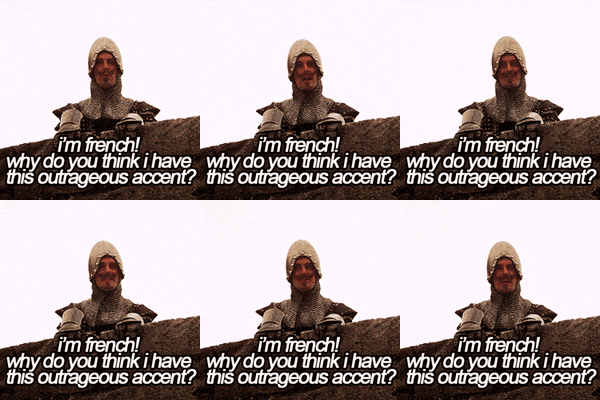
Answer: FEEBLE (i.e. “wasted”). Solution is FEE (i.e. “payment”) followed by BLÉ (i.e. “French corn”, i.e. the French for “corn”. Okay, two things here. First up, this should apparently be “French wheat”, as BLÉ means “wheat”. MAIS, meanwhile, is “corn”. Second, ask yourself how many people here in Blighty are honestly going know that? I don’t recall this in French lessons. It was all cats, dogs, tables, books and counting to ten. Probably other things too, but certainly not whatever the French is for corn. Anyway, who on earth is going to ask for corn over in France other than French farmers and commodity traders? “Excuse me, my good man, I was wondering where in this wonderful land I could buy a lovely bag of corn”. Give me a break. It’s shite like this that turns me off these Jumbos. That alone would have been an instant kill this week had Billy Bloody Shakespeare not already stunk up the place. Have a Jumbo-sized meme).
- Route diverted further from the centre (5)
Answer: OUTER (i.e. situated “further from the centre”). Solution is an anagram (indicated by “diverted”) of ROUTE.
- Frontage a shop can install above on opening (6)
Answer: FASCIA (i.e. “frontage”). “On opening” indicates the solution is also derived from the first letters of Frontage A Shop Can Install Above.
- University in middle of Mercia is concerned with spelling (5)
Answer: RUNIC (i.e. “concerned with spelling” – some believe runes possess magical properties, so I think this is more to do with magic spells than anything relating to language). Solution is UNI (short for “university”) placed “in” RC (i.e. “middle [letters] of Mercia”), like so: R(UNI)C.
- Sudden game point after a bye (6)
Answer: ABRUPT (i.e. “sudden”). Solution is RU (i.e. “game”, specifically Rugby Union) and PT (a recognised abbreviation of “point”) both placed “after” A and B (a recognised abbreviation of “bye” used in cricket), like so: A-B-(RU-PT).
- Mistake about mostly doubtful hour’s suspense at end of programme (11)
Answer: CLIFFHANGER (i.e. “suspense at end of programme”). Solution is CLANGER (i.e. “mistake”) wrapped “about” IFFY (i.e. “doubtful”) once its last letter has been removed (indicated by “mostly”), and H (a recognised abbreviation of “hour”), like so: CL(IFF-H)ANGER.
- Hardly pausing to avoid the risk of work after card game (7-4)
Answer: WHISTLESTOP (i.e. “hardly pausing”). Solution is LEST (i.e. “to avoid the risk of”) and OP (i.e. “work”, specifically a recognised abbreviation of “opus”) both placed “after” WHIST (i.e. “card game”), like so: WHIST-(LEST-OP).
- Child’s pet is unreliable, but grand for second daughter (5)
Answer: DOGGY (i.e. “child’s pet”). Solution is DODGY (i.e. “unreliable”) with the “second” D (a recognised abbreviation of “daughter”) swapped “for” G (ditto “grand”), like so: DO(D)GY => DO(G)GY.
- Five tangling with Balrog such as may be let go (10)
Answer: FORGIVABLE (i.e. “such as may be let go”). Solution is an anagram (indicated by “tangling”) of FIVE and BALROG. Interesting that we had FORGIVE only last week. I’d wang on about repeats again if it wasn’t for the risk of repeating myself.
- Funny feeling with home teaching (9)
Answer: INTUITION (i.e. “funny feeling”). Solution is IN (i.e. at “home”) followed by TUITION (i.e. “teaching”).
- Bird circling unfortunately cut person waving stick (9)
Answer: CONDUCTOR (i.e. “person waving stick”). Solution is CONDOR (i.e. “bird”) wrapped around or “circling” an anagram (indicated by “unfortunately”) of CUT, like so: COND(UCT)OR.
- Weep about Stan’s partner and mine (8)
Answer: COLLIERY (i.e. coal “mine”). Solution is CRY (i.e. “weep”) wrapped “about” OLLIE (i.e. “Stan’s partner”, referring to ye olde cinema double act Laurel & Hardy), like so: C(OLLIE)RY. I really ought to throw a prehistoric cinema demerit at this one, but the fact is I rather like Laurel & Hardy.
- Child that’s taken on song and dance part on the stage finally (7)
Answer: ADOPTEE (i.e. “child that’s taken on”). Solution is ADO (i.e. fuss or a “song and dance”) followed by PT (a recognised abbreviation of “part”), then E and E (i.e. “the stage finally”, i.e. the last letters of “the” and “stage”).
- Run a social engagement around one in shed (7)
Answer: RADIATE (i.e. to “shed”). Solution is R (a recognised abbreviation of “run” used in a number of ball games) followed by A DATE (i.e. “an engagement”) once wrapped “around” I (i.e. “[Roman numeral] one”), like so: R-(A-D(I)ATE).
- Mostly kind about ram’s dazed state (6)
Answer: STUPOR (i.e. “dazed state”). Solution is SORT (i.e. type or “kind”) with the last letter removed (indicated by “mostly”) and the remainder wrapped “about” TUP (i.e. another word for a “ram” we’ve seen a number of times recently in Jumbos), like so: S(TUP)OR.
- Section of sacred opus? (5)
Answer: CREDO. Solution satisfies the clue as a whole, but “section of” also indicates the solution has been hidden in the clue, like so: SA(CRED O)PUS.
- Southern English after staff for northern vicarage (5)
Answer: MANSE (i.e. “northern vicarage”, i.e. one in Scotland). Solution is S (a recognised abbreviation of “southern”) and E (ditto “English”) both placed “after” MAN (i.e. to recruit or “staff”), like so: MAN-(S-E).
 Lucian Poll's Web Ramblings
Ho hum, there were no particularly good clues here but none that were terribly bad.
Slight grumbles about 13A (cube is not the only solid), 4D (arcane US animal) and 10D (arcane tree genus).
A word in defence of 24D … British usage of corn means wheat (blé) but US corn is maize (mais).
Ho hum, there were no particularly good clues here but none that were terribly bad.
Slight grumbles about 13A (cube is not the only solid), 4D (arcane US animal) and 10D (arcane tree genus).
A word in defence of 24D … British usage of corn means wheat (blé) but US corn is maize (mais).
24 down. Whilst I accept that blé is not a common word for English speakers, I note that Chambers says that corn means “cereal plants generally, esp (in England) wheat”. And we always used to talk about cornfields when I was young, meaning any of wheat, barley or oats.
George
PS I do not understand the new system for leaving coments. It says I have to log in because it recognises my e-mail address as belong to someone else. But it doesn’t!
Overuse of OVER to indicate reversals ? Seems to me there’s been a recent run of puzzles where a style or device is rolled out heavily.
I’d prefer swotting up on Chas and Billy rather than googling mothers of Leslie’s but I do accept the criticism of over reliance on old school artists.
A goodish puzzle overall, for me. Thx for write up. Not long to go now.