
A relatively straightforward grid as a whole, spiced up in places with a few exotics – not all of them terribly fair, I would argue. The clues were a mixed bag too. Oh well. Now that the deadline has passed for the competition, you can find my completed grid below along with explanations of my solutions where I have them. I hope you find them helpful. If you’ve found an old unfinished Jumbo down the back of the sofa then you can find a few hundred previous solutions via my Just For Fun page.
Thanks as always for the kind words. I think, by the time you read this, it’ll be a couple of days before Christmas, so I hope you have a good un! Till next time, stay safe out there kids.
LP
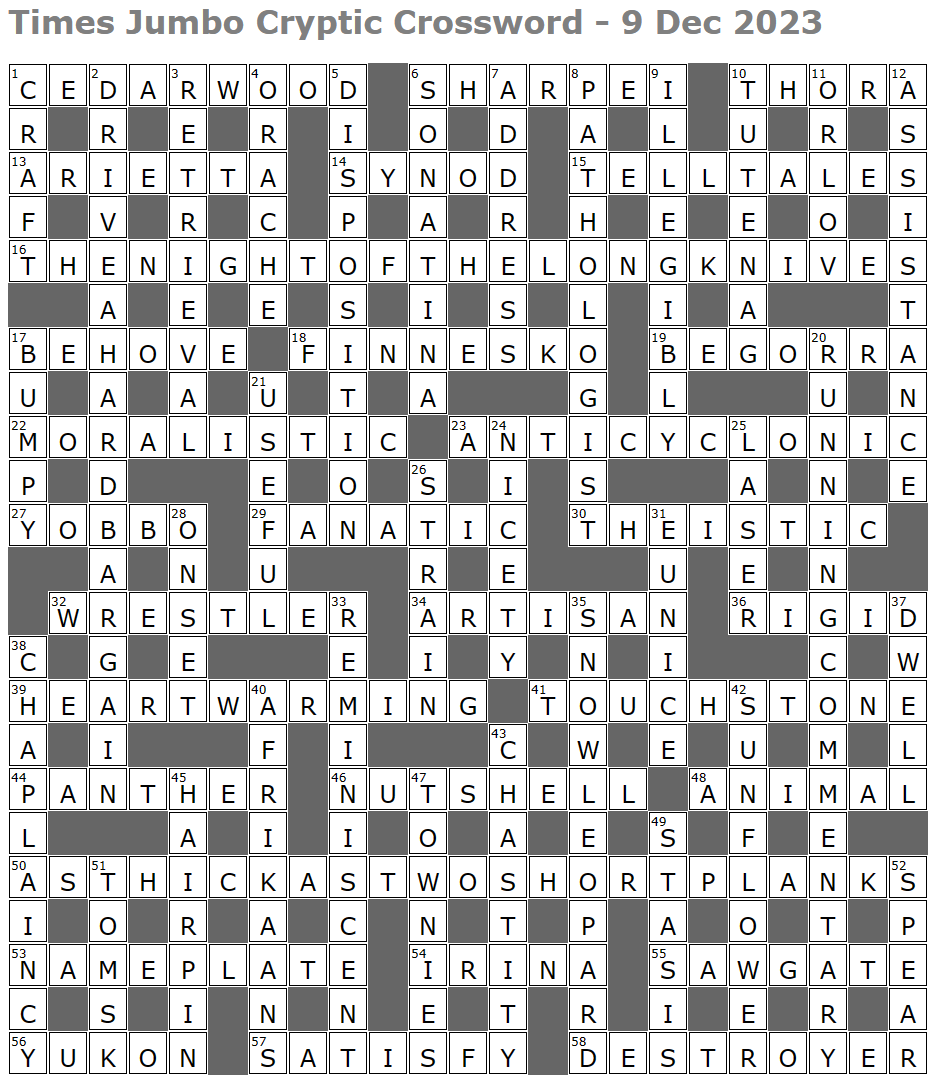
Across clues
- Man in vehicle by court primarily delivering building material? (9)
Answer: CEDARWOOD (i.e. “building material”). Solution is ED (i.e. a “man’s” name) placed “in” CAR (i.e. “vehicle”). This is then followed by WOO (i.e. to “court” someone) and D (i.e. “primarily delivering”, i.e. the first letter of “delivering”), like so: C(ED)AR-WOO-D. One! One forename, ah-ah-ahh!
- Dog with quick wits that is brought from the east (4,3)
Answer: SHAR PEI (i.e. “dog”). Solution is SHARP (i.e. “with quick wits”) followed by IE (i.e. “that is”, i.e. “i.e.”, short for the Latin id est) once the latter has been reversed (indicated by “brought from the east” – this being an across clue), like so: SHARP-EI. One I remembered from its last appearance, if I’m honest.
- Woman originally housing soldiers in old volunteer force (5)
Answer: THORA (i.e. “woman’s” name). Solution is H (i.e. “originally housing”, i.e. the first letter of “housing”) and OR (i.e. “soldiers”, specifically the Other Ranks of the British Army), both placed “in” TA (i.e. “old volunteer force”, namely the Territorial Army), like so: T(H-OR)A. Two! Two forenames! Ah-ah-ahh!
- Song, and in French, digested by a girl (7)
Answer: ARIETTA (i.e. a “song” or short aria). Solution is ET (i.e. “and in French”, i.e. the French for “and”) placed in or “digested by” A and RITA (i.e. a “girl’s” name). Three! Three forenames! Ah-ah-ahh!
- Church council looking into heresy, no doubt (5)
Answer: SYNOD (i.e. “church council”). “Looking into” indicates the solution has been hidden in the clue, like so: HERE(SY NO D)OUBT.
- Informers Swiss hero pursues, as mentioned in speech (9)
Answer: TELLTALES (i.e. “informers”). Solution is William TELL (i.e. “Swiss hero”) followed by a homophone (indicated by “as mentioned in speech”) of TAILS (i.e. “pursues”), like so: TELL-TALES.
- Brutal purge in which massive cuts were made in a dark period? (3,5,2,3,4,6)
Answer: THE NIGHT OF THE LONG KNIVES (i.e. “brutal purge” – the phrase relates to a number of historical events of political upheaval and betrayal. The phrase was first used to describe the night of 30th June 1934, when Adolf Hitler seized command of the Sturmabteilung, a Nazi paramilitary organization, ordering the murder of its leaders. It was also used to describe when then Prime Minister Harold Macmillan sacked a third of his cabinet in 1962 after a bad by-election). The rest of the clue plays on NIGHT being “a dark period” and “massive cuts” being made by LONG KNIVES. You get the idea.
- Suit bishop wore finally at a south coast resort (6)
Answer: BEHOVE (i.e. “suit”). Solution is B (a recognised abbreviation of “bishop” used in chess) followed by E (i.e. “wore finally”, i.e. the last letter of “wore”) and HOVE (i.e. an English “south coast resort”).
- Reindeer skin boots principally for one’s kin, surprisingly (8)
Answer: FINNESKO (i.e. “reindeer skin boots”). Solution is F (i.e. “principally for”, i.e. the first letter of “for”) followed by an anagram (indicated by “surprisingly”) of ONE’S KIN, like so: F-INNESKO. One I knew thanks to a pub in Norwich, The Reindeer, which for a short time was part of the Firkin brewery chain, when it became the Finnesko & Firkin.
- Solicit alms with soldiers – gunners, to be sure (7)
Answer: BEGORRA (i.e. “to be sure” – ehhhhh, I’m not convinced. They’re both Irish expressions, to be sure, but is that enough? There’s no equivalence to my eye: BEGORRA is an outburst – By God! – while “to be sure” is an expression of agreement. Would you argue equivalence between expressions like “gercha” and “have a butcher’s” because they’re associated with cockneys? I doubt it. I might be barking up the wrong tree, but I think this is worthy of a yellow card). Solution is BEG (i.e. “solicit alms”) followed by OR (i.e. “soldiers”, the Other Ranks again, copied and pasted from 10a) and RA (i.e. “gunners”, specifically the Royal Artillery of the British Army).
- Self-righteous tailors randomly caught by microphone (10)
Answer: MORALISTIC (i.e. “self-righteous”). Solution is an anagram (indicated by “randomly”) of TAILORS placed in or “caught by” MIC (short for “microphone”), like so: M(ORALIST)IC.
- Like some calm weather, but opposed to coming round on visits (12)
Answer: ANTICYCLONIC (i.e. “like some calm weather” – a tad ironic given the UK is being battered by not one but two storms today!) Solution is ANTI (i.e. “opposed to”) followed by CYCLIC (i.e. “coming round”) once wrapped around or “visited” by ON, like so: ANTI-CYCL(ON)IC.
- Old boy with son backing antisocial youth (5)
Answer: YOBBO (i.e. “antisocial youth”). Solution is OB (a recognised abbreviation of “old boy”) and BOY (i.e. “son”) all reversed (indicated by “backing”), like so: YOB-BO. A somewhat underwhelming clue.
- Distraught, losing right to arrest a zealot (7)
Answer: FANATIC (i.e. “zealot”). Solution is FRANTIC (i.e. “distraught”) with the R removed (indicated by “losing right” – R being a recognised abbreviation of “right”) and A being placed inside of or “arrested by” the remainder, like so: F(R)ANTIC => FANTIC => FAN(A)TIC.
- Like some believers, cite this in translation (8)
Answer: THEISTIC (i.e. “like some believers”). Solution is an anagram (indicated by “in translation”) of CITE THIS.
- Sporting type’s wife taking break by the French river (8)
Answer: WRESTLER (i.e. “sporting type”). Solution is W (a recognised abbreviation of “wife”) followed by REST (i.e. a “break”), then LE (i.e. “the French”, i.e. the masculine form of “the” in French) and R (a recognised abbreviation of “river”).
- Skilled craftsman’s perch over in Irish islands (7)
Answer: ARTISAN (i.e. “skilled craftsman”). Solution is SIT (i.e. to “perch”) reversed (indicated by “over”) and placed “in” ARAN (i.e. “Irish islands”), like so: AR(TIS)AN.
- Inflexible Democrat on Swiss mountain (5)
Answer: RIGID (i.e. “inflexible”). Solution is D (a recognised abbreviation of “Democrat”) placed “on” or after RIGI (i.e. a “Swiss mountain” – never heard of it), like so: RIGI-D.
- Gratifying at first to welcome member during trial (5-7)
Answer: HEART-WARMING (i.e. “gratifying”). Solution is T and W (i.e. “at first to welcome”, i.e. the first letters of “to” and “welcome”), together with ARM (i.e. “member” or limb), placed in or “during” HEARING (i.e. “trial”), like so: HEAR(T-W-ARM)ING.
- Standard Shakesperean clown (10)
Answer: TOUCHSTONE. Solution satisfies a criterion or “standard”, and also “Shakespearean clown” in his play As You Like It.
- Big cat beginning to paw part of flowering plant (7)
Answer: PANTHER (i.e. “big cat”). Solution is P (i.e. “beginning [letter] to paw”) followed by ANTHER (i.e. “part of flowering plant” – one I remembered, but only working backwards from the whole solution. I recall having one of my customary rants when ANTHER appeared in a run of similarly exotic solutions).
- Teaching union’s nightmare: it may be about Brazil (8)
Answer: NUTSHELL (i.e. “it may be about Brazil”). When written as NUT’S HELL the solution also playfully satisfies “teaching union’s nightmare”, the NUT being the National Union of Teachers.
- Eg armadillo’s plates going from back to front (6)
Answer: ANIMAL (i.e. “eg armadillo” – other species are available). Solution is LAMINA (i.e. “plates”) reversed (indicated by “going from back to front”). Nicely done.
- Stupid, compared with a couple of brief political policies? (2,5,2,3,5,6)
Answer: AS THICK AS TWO SHORT PLANKS (i.e. “stupid”). Clue plays on THICK being “stupid”, AS being “compared with”, TWO being “a couple”, SHORT being “brief” and PLANKS being “political policies” – Chambers offers: “the principles or aims that form the platform or programme of a political party”.
- Panel team designed, giving identification on door? (9)
Answer: NAMEPLATE (i.e. “giving identification on door”). Solution is an anagram (indicated by “designed”) of PANEL TEAM.
- Russian girl, one at home in Burlington House (5)
Answer: IRINA (i.e. “Russian girl”). Solution is I (i.e. “[Roman numeral] one”) followed by IN (i.e. “at home”) once placed “in” RA (i.e. “Burlington House”, home to the Royal Academy – I’ve seen this usage a couple of times, but I never seem to remember it), like so: I-R(IN)A. Come on, now, it’s bad enough when setters resort to using forenames to plug gaps in their grids, but reaching for those of other countries is another level. This is just made-to-fit nonsense by someone too lazy to rework an awkward spot in their grid. Also… four! Four forenames! Ah-ah-ahhhh.
- Gap left by cutter observed at entrance (3,4)
Answer: SAW GATE (i.e. “gap left by cutter” – I guess “groove” didn’t… er… cut it). Solution is SAW (i.e. “observed”) followed by GATE (i.e. “entrance”).
- Part of Canada our country invested in over there (5)
Answer: YUKON (i.e. “part of Canada”). Solution is UK (i.e. “our country”, The Times being a British newspaper) placed or “invested in” YON (i.e. “over there”, poetically), like so: Y(UK)ON.
- It’s fine for example to go outside and meet (7)
Answer: SATISFY (i.e. “meet”). Solution is TIS (i.e. “it’s”, specifically an archaic contraction of “it is”) and F (a recognised abbreviation of “fine” used in grading pencils) both placed in or having “outside” of them SAY (i.e. “for example”), like so: SA(TIS-F)Y.
- One dispatches ungulates crossing east part of this ancient city (9)
Answer: DESTROYER (i.e. “one dispatches”). Solution is DEER (i.e. “ungulates”, being a hoofed animal) wrapped around or “crossing” S (i.e. “east part of this”, i.e. the last letter of “this” – this being an across clue) and TROY (i.e. “ancient city”), like so: DE(S-TROY)ER.
Down clues
- Cunning service personnel appearing in court (5)
Answer: CRAFT (i.e. “cunning”). Solution is RAF (i.e. military “service”, the Royal Air Force) placed “in” CT (a recognised abbreviation of “court”), like so: C(RAF)T.
- Act uncompromisingly, make another trip round difficult obstacle (5,1,4,7)
Answer: DRIVE A HARD BARGAIN (i.e. “act uncompromisingly”). Solution is DRIVE AGAIN (i.e. “make another trip”) wrapped “round” HARD (i.e. “difficult”) and BAR (i.e. “obstacle”), like so: DRIVE-A(HARD-BAR)GAIN.
- Getting back from river late for a change (9)
Answer: RETRIEVAL (i.e. “getting back”). Solution is an anagram (indicated by “for a change”) of RIVER LATE.
- Roman poet lowers head, finding herbaceous plant (6)
Answer: ORACHE (i.e. “herbaceous plant”). Solution is HORACE (i.e. “Roman poet”) with the first letter or “head” moved along or “lower” – this being a down clue – like so: (H)ORACE => ORAC(H)E.
- Former princess’s place and character (11)
Answer: DISPOSITION (i.e. “character”). When written as DI’S POSITION the solution also playfully satisfies “former princess’s place”.
- A woman overwhelmed by offspring’s composition (8)
Answer: SONATINA (i.e. musical “composition”). Solution is A and TINA (i.e. “woman’s” name) both placed beneath or “overwhelmed by” – this being a down clue – SON (i.e. “offspring”), like so: SON-(A-TINA). Five! Five forenames! Ah-ah-ahhh!
- Deal with daughter wearing a formal garment (7)
Answer: ADDRESS (i.e. “deal with”). Solution is D (a recognised abbreviation of “daughter”) placed in or “wearing” A and DRESS (i.e. “formal garment”), like so: A-(D)-DRESS.
- Way old register is kept ultimately for medical specialist (11)
Answer: PATHOLOGIST (i.e. “medical specialist”). Solution is PATH (i.e. “way”) followed by O (a recognised abbreviation of “old”), then LOG (i.e. “register”), then IS and T (i.e. “kept ultimately”, i.e. the last letter of “kept”).
- Bilge Lily turned out, in badly formed characters (9)
Answer: INELIGIBLY (i.e. “in badly formed characters”). Solution is an anagram (indicated by “turned out”) of BILGE LILY.
- Pupil mostly to keep on at producing alloy (7)
Answer: TUTENAG (i.e. an “alloy” of zinc and copper). Solution is TUTEE (i.e. “pupil”) with the last letter removed (indicated by “mostly”) and the remainder followed by NAG (i.e. “keep on at”), like so: TUTE-NAG.
- Some poor lovelorn wooer of Catherine the Great (5)
Answer: Grigory ORLOV (i.e. “wooer of Catherine the Great”). “Some” indicates the solution has been hidden in the clue, like so: PO(OR LOV)ELORN.
- A standpoint limiting sibling’s aid (10)
Answer: ASSISTANCE (i.e. “aid”). Solution is A followed by STANCE (i.e. “standpoint”) once wrapped around or “limiting” SIS (i.e. “sibling”, short for sister), like so: A-S(SIS)TANCE.
- Uneven universal politician in past (5)
Answer: BUMPY (i.e. “uneven”). Solution is U (a recognised abbreviation of “universal” in film classification) and MP (i.e. “politician” or Member of Parliament) all placed “in” BY (i.e. “past”), like so: B(U-MP)Y.
- Blow-by-blow account of London Marathon, possibly? (7,10)
Answer: RUNNING COMMENTARY. Solution satisfies “blow-by-blow account” and, playfully, with a little recycling, “account of London Marathon, possibly”.
- Handy American source of power English brought up (6)
Answer: USEFUL (i.e. “handy”). Solution is US (i.e. “American”) followed by FUEL (i.e. “source of power”) once the E (a recognised abbreviation of “English”) has been moved back a couple of notches (indicated by “brought up” – this being a down clue), like so: US-FU(E)L => US-(E)FUL.
- Fine point involving diamonds initially touted in New York (6)
Answer: NICETY (i.e. “fine point”). Solution is ICE (slang for “diamonds”) and T (i.e. “initially touted”, i.e. the first letter of “touted”) both placed “in” NY (a recognised abbreviation of “New York”), like so: N(ICE-T)Y.
- Genuine upset about top of solid beam (5)
Answer: LASER (i.e. “beam”). Solution is REAL (i.e. “genuine”) reversed (indicated by “upset” – this being a down clue) and wrapped “about” S (i.e. “top of solid”, i.e. the first letter of “solid”), like so: LA(S)ER.
- Struggle to produce a little music (6)
Answer: STRAIN. Solution satisfies “struggle” and “a little music”.
- Assault where film actors may be working (5)
Answer: ONSET (i.e. “assault”). When written as ON SET the solution also satisfies “where film actors may be working”.
- Girl of pleasant disposition supporting Brussels (6)
Answer: EUNICE (i.e. “girl’s” name). Solution is NICE (i.e. “of pleasant disposition”) placed after or “under” – this being a down clue – EU (i.e. the European Union, commonly referred to as “Brussels” after the location of its headquarters), like so: EU-NICE. Six! Six forenames! Ah-ah-ahhh!
- Evocative of short dresses in modern setting (11)
Answer: REMINISCENT (i.e. “evocative of”). Solution is MINIS (i.e. “short dresses”) placed or “set in” RECENT (i.e. “modern”), like so: RE(MINIS)CENT.
- Does it weigh more than an ounce? Yes and no (4,7)
Answer: SNOW LEOPARD. The clue plays on how a variant meaning of “ounce” is a SNOW LEOPARD, their weights equivalent as they are one and the same thing, but also that the animal will weigh more than an “ounce” of weight. You get the idea.
- Live to prosper, though lacking love (5)
Answer: DWELL (i.e. reside within or “live”). Solution is DO WELL (i.e. “to prosper”) with the O removed (indicated by “though lacking love” – “love” being a zero score in tennis).
- Fellow rested extremely comfortably in priest’s office (10)
Answer: CHAPLAINCY (i.e. “priest’s office”). Solution is CHAP (i.e. “fellow”) followed by LAIN (i.e. “rested”) and CY (i.e. “extremely comfortably”, i.e. the first and last letters of “comfortably”).
- A day old Turkic ruler heard son’s foreign language (9)
Answer: AFRIKAANS (i.e. “foreign language”). Solution is A followed by FRI (i.e. “day”, short for Friday), then a homophone (indicated by “heard”) of KHAN (i.e. “old Turkic ruler”) and S (a recognised abbreviation of “son”), like so: A-FRI-KAAN-S.
- Bloomer made by tabloid upset about womaniser (9)
Answer: SUNFLOWER (i.e. “bloomer”). Solution is SUN (i.e. UK “tabloid” newspaper) followed by RE (i.e. “about” – think email replies) and WOLF (i.e. “womaniser”) once these last two have been reversed (indicated by “upset” – this being a down clue), like so: SUN-(FLOW-ER).
- Sexual abstinence enjoys benefit at last in Westminster, say (8)
Answer: CHASTITY (i.e. “sexual abstinence”). Solution is HAS (i.e. “enjoys”) and T (i.e. “benefit at last”, i.e. the last letter of “benefit”) both placed “in” CITY (i.e. “Westminster, say”), like so: C(HAS-T)ITY.
- Instrument popular around island, it keeps one’s thatch in place (7)
Answer: HAIRPIN (i.e. “it keeps one’s thatch in place”). Solution is HARP (i.e. musical “instrument”) and IN (i.e. “popular”) all wrapped “around” I (a recognised abbreviation of “island”), like so: HA(I)RP-IN.
- Urbanites acknowledge having connections outside (7)
Answer: TOWNIES (i.e. “urbanites”). Solution is OWN (i.e. “acknowledge”) placed in or having “outside” of it TIES (i.e. “connections”), like so: T(OWN)IES.
- Way a group of agents identifies stagnation (6)
Answer: STASIS (i.e. “stagnation”). Solution is ST (i.e. “way”, specifically a recognised abbreviation of “street”) followed by A and SIS (i.e. “group of agents”, specifically Secret Intelligence Service, or MI6).
- Cats originally kept in Siberian city (5)
Answer: TOMSK (i.e. “Siberian city”). Solution is TOMS (i.e. “cats”) followed by K (i.e. “originally kept”, i.e. the first letter of “kept”). I dunno, Russian princes, Russian girls and now Russian cities. Looks like we’ve got another one, Senator McCarthy. Book ’em, Danno.
- Weapon European leader kept in box (5)
Answer: SPEAR (i.e. “weapon”). Solution is E (i.e. “European leader”, i.e. the first letter of “European” – a little redundant given E is already a recognised abbreviation of “European”) placed or “kept in” SPAR (i.e. to “box”), like so: SP(E)AR.
 Lucian Poll's Web Ramblings
I had never heard of (6a) “SHAR PEI”, but it could be deduced. A middling crossword, but very enjoyable. I am off to the newsagent tomorrow for the next Sat. Jumbo and will probably also pick up The Guardian for their holiday crossword as well. But I must confess that The Guardian’s crosswords are not were they were. The loss of Araucaria was tragic and irreplaceable.
Thank you, Lucian. I erred at 48 across and appreciate the right answer. I hope that you have a good Christmas holiday. I will hope for a Boxing Day crossword and may go look to see what puzzle GCHQ has for us this year.
Hello again.
I absolutely agree with you about begorra!
And I don’t like lamina, plates should be laminas or laminae surely?
Merry Christmas, you deserve it
or indeed lamini (SOED)?
Well, here we go. The new ritual is digging out the saved old puzzle on Sat morning, and checking for any I had doubts on, or where I needed our own Mycroft’s explanation.
A pox on The Times for causing this dislocation.
I really disliked 19a Begorra, but quite enjoyed the rest of the puzzle.
Thank you Lucian. Happy mid winter festival and New Year to you and all my fellow puzzlers.
I wrote above that “I am off to the newsagent tomorrow for the next Sat. Jumbo”. Well, shock! horror! No copy of “The Times” to be found today. So I bought “The Guardian” instead. (I had forgotten what a moany bunch they are).
I immediately turned to the inside of the back page. Horror upon horrors. The lights in the crossword grid are only around 4mm square, whereas in “The Times” Jumbo, they are nearly twice the size (around 7mm square). Even worse, the point size of the clues themselves is impossibly tiny. With my eyesight no longer in the first flush of youth, “The Guardian” holiday crossword will be dumped in the bin.
Do the children at these organs have something against older people? My local paper runs an 8-page puzzle section, which I have always enjoyed. But recently, instead of black text on a white background, they are using curious colour combinations such as white text on a light-blue background. Impossible without eye-strain.
Anyway, Happy Christmas everyone.
Thanks Lucian. Having felt rather disgruntled about your decision to delay publishing solutions, I actually find it’s forcing me to spend time revisiting the clues I’m stuck on, rather than giving up & cribbing off you. So I’m pleased to announce I finished this one. Wishing you a happy Christmas.
Further to my grumpy complaint about impossible colour combinations and point sizes in “The Guardian”, I went out this morning (Christmas Eve) and bought a copy of “The Mail on Sunday”. Oh joy! Their puzzles are readable – and generally black on white. The cryptic crossword is pretty basic, but I have huge admiration as I first learned cryptic clues from “The Mail” in the 1960s.
Here is one from today’s “Mail on Sunday”.
9a. “”Sit, holding last of writer’s writing (5)”