Review – The Shadow of the Soul

Note: This review contains spoilers for “A Matter of Blood” (albeit nothing you wouldn’t find in the blurb).

“The Shadow of the Soul” is book two of Sarah Pinborough’s “Dog-Faced Gods” trilogy (also known as the “Forgotten Gods” trilogy in the US) and continues the story of Detective Inspector Cassius Jones following the dramatic conclusion of “A Matter of Blood”.

Six months have passed since that climactic shootout, London is recovering from a string of recent severe bomb attacks, and Cass Jones is investigating a series of unusual student suicides, each linked by a single bizarre phrase: “Chaos in the darkness”. He has a new partner in tow that he can barely stand, his testimonies against fellow coppers attract suspicion and resentment from many of his colleagues, and he finds his messy private life and family history further entwined in the machinations of the mysterious Mr Bright and The Bank.

Specifically, it turns out that Luke, the nephew he had thought murdered, was not the biological son of his brother, Christian. A switch at birth had taken place, and one that Christian had grown to suspect. It does not take a giant leap of logic to suspect Mr Bright’s involvement, particularly when Cass finds the man in age-old family photographs looking not a day younger.

We are introduced to a new character, Abigail Porter, security operative for the Prime Minister. When CCTV footage reveals a large fat man in the vicinity immediately before each bomb blast in London, it becomes evident that they are seeing the same person each time, something that should not be impossible when the bombs were all detonated simultaneously. When Abigail spots the same figure in the crowd prior to an official engagement she chases him down into a tube station. He looks close to death and, when he touches her hand, her mind is filled with bizarre images and sensations. He leaves her with a single word, “Interventionist”, before hurling himself under a train with a big grin on his face.

Meanwhile a fear of death permeates the cohorts of The Bank. They are supposed to be eternal, otherworldly beings, and yet several of their number are finding their lifeforce, their “Glow”, on the wane. While Mr Bright is convinced it is all a state of mind – that they have simply grown tired of living for so long – the fear among the ranks is proving enough to stoke a rebellion. It is the last thing Mr Bright needs. The first of their kind remains comatose, and the way home across the Walkways is proving as elusive as ever.

For anyone who thought “A Matter of Blood” dragged a little (particularly in regard to Cass Jones’ home life) let me put your mind at rest. “The Shadow of the Soul” thunders along like a speeding freight train. With the (ahem) dead weight cut from Cass’ overarching story, the pages turn thick and fast, helped in no small part by a healthy dollop of Even More Plot. Yum!

Sometimes when completely new characters are crowbarred into established stories it can be quite jarring and off-putting. (I finally lost track of how big Tony Soprano’s extended family became by season six, for example.) While the temptation would have been there to plonk Abigail Porter into the story simply as a means to further Mr Bright’s storyline, this has been largely resisted and results in a great, fully-rounded and kick-ass character: perhaps my favourite of the trilogy.

On top of this, exposition is drip-fed into the narrative in mostly the right places and really helps draws you into the story. If you hadn’t quite guessed who or what the cohort were by the end of book one, for example, you’ll be in little doubt by the end of this one.

There are issues to overlook, however. We have the re-emergence of Guess The Login Password, which, as my previous review mentioned, is a plot trope that should suffer the editor’s red pen the world over. Luckily this time it’s not as integral to the plot. There is also the usual riddle-talking and copious amounts of I-know-something-you-don’t-know from Mr Bright that can become rather tiring.

There was another thing that niggled me throughout the series, though I fully admit this may have been just me. I am aware that the author used her former pupil’s names for characters in her earlier books. For this trilogy she appears to have name-checked several fellow authors and editors in the field: Ramsey (Campbell), (Jo) Fletcher, (Steve) Rasnic (Tem), Brian Freeman, (Stephen) Jones, (Paul) Cornell and so on. On the one hand this is a nice gesture, and yet, once I noticed it happening, I must say every fresh nod bounced me a little out of the story.

Otherwise I was looking at an entertaining read in “The Shadow of the Soul”, and one that satisfyingly ratchets things up from “A Matter of Blood”. Recommended, but make sure you read the first book!

4/5

Review – A Matter of Blood

They’re funny old things, book trilogies. Some genres seem to suit them better than others. For example, you’ll be doing well to pick a sci-fi or fantasy novel off the shelves and not find it “Volume whatever of The Handlecrank Trilogy”. (Usually the second.) There are some genres, however, that are ill-suited to trilogies. Crime, for example, where the book series is king owing to its inherent case-by-case story structure. Horror, too, is often stony ground for trilogies. (Tales of high terror and nerve-shredding peril tend to lose something when you know the protagonist needs to survive to book three.)

So when someone takes the crime and horror genres and then fashions them into a dark fantasy trilogy I’m left with two thoughts. One is: “There’s something you don’t see every day.” The other: “I want to read that!”

All such blathering leads me to Sarah Pinborough’s “Dog-Faced Gods Trilogy”. (Also known as “The Forgotten Gods Trilogy” in the US.)

“A Matter of Blood” is the first of the trilogy, in which we find London suffering under the weight of recession, a highly-contagious new strain of HIV and a serial killer known as the Man of Flies.

The wider world is largely beholden to The Bank: an organisation that was formed by the wealthiest to pour oil over choppy economic waters, one whose fingerprints cover nearly every financial transaction made, but also one that is secretly controlled by cohorts of otherworldly beings. When one of the cohort starts to die – something that isn’t supposed to happen to the everlasting – discord and fear build through the ranks.

Amid all of this we are drawn into the messy world of Detective Inspector Cassius Jones as he investigates a string of murder victims: each with the words NOTHING IS SACRED written across their chest; each sporting a neat arrangement of fly eggs about their person. Meanwhile a parallel investigation is attempting to track the killers of two school friends in what appears to have been a botched gangland hit.

When someone anonymously deposits a DVD at the station showing the boys’ shooting, intrigue is notched higher still. Or at least, that is, until Christian, Cass’ brother, apparently shoots his wife, young son and then himself.

Could there be a connection? Well, we wouldn’t have a 419 page novel if there wasn’t, would we? “Ah, but is it any good,” you ask? My answer is “Yes, but…”

The yes: In “A Matter of Blood” we are given a believable alternate London with a large cast of well-drawn characters on both sides of the law. The star of the show is, of course, Cass Jones, a satisfyingly complex character whose rough edges – his chequered history, his infidelity, his acquaintance with Charles (so to speak), his foot in the criminal underworld – instantly engage the reader. Such a large cast makes for a lot of plot to chew over, and, happily, there isn’t much flab in those pages.

The but: Plot advancement and pacing is sometimes reliant on characters doing dumb or unbelievable things, often jarringly so. An example of a dumb move sees Cass attempting to gain illegal access to The Bank’s headquarters. It quickly becomes apparent why, for the sake of the plot, he does this, but his motive in doing so is weak. Indeed, when he later questions his dumb move you can’t help but wonder if there’s a hint of authorial voice in there. A rather large example of plot-stalling emerges once you’ve read the trilogy and realise one key (and short-lived) character could have saved at least a book and a half by getting to the point and not talking in unnecessary riddles.

More yes: the near-future world in which this all takes place is often brilliantly realised. There is an excellent sense of place in each scene, achieved not through pages of dry description, but through the observations of believable characters. The police procedural elements of the story are so well done there were often times I forgot I was reading a dark fantasy story.

More but: You have all this sterling attention to detail only to then see the story resort to hoary old plot tropes such as “Guess The Login Password”! (And a two-character password at that. If you listen carefully you can hear a million IT guys across the world “WTF” simultaneously, and a squillion office workers say “Huh, I wish.”) Seriously, folks, there are less clunky ways of gaining access to a locked laptop.

So it goes, back and forth, between the really good and the not-quite-so-good. If you can accept the story for what it is and don’t peek too deeply into its plot holes then you’ll find a lot here to enjoy. It does suffer a little for being the first of a trilogy, but, rather like Mark Hodder’s “Burton & Swinburne” series, the story really picks up in subsequent books.

If the somewhat permeable nature of some trilogies (*cough* Night Watch *cough*) has left you jaded, it’s also worth mentioning that there is a genuine sense of closure in “The Dog-Faced Gods”.

(Unless, of course, the planned TV series is a roaring success, in which case all bets are off!)

3/5, but this is a trilogy worth sticking with.

Oh, *there* you are…

Howdy, folks, it’s your least humble servant here again with an apology for not blogging sooner. In short, I went and repeated the same error as last year: that of letting December happen after a successful NaNoWriMo. In doing so I caught a bad dose of January too.

Writing has gone unwritten. Books read have gone unreviewed. Books unread continue to breed with gay abandon when I’m not looking. Then, of course, there’s The Day Job. (Wields crucifix-fingers.) Sadly my Christmas wish for 48-hour days (or a big lottery win) never came true.

Progress on The Forum of the Dead has stalled as a result, and will likely need a reboot, which is disappointing but, weirdly, kind of appealing at the same time. To console myself I’m writing a much more simple (and shorter) ghost story, which is keeping me amused on these wet, blustery nights.

For this post, however, I’ll wrap up a few remaining thoughts from when I published The Floors last year. I’ll keep them brief(ish), but these are the things I’ll keep in mind for future projects.

Promotion

In a previous post I outlined the costs incurred in advertising The Floors, which had come to a pretty penny. Indeed, once the editing costs were factored in I was looking at a break-even figure akin to those targeted by small presses. “Tall order” didn’t cover the half of it!

So, nearly five months later, have I made back the cost? Good lord, no, but then that was pretty much to be expected. I’m an unknown quantity in a crowded, noisy marketplace, after all. On top of that The Floors is self-published, which nowadays is enough to see a significant number of readers running for cover from the shit-volcano’s pyroclastic cloud.

Okay, so did I attract any readers? Indeed I did, and genuine “saw my ad and thought they’d give it a whirl” readers too. And do you know what? It felt great! Not only did I see sales of the eBook, but also the (nearly five times more expensive) paperback edition, which, given the work it had taken, was really satisfying. Me = 🙂 x 100.

So would I use print advertising again? Yes, I think I would, despite the cost. In part it helps support the magazines I love to read, it also helps reinforce my (assumed) name and, of course, there’s the large ego-massage of seeing my advert in print. Next time, however, I may hold fire on the teaser ads.

Print advertising wasn’t the only avenue explored. I achieved some unexpectedly strong signal boosts via a few Goodreads giveaways, for example, each garnering well over a thousand entrants. Yes, there are many on Goodreads who’ll chuck their hat into the ring for anything that’s free, but I was delighted to receive some really heartening feedback from those who were truly interested in reading The Floors, and the book now rests in over a thousand Goodreaders’ virtual bookshelves. It’s that kind of response and feedback that will most definitely see me use a few giveaways for future projects.

Then there was the super-ego-boost of seeing a couple of copies of The Floors sitting on the bookshelves of a local department store, squeezed alongside Tim Powers and Terry Pratchett. See?
20140203-002348.jpg

What did that cost? A polite enquiry at the till, a brief pitch to their book buyer, a professional-looking delivery note and 40% of the cover price. (Actually, those two copies have since been snapped up so I’d better see if they’d like any more.)

I’m much less inclined to use Twitter and Facebook to promote any future projects, however, partly due to the ill reputation inherent in that approach, and partly because of the fart it represents in the force 10 hurricane of self-promotion. Some Facebook groups have taken a stand against the self-promoting spammers, and I can only see the trend continuing. Not only that, but when Facebook and Twitter apps both contain the means to filter out the noise and focus only on those you want to truly follow, the incessant buy-me-buy-me-buy-me tactic seems all the more futile and desperate.

Moving on, we come to…

Print graphics

Here are a few important lessons for anyone tempted to do their own artwork. (Don’t worry, folks, it’s not the rather tiresome, smug and predictable “Don’t do your own artwork.” We’re better than that, here.)

There are some awesome programs out there to help create on-screen graphics, and, amazingly, they’re free! Seriously, Inkscape and GIMP are astonishingly good. The elevator panel and marble effect wallpaper currently used in this blog only took a few hours to create. That and a lot of processing power.

Sadly, those free programs don’t support print formats such as CMYK (Cyan-Magenta-Yellow-Black), which is a format used to overlay colours on a white sheet of paper. Instead Inkscape and GIMP only seem to support RGB images (Red-Green-Blue), which is a graphics format designed to illuminate pixels on an otherwise black screen. If you want to produce CMYK images you’re probably looking at commercial software such as Adobe Photoshop or Microsoft Publisher.

Okay, all this may sound like a technicality. Image files is image files is eggs is eggs, right? Printers will readily accept RGB files, so what’s the big deal? This is true, but please, please, please take note of this one crucial fact: RGB is murkier in print than it looks on your screen!

The Floors - Cemetery Dance Advert v3 (Scaled down)Here’s an example.

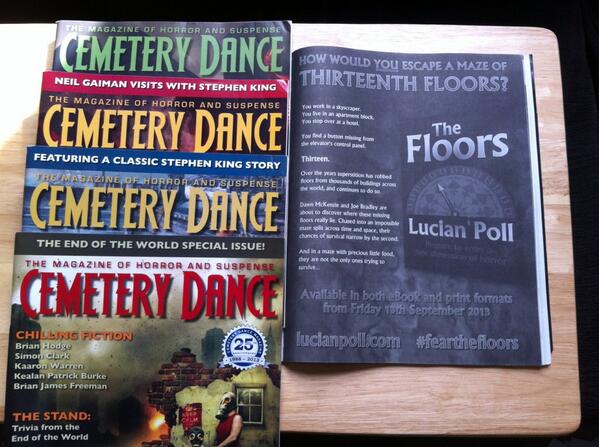
On the right is an advert I created for The Floors. which was placed in the latest issue of the mighty fine Cemetery Dance magazine.

The image was put together using Inkscape and exported to a PNG file. GIMP was then used to convert the file into a PDF.

You can click on the thumbnail for a bigger image. (Even then I’ve scaled it down 75% – 300dpi makes for some big files!)

So let’s take a shufti at how the advert looked in the flesh…

As you can see, a certain degree of vibrancy has been lost between the on-screen image and the printed copy. When you take the magazine away from direct sunlight the advert becomes rather dark indeed!

This wasn’t an isolated incident. My teaser ad for Scream turned out rather murky too, as did the initial proof copy from CreateSpace. (Never underestimate the value of a proof copy!) While these findings were a little disappointing, I’m happy to chalk them up to experience. Needless to say, subsequent artwork has seen the brightness dialled up a little more!

Overall, the discrepancy between on-screen RGB artwork and the results on paper was a valuable lesson learned, particularly for when I reboot The Forum of the Dead, as this story will contain significant graphical content.

Okay, so much for being brief! That’s all for now, folks. I hope you found these wee insights of some use, and that I won’t leave it so long before blathering again!

Laters, taters.