Times Jumbo Cryptic Crossword 1692

A fairly straightforward Jumbo. I don’t mind that! Like recent Jumbos there was a refreshing lack of tired old Times crossword clichés – and this time without needing to reach for Billy Shakespeare, hurrah! – so the countdown stays at 10 Jumbos to go.

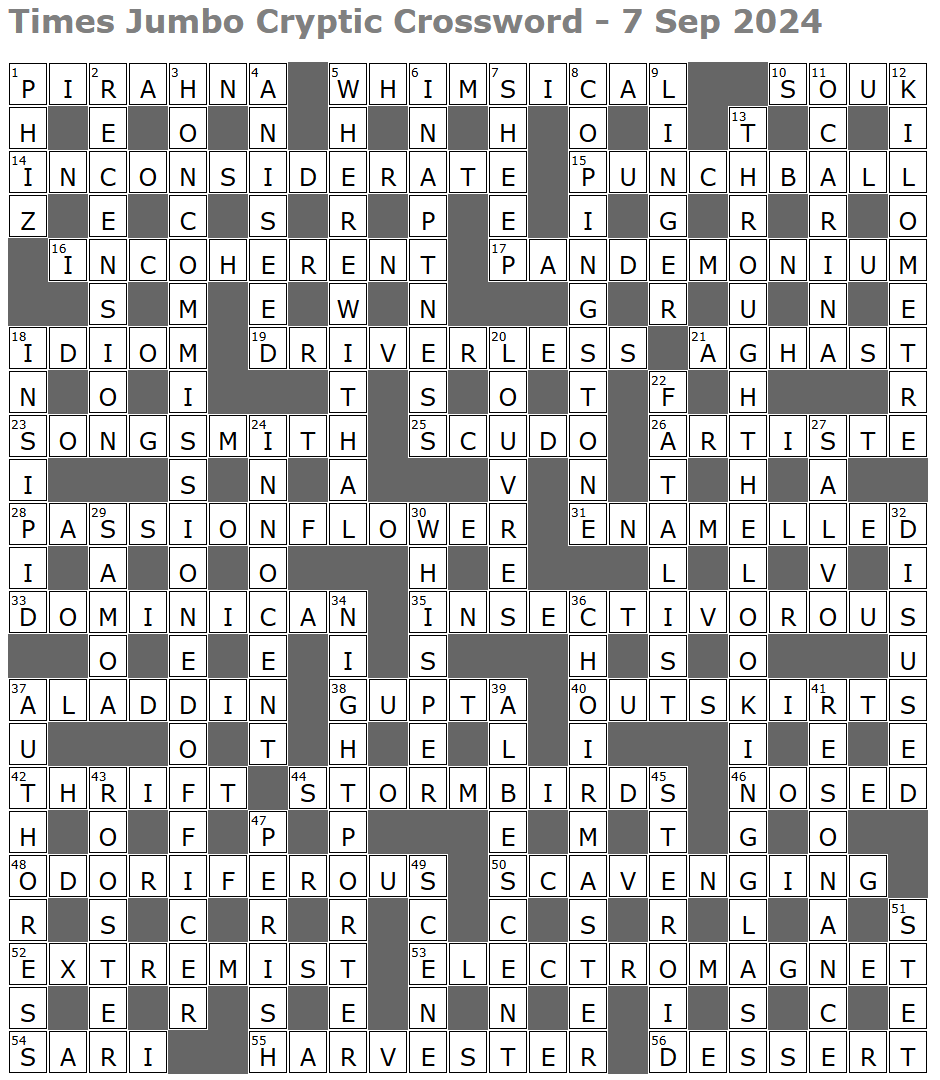
Now that the competition has long since passed you can find my completed grid below along with explanations of my solutions where I have them. I hope you find them helpful. If a recent Jumbo has your life then you might find my Just For Fun page of use, where you’ll find links to hundreds of the things.

Thanks again for your patience and input. Till next time, stay safe out there kids.

LP
The case for the prosecution
Across clues

  1. Quiet country with hot area for predatory fish (7)

Answer: PIRAHNA (i.e. “predatory fish”). Solution is P (i.e. “quiet”, specifically a recognised abbreviation of “piano” in musical lingo) followed by IRAN (i.e. “country”), then H (a recognised abbreviation of “hot” used on water taps) and A (a recognised abbreviation of “area”).

  1. Quirky law from east binding that chap thus (9)

Answer: WHIMSICAL (i.e. “quirky”). Solution is LAW reversed (indicated by “from east” – this being an across clue) and wrapped around or “binding” HIM (i.e. “that chap”) and SIC (i.e. “thus”, from the Latin), like so: W(HIM-SIC)AL.

  1. Muslim market? It’s substantially like this country (4)

Answer: SOUK (i.e. “Muslim market”). When written as SO UK the solution also satisfies “substantially like this country”. It’s interesting that we’ve had several Muslim-related solutions recently in Jumbos, e.g. FEDAYEEN, MARABOUT, HALAL, SOUK. I wonder if there’s been some edict to make Jumbos a little more diverse. The Times is on a drive to increase the appeal of their crosswords, so I wouldn’t put it past them.

  1. Selfish person in the know worried about scam (13)

Answer: INCONSIDERATE (i.e. “selfish”). Solution is INSIDER (i.e. “person in the know”) and ATE (i.e. “worried”) all wrapped “about” CON (i.e. “scam”), like so: IN(CON)SIDER-ATE.

  1. Drink before dance? It’s what a boxer may have (9)

Answer: PUNCHBALL (i.e. “what a boxer may have”). Solution is PUNCH (i.e. “drink”) followed by BALL (i.e. “dance”).

  1. Essential to secure company for rambling (10)

Answer: INCOHERENT (i.e. “rambling”). Solution is INHERENT (i.e. “essential”) wrapped around or “securing” CO (a recognised abbreviation of “company”), like so: IN(CO)HERENT.

  1. Din god and devil initially investigated with sign of hesitation (11)

Answer: PANDEMONIUM (i.e. “din”). Solution is PAN (i.e. a Greek “god”) followed by DEMON (i.e. “devil”), then I (i.e. “initially investigated”, i.e. the first letter of “investigated”) and UM (i.e. “sign of hesitation”).

  1. Man with papers and style (5)

Answer: IDIOM (i.e. “style”). Solution is IOM (i.e. “Man”, in this case a recognised abbreviation of the Isle of Man) placed after or “with” ID (i.e. identity “papers”), like so: ID-IOM. A word I’ll always remember thanks to Sir Lancelot in Monty Python and the Holy Grail.

  1. Like automated vehicles, oddly red and silver – and small (10)

Answer: DRIVERLESS (i.e. “like automated vehicles”). Solution is an anagram (indicated by “oddly”) of RED and SILVER followed by S (a recognised abbreviation of “small”), like so: DRIVERLES-S.

  1. Agent disturbed by swindles, overcome with horror (6)

Answer: AGHAST (i.e. “overcome with horror”). Solution is AGT (a recognised abbreviation of “agent”) wrapped around or “disturbed by” HAS (i.e. “swindles”), like so: AG(HAS)T.

  1. Composer’s offspring disheartened guests with German hotel (9)

Answer: SONGSMITH (i.e. “composer”). Solution is SON (i.e. “offspring”) followed by GS (i.e. “disheartened guests”, i.e. the word “guests” with all its middle letters removed), then MIT (i.e. “with German”, i.e. the German for “with”) and H (“hotel” in the phonetic alphabet).

  1. Old Italian coin, something chewed over by bankers ultimately (5)

Answer: SCUDO (i.e. “old Italian coin”). Solution is CUD (i.e. “something chewed”) and O (a recognised abbreviation of “over” used in cricket) all placed after or “by” S (i.e. “bankers ultimately”, i.e. the last letter of “bankers”), like so: S-(CUD-O).

  1. Entertainer’s treat is misguided (7)

Answer: ARTISTE (i.e. “entertainer”). Solution is an anagram (indicated by “misguided”) of TREAT IS.

  1. Die by river, clutching one tropical bloom? (7,6)

Answer: PASSION FLOWER (i.e. “tropical bloom”). Solution is PASS ON (i.e. “die”) and FLOWER (i.e. “river”, as in how one flows) all wrapped around or “clutching” I (i.e. “[Roman numeral] one”), like so: PASS-(I)-ON-FLOWER.

  1. English celebrity escorted across lake, given a coat (9)

Answer: ENAMELLED (i.e. “given a coat”). Solution is E (a recognised abbreviation of “English”) followed by NAME (i.e. “celebrity”) and LED (i.e. “escorted”) all wrapped around or placed “across” L (a recognised abbreviation of “lake”), like so: E-NAME-(L)-LED.

  1. Monk’s function requiring small container (9)

Answer: DOMINICAN (i.e. “monk”). Solution is DO (i.e. “function” or party) followed by MINI (i.e. “small”) and CAN (i.e. “container”).

  1. Like a mole, for example, eating his grub? (13)

Answer: INSECTIVOROUS. Clue satisfies the clue as a whole. “Moles” eat insects, and the rest of the clue plays on “grubs” being insects in their infancy. You get the idea.

  1. On radio, a youth contributing to panto (7)

Answer: ALADDIN (i.e. a “panto”). Solution is A followed by a homophone (indicated by “on radio”) of LAD (i.e. “youth”), then IN (i.e. “contributing to”), like so: A-LADD-IN.

  1. Indian dynasty in the end calling up forgotten reserve troops (5)

Answer: GUPTA (i.e. “Indian dynasty” of yore). Solution is G (i.e. “in the end calling”, i.e. the last letter of “calling”) followed by UP, then TA (i.e. “forgotten reserve troops”, the Territorial Army – feels odd to refer to them as forgotten: they were merely renamed the Army Reserve a decade or so ago).

  1. Unfashionable wear for women in the suburbs (9)

Answer: OUTSKIRTS (i.e. “suburbs”). Solution is OUT (i.e. “unfashionable”) followed by SKIRTS (i.e. “wear for women”).

  1. Start of terrible split about husband’s frugality (6)

Answer: THRIFT (i.e. “frugality”). Solution is T (i.e. “start [letter] of terrible”) and RIFT (i.e. “split”) all wrapped “about” H (a recognised abbreviation of “husband”), like so: T-(H)-RIFT.

  1. Sentence in writing on southern peak’s fulmars, etc (10)

Answer: STORMBIRDS (i.e. “fulmars, etc”). Solution is BIRD (i.e. slang for a prison “sentence”) placed “in” MS (i.e. “writing”, short for a manuscript) and placed “on” or after S (a recognised abbreviation of “southern”) and TOR (i.e. rocky “peak”), like so: (S-TOR)-M(BIRD)S.

  1. Moved slowly, finally summoned by hooter (5)

Answer: NOSED (i.e. “moved slowly”). Solution is D (i.e. “finally summoned”, i.e. the last letter of “summoned”) placed after or “by” NOSE (i.e. “hooter”, slang thereof), like so: NOSE-D.

  1. Having a bouquet prepared for our side only at first (11)

Answer: ODORIFEROUS (i.e. “having a bouquet”). Solution is an anagram (indicated by “prepared”) of FOR OUR SIDE and O (i.e. “only at first”, i.e. the first letter of “only”).

  1. In South Carolina, getting own back for foraging (10)

Answer: SCAVENGING (i.e. “foraging”). Solution is SC (i.e. US state abbreviation of “South Carolina”) followed by AVENGING (i.e. “getting own back”). An easier get given we had a very similar clue only a few Jumbos earlier in grid 1689. I’m quite the stuck record on this, I know, but it does keep happening…

  1. Be divided by new term for hardliner (9)

Answer: EXTREMIST (i.e. “hardliner”). Solution is EXIST (i.e. “be”) wrapped around or “divided by” an anagram (indicated by “new”) of TERM, like so: EX(TREM)IST.

  1. Choose Italian film about golf: it has drawing power (13)

Answer: ELECTROMAGNET (i.e. “it has drawing power”). Solution is ELECT (i.e. “choose”) followed by ROMAN (i.e. “Italian”) and ET (i.e. “film”, darling of cryptic crossword setters everywhere, ET: The Extra-Terrestrial) all wrapped “about” G (“golf” in the phonetic alphabet), like so: ELECT-ROMA(G)N-ET.

  1. Dress with a certain appeal, primarily round India (4)

Answer: SARI. Solution satisfies the clue as a whole, but also comprises SA (i.e. “a certain appeal”, in this case a recognised abbreviation of “sex appeal” you only ever really see in cryptic crosswords) followed by R (i.e. “primarily round”, i.e. the first letter of “round”) and I (“India” in the phonetic alphabet).

  1. Seasonal farm worker, one hastening to acquire garment (9)

Answer: HARVESTER (i.e. “seasonal farm worker”). Solution is HARER (i.e. “one hastening” or haring about) wrapped around or “acquiring” VEST (i.e. “garment”), like so: HAR(VEST)ER.

  1. Fool, possibly, principally serving in arid waste (7)

Answer: DESSERT (i.e. “fool, possibly”. Other desserts are available). Solution is S (i.e. “principally serving”, i.e. the first letter of “serving”) placed “in” DESERT (i.e. “arid waste”), like so: DE(S)SERT.

Down clues

  1. Dickensian illustrator purchasing house in Zurich first of all (4)

Answer: PHIZ (i.e. “Dickensian illustrator”, real name Hablot Knight Browne). “First of all” indicates the solution is derived from the initial letters of Purchasing House In Zurich. The wordplay was fairly obvious, making this rather exotic solution an easier get, but ask yourself how many other words would have fitted P_I_.

  1. Revised text about religious feast, as released (9)

Answer: RECENSION (i.e. “revised text”). Solution is RE (i.e. “about” or regarding – think email replies) followed by ASCENSION (i.e. “religious feast”) once the AS has been removed (indicated by “as released”), like so: RE-CENSION.

  1. Tips from new commander overwhelmed a sergeant, say (3-12,7)

Answer: NON-COMMISSIONED OFFICER (i.e. “a sergeant, say”). Clue plays on the initials, NCO, a recognised abbreviation of the solution, also being the “tips” or first letters of New Commander Overwhelmed.

  1. A requirement to digest one’s cake flavouring (7)

Answer: ANISEED (i.e. “cake flavouring”). Solution is A and NEED (i.e. “requirement”) all wrapped around or “digesting” I’S (i.e. “[Roman numeral] one’s”), like so: A-N(I’S)EED.

  1. Necessary funds enclosed in top half of wallet? (11)

Answer: WHEREWITHAL (i.e. “necessary” or the means). Solution is HEREWITH (i.e. “enclosed”) placed “in” WAL (i.e. “top half of [the word] wallet”), like so: W(HEREWITH)AL.

  1. Unsuitability of snap I sent out (9)

Answer: INAPTNESS (i.e. “unsuitability”). Solution is an anagram (indicated by “out”) of SNAP I SENT.

  1. Eg, Leicester’s novel record? (5)

Answer: SHEEP (i.e. “e.g. Leicester” – other breeds are available). Solution is SHE (a “novel” by H Rider Haggard) followed by EP (i.e. “record”, specifically an Extended Play).

  1. Builders may use one managing pit (6,5)

Answer: COPING STONE (i.e. “builders may use one”). Solution is COPING (i.e. “managing”) followed by STONE (i.e. a “pit” or fruit-stone).

  1. Hang about, departing at last in ocean-going vessel (6)

Answer: LINGER (i.e. “hang about”). Solution is G (i.e. “departing at last”, i.e. the last letter of “departing”) placed “in” LINER (i.e. “ocean-going vessel”), like so: LIN(G)ER.

  1. Old woman carrying in a simple wind instrument (7)

Answer: OCARINA (i.e. “simple wind instrument”). Solution is O (a recognised abbreviation of “old”) and CARA (i.e. “woman’s” name) all wrapped around or “carrying” IN, like so: O-CAR(IN)A.

  1. Unit of distance? More like temperature, surprisingly (9)

Answer: KILOMETRE (i.e. “unit of distance”). Solution is an anagram (indicated by “surprisingly”) of MORE LIKE and T (a recognised abbreviation of “temperature”).

  1. Dodgson’s work reportedly disconcerted The Mirror? (7,3,7-5)

Answer: THROUGH THE LOOKING-GLASS (i.e. “Dodgson’s work” – he was better known as Lewis Carroll). Solution is a homophone (indicated by “reportedly”) of THREW (i.e. “disconcerted”) followed by THE and LOOKING-GLASS (i.e. “mirror” – ignore the misleading capitalisation). Though I have some affection for Carroll’s work, and though this is a famous book, I can’t ignore this is another Jumbo crutching on old novels to get the job done. Have a demerit.

  1. Popular drink yours truly would find tasteless (7)

Answer: INSIPID (i.e. “tasteless”). Solution is IN (i.e. “popular”) followed by SIP (i.e. “drink”) and I’D (i.e. “yours truly would”, a contraction of I WOULD).

  1. French museum’s door or window slats (7)

Answer: LOUVRES (i.e. “door or window slats”). When written as LOUVRE’S the solution also satisfies “French museum’s”.

  1. Taken in by bulky catalogue, head of authority who’s resigned (8)

Answer: FATALIST (i.e. “who’s resigned”). Solution is A (i.e. “head of authority”, i.e. the first letter of “authority”) placed or “taken in by” FAT (i.e. “bulky”) and LIST (i.e. “catalogue”), like so: FAT-(A)-LIST.

  1. Offender to begin with breaking into pub cash? Not guilty (8)

Answer: INNOCENT (i.e. “not guilty”). Solution is O (i.e. “offender to begin with”, i.e. the first letter of “offender”) placed in or “breaking into” INN (i.e. “pub”) and CENT (i.e. “cash”), like so: INN-(O)-CENT.

  1. Colossal volley? Not entirely (5)

Answer: SALVO. Solution can satisfy “colossal volley”, but “not entirely” also indicates the solution has been hidden in the clue, like so: COLOS(SAL VO)LLEY. Nicely worked.

  1. A flightless bird once associated with south Pacific state (5)

Answer: SAMOA (i.e. “Pacific state”). Solution is A and MOA (i.e. “flightless bird once”, now extinct) both placed after or “with” S (a recognised abbreviation of “south”), like so: S-(A-MOA).

  1. Communicate quietly with that man’s reputation rising (7)

Answer: WHISPER (i.e. “communicate quietly”). Solution is W (a recognised abbreviation of “with”) followed by HIS (i.e. “that man’s”) and REP (short for “reputation”) once this latter has been reversed (indicated by “rising” – this being a down clue), like so: W-HIS-PER.

  1. Neglected, and treated with contempt around university (7)

Answer: DISUSED (i.e. “neglected”). Solution is DISSED (i.e. “treated with contempt”) wrapped “around” U (a recognised abbreviation of “university”), like so: DIS(U)SED.

  1. Hotel employee’s dark period overcoming drink? (5,6)

Answer: NIGHT PORTER (i.e. “hotel employee”). Solution is NIGHT (i.e. “dark period”) followed by PORTER (i.e. “drink”).

  1. Church musician often representing him as rector (11)

Answer: CHOIRMASTER (i.e. “church musician often” – non-religious choirs are available). Solution is an anagram (indicated by “representing”) of HIM AS RECTOR.

  1. Oaths sure upset a writer! (9)

Answer: AUTHORESS (i.e. “a writer”). Solution is an anagram (indicated by “upset”) of OATHS SURE.

  1. Man showing sign of age, perhaps hides key, turning white (9)

Answer: ALBESCENT (i.e. “turning white”). Solution is AL (i.e. “man’s” name) and BENT (i.e. “showing sign of age”) all wrapped around or “hiding” ESC (i.e. “key” on a computer keyboard, short for Escape), like so: AL-B(ESC)ENT.

  1. Eastern lad having administered church without reverberation (9)

Answer: RESONANCE (i.e. “reverberation”). Solution is E (a recognised abbreviation of “eastern”) and SON (i.e. “lad”) both placed in or having “without” it RAN (i.e. “having administered”) and CE (i.e. “church”, specifically the Church of England), like so: R(E-SON)AN-CE.

  1. Aussie native’s note on rook – for cock? (7)

Answer: ROOSTER (i.e. “cock”). Solution is ROO’S (i.e. “Aussie native’s”) followed by TE (i.e. “note” in the sol-fa scale, sometimes written TI) and R (a recognised abbreviation of “rook” used in chess).

  1. Heavenly body, not a fat-soluble compound (7)

Answer: STEROID (i.e. “fat-soluble compound”). Solution is ASTEROID (i.e. “heavenly body”) with the A removed (indicated by “not a”).

  1. Retired agent is first of heroes to die (6)

Answer: PERISH (i.e. “to die”). Solution is REP (i.e. “agent”, short for representative) reversed (indicated by “retired”) and followed by IS, then H (i.e. “first [letter] of heroes”), like so: PER-IS-H.

  1. Speaker’s perceived environment (5)

Answer: SCENE (i.e. “environment”). Solution is a homophone (indicated by “speaker’s”) of SEEN (i.e. “perceived”).

  1. Situated outside entrance to temple, let it remain (4)

Answer: STET (i.e. “let it remain”). Solution is SET (i.e. “situated”) wrapped around or placed “outside” of T (i.e. “entrance to temple”, i.e. the first letter of “temple”), like so: S(T)ET.

Times Jumbo Cryptic Crossword 1691

A very similar Jumbo to 1690: medium-strength; lower-than-usual Times crossword clichés, and an inevitable, almost fatal, attraction to the Bard. The latter alone is an instant kill, so there are now only 10 more Jumbos to go before I wrap up these posts.

Now that the competition deadline has long ago passed you can find my completed grid below along with explanations of my solutions where I have them. I hope you find them helpful. If a recent Jumbo has done you a wrong un then you might find my Just For Fun page of use, where you’ll find links to solutions for hundreds of the things.

Thanks again for your patience and input. Till next time stay safe out there kids.

LP

The case for the prosecution

Across clues

  1. Pet at the chemist’s, the old story (4,2,5)

Answer: PUSS IN BOOTS (i.e. “the old story” – a bit of a hand-wavy description). Solution is PUSS (i.e. a “pet”) followed by IN BOOTS (i.e. “at the chemist’s”, at least here in the UK. Other chemists are available).

  1. He directed men and boys to conserve energy source first (5,6)

Answer: ORSON WELLES (i.e. “he directed” movies). Solution is OR (i.e. “men”, specifically the Other Ranks of the British Army) followed by SONS (i.e. “boys”) once wrapped around or “conserving” E (a recognised abbreviation of “energy”) once this has “first” been preceded by WELL (i.e. “source”), like so: OR-SON(WELL-E)S.

  1. Brandish gun, a fine specimen (9)

Answer: SHOWPIECE (i.e. “a fine specimen”). Solution is SHOW (i.e. “brandish”) followed by PIECE (slang for a “gun”).

  1. In brief ceremony almost nothing about one could be more richly stylish (7)

Answer: RITZIER (i.e. “more richly stylish”). Solution is RITE (i.e. “ceremony”) with its last letter removed (indicated by “in brief”) and ZERO (i.e. “nothing”) also with its last letter removed (indicated by “almost”). This is then wrapped “about” I (i.e. “[Roman numeral] one”), like so: RIT-Z(I)ER.

  1. Plague is to lessen after time (5)

Answer: TEASE (i.e. to “plague” or annoy). Solution is EASE (i.e. “to lessen”) placed “after” T (a recognised abbreviation of “time”), like so: T-EASE.

  1. Diver circles a good lake (6)

Answer: LAGOON (i.e. “lake”). Solution is LOON (i.e. “diver” bird) wrapped around or “circling” A and G (a recognised abbreviation of “good”), like so: L(A-G)OON.

  1. Chief bird showing off (8)

Answer: SWANKING (i.e. “showing off”). When written as SWAN KING the solution also playfully satisfies “chief bird”. Hats off to the setter for getting WANKING into the grid. Good work! I’d shake your hand but, well, you know…

  1. Cover where some dogs like to sprawl (7)

Answer: OVERLAP (i.e. to “cover”). When written as OVER LAP the solution also satisfies “where some dogs like to sprawl”.

  1. Don’t delay rushed, curt thank-you note? (2,4,4,3,7)

Answer: NO TIME LIKE THE PRESENT (i.e. “don’t delay”). When written as NO TIME! LIKE THE PRESENT! the solution playfully satisfies “rushed, curt thank-you note”.

  1. Wrongly suggesting eastern and southern area of US? (7)

Answer: MIDWEST (i.e. “area of US”). Clue is playing on how E and S (recognised abbreviations of “east” and “south” form the MID of WEST, and how neither direction correctly describes where the Midwest is. You get the idea.

  1. Wife no longer referred to as aroused (7)

Answer: EXCITED (i.e. “aroused” – goodness me, setter, and so soon after WANKING. You’re insatiable!) Solution is EX (i.e. “wife no longer” – well, that might explain the WANKING) followed by CITED (i.e. “referred to”).

  1. Convertible option coming from the leader (3,4)

Answer: TOP-DOWN. Solution satisfies “convertible option” and “coming from the leader”.

  1. Overcharge for plant (4)

Answer: RUSH. Solution satisfies to “overcharge” (informally, according to my Chambers) and a “plant”.

  1. Find one’s about to enter port (8)

Answer: DISCOVER (i.e. “find”). Solution is I’S (i.e. “[Roman numeral] one” made possessive) and C (i.e. “about”, specifically a recognised abbreviation of “circa”) both placed in or “entering” DOVER (i.e. “port”), like so: D(I’S-C)OVER.

  1. Tutor’s work with small son on sci-fi writer (9)

Answer: GOVERNESS (i.e. “tutor”, especially in a private household). Solution is GO (i.e. “work”) followed by S (a recognised abbreviation of “small”) and S (ditto “son”) once first placed “on” or after Jules VERNE (i.e. “sci-fi writer”), like so: GO-(VERNE-S-S).

  1. Entering hotel, putting specs and card in receptacle (7,2)

Answer: BOOKING IN (i.e. “entering hotel”). Solution is OO (i.e. “specs”, as in how spectacles look like a pair of Os) and KING (i.e. playing “card”) both placed “in” BIN (i.e. “receptacle”), like so: B(OO-KING)IN.

  1. Check competitiveness, not initially courteous behaviour (8)

Answer: CHIVALRY (i.e. “courteous behaviour”). Solution is CH (a recognised abbreviation of “check” used in chess) followed by RIVALRY (i.e. “competitiveness”) once the first letter has been removed (indicated by “not initially”), like to: CH-IVALRY.

  1. Swimmer’s blue with cold penetrating (4)

Answer: SCAD (i.e. a fish or “swimmer”). Solution is SAD (i.e. “blue”) wrapped around or “penetrated” by C (a recognised abbreviation of “cold” used on water taps), like so: S(C)AD.

  1. Buried away from home, with no confirmation of age (7)

Answer: UNDATED (i.e. “with no confirmation of age”). Solution is INUNDATED (i.e. “buried”, say, with work) with the IN (i.e. at “home”) removed or taken “away from” the word.

  1. Plant college in favoured area (7)

Answer: PETUNIA (i.e. “plant”). Solution is UNI (i.e. “college”, short for university) placed “in” PET (i.e. “favourite”) and A (a recognised abbreviation of “area”), like so: PET-(UNI)-A.

  1. A quiet reputation not at first given to dwarf’s leader, Bashful (7)

Answer: ASHAMED (i.e. “bashful”). Solution is A followed by SH (i.e. “quiet”), then NAME (i.e. “reputation”) once its initial letter has been removed (indicated by “not at first”). This is all then followed by D (i.e. “dwarf’s leader”, i.e. the first letter of “dwarf”), like so: A-SH-AME-D.

  1. Parliament put in a fix by a rigged photo: now there’s a story (3,5,2,4,6)

Answer: THE HOUSE AT POOH CORNER (i.e. “story” by AA Milne). Solution is THE HOUSE (i.e. “parliament”) followed by CORNER (i.e. to “put in a fix”) once first placed after or “by” A and an anagram (indicated by “rigged”) of PHOTO, like so: THE-HOUSE-(A-TPOOH-CORNER).

  1. Look into swimming costume; a bit short for very large figures (7)

Answer: COLOSSI (i.e. “very large figures”). Solution is LO (i.e. “look”, as in lo and behold) placed “into” COSSIE (informal word for a “swimming costume”) once its last letter has been removed (indicated by “a bit short”), like so: CO(LO)SSI.

  1. Sort of love some tea with meals provided (8)

Answer: CUPBOARD (i.e. “sort of love”, specifically a “hypocritical show of affection for material gain” (Chambers)). Solution is CUP (i.e. “some tea”) followed by BOARD (i.e. of accommodation “with meals provided”).

  1. Following collapse close crew’s quarters (6)

Answer: FO’C’SLE (i.e. ship’s “crew’s quarters”, a contracted form of forecastle). Solution is F (a recognised abbreviation of “following”) followed by an anagram (indicated by “collapse”) of CLOSE, like so: F-OCSLE.

  1. Loaded information at end of magazine column (5)

Answer: SPINE (i.e. “column”). Solution is SPIN (i.e. “loaded information”, especially politically) followed by E (i.e. “end [letter] of magazine”).

  1. Novice to shower wearing shirt (7)

Answer: TRAINEE (i.e. “novice”). Solution is RAIN (i.e. “to shower”) placed in or “wearing” TEE (i.e. variety of “shirt”), like so: T(RAIN)EE.

  1. Piano, late alternative for leader of singing (9)

Answer: PRECENTOR (i.e. “leader of singing” in a church choir). Solution is P (a recognised abbreviation of “piano” in musical lingo) followed by RECENT (i.e. of “late”) and OR (i.e. “alternative”).

  1. Digression as man interrupts two relatives (11)

Answer: PARENTHESIS (i.e. “digression”). Solution is HE (i.e. “man”) placed in or “interrupting” PARENT and SIS (i.e. “two relatives”, the latter shortened form of sister), like so: PARENT-(HE)-SIS.

  1. Refuse to deal with brawl: I had come in time for a bargain (5,6)

Answer: BLACK FRIDAY (i.e. “time for a bargain”). Solution is BLACK (i.e. to boycott or “refuse to deal with”) followed by I’D (a contraction of “I had”) once placed “in” FRAY (i.e. “brawl”), like so: BLACK-FR(I’D)AY.

Down clues

  1. Pound and a penny, let’s start to eat out (6)

Answer: PESTLE (i.e. to “pound”). Solution is P (a recognised abbreviation of “penny”) followed by an anagram (indicated by “out”) of LET’S and E (i.e. “start [letter] to eat”).

  1. In great misery, God’s help found so transforming (6,2,7)

Answer: SLOUGH OF DESPOND (i.e. “in great misery” – not a phrase I’m familiar with, if I’m honest). Solution is an anagram (indicated by “transforming”) of GOD’S HELP FOUND SO.

[EDIT: Thanks to Andy in the comments for the typo fix. I’d written SLOUGH IN DESPOND by accident. The solution was correct in the grid. – LP]

  1. Better holding is made up (10)

Answer: IMPROVISED (i.e. “made up”). Solution is IMPROVED (i.e. “better”) wrapped around or “holding” “IS”, like so: IMPROV(IS)ED.

  1. Bowled, do you agree? Not if these result (4)

Answer: BYES. Solution satisfies the clue as a whole given BYES are runs scored in cricket that are not attributable to the batter, and given that no runs of any flavour would be awarded if a batsman gets bowled out. The solution is also formed from B (a recognised abbreviation of “bowled” in cricket) followed by YES (i.e. “do you agree”).

  1. Compose in too ornate a style, but finished properly, we hear (9)

Answer: OVERWRITE (i.e. “compose in too ornate a style”). Solution is OVER (i.e. “finished”) followed by a homophone (indicated by “we hear”) of RIGHT (i.e. “properly”), like so: OVER-WRITE.

  1. Not the usual way to classify (7)

Answer: STRANGE (i.e. “not the usual”). Solution is ST (i.e. “way”, specifically a recognised abbreviation of “street”) followed by RANGE (i.e. “to classify”).

  1. Don’t hold back Lady Macbeth’s feeling about her spot? (3,4,2)

Answer: OUT WITH IT (i.e. “don’t hold back”). Solution plays on a quote from Lady Macbeth, “out, damned spot!”, thinking her hands are stained with blood. Oh dear, Billly Shakespeare alert! And things were going so well this week too. But here’s another Times setter who simply has to get history’s only playwright into their Jumbo by any means necessary. It’s like some kind of sick addiction. You know the deal, though: Shakespeare = instant deduction from the remaining blog count.

  1. Big band music be hanged (5)

Answer: SWING. Solution satisfies “big band music” and “be hanged”.

  1. Most precise projectile fired into sniper’s lair (9)

Answer: NARROWEST (i.e. “most precise”). Solution is ARROW (i.e. “projectile”) placed or “fired into” NEST (i.e. “sniper’s lair”), like so: N(ARROW)EST.

  1. Dangerous activity for the most gentlemanly competitor (7,5)

Answer: EXTREME SPORT (i.e. “dangerous activity”). Solution is EXTREME (i.e. “the most”) followed by SPORT (i.e. “gentlemanly competitor”).

  1. Brochure made from the tiniest bit of tree? (7)

Answer: LEAFLET (i.e. “brochure”). The remainder of the clue plays on leaves on trees and how the suffix -LET is used to signify diminutives. You get the idea.

  1. Oozing round one side of lid, about to drop off (6)

Answer: SLEEPY (i.e. “about to drop off”). Solution is SEEPY (i.e. “oozing”) wrapped “round” L (i.e. “one side of lid”, specifically the left side of the word), like so: S(L)EEPY.

  1. Observe diluted gallon coming to the boil (8)

Answer: SEETHING (i.e. “coming to the boil”). Solution is SEE (i.e. “observe”) followed by THIN (i.e. “diluted”) and G (a recognised abbreviation of “gallon”).

  1. Gang regularly taken in school run a pain (7)

Answer: PODAGRA (i.e. “pain”, another word for gout). Solution is AG (i.e. “gang regularly”, i.e. every other letter of GANG) placed “in” POD (i.e. “school” of fish), R (a recognised abbreviation of “run” used in a number of ball games) and A, like so: POD-(AG)-R-A. Made. To. Fit.

  1. Unbalanced, I am helped to avoid area (3-5)

Answer: ONE-SIDED (i.e. “unbalanced”). Solution is ONE’S AIDED (i.e. “I am helped”) with the A removed (indicated by “to avoid area” – A being a recognised abbreviation of “area”).

  1. Muslim hermit is around after a month (8)

Answer: MARABOUT (i.e. “Muslim hermit” – another new one on me, though I doubt I’ll remember this one). Solution is ABOUT (i.e. “around”) placed “after” MAR (i.e. “a month”, in this case short for March), like so: MAR-ABOUT.

  1. Senior commander arrests one very unmilitary (5)

Answer: CIVIC (i.e. “unmilitary”). Solution is CIC (i.e. “senior commander”, specifically a Commander in Chief) wrapped around or “arresting” I (i.e. “[Roman numeral] one”) and V (a recognised abbreviation of “very”), like so: C(I-V)IC.

  1. Not quite get the better of author, more than satisfied with extravagant fee (15)

Answer: OVERCOMPENSATED (i.e. “with extravagant fee”). Solution is OVERCOME (i.e. “get the better of”) once its last letter has been removed (indicated by “not quite”) and the remainder followed by PEN (i.e. to “author”) and SATED (i.e. “more than satisfied”), like so: OVERCOM-PEN-SATED.

  1. Tin with dreadful soup – just one star (7)

Answer: CANOPUS (i.e. the brightest “star” in the constellation Carina, wherever that is). Solution is CAN (i.e. “tin”) followed by an anagram (indicated by “dreadful”) of SOUP, like so: CAN-OPUS. Another made-to-fit solution, but at least this was an easier get.

  1. Be in charge and come down to speak (5)

Answer: REIGN (i.e. “be in charge”). Solution is a homophone (indicated by “to speak”) of RAIN (i.e. “come down”).

  1. In dispute, referee’s assistant intended to ignore fine (8)

Answer: VARIANCE (i.e. “in dispute”). Solution is VAR (i.e. “referee’s assistant”, short for Video Assistant Referee) followed by FIANCÉ (i.e. one’s “intended”) once the F has been removed (indicated by “to ignore fine” – F being a recognised abbreviation of “fine” used in grading pencils), like so: VAR-IANCE.

  1. Philosopher isn’t tweeting nonsense (12)

Answer: Ludwig WITTGENSTEIN (i.e. “philosopher”). Solution is an anagram (indicated by “nonsense”) of ISN’T TWEETING. Pretty well known he may be, but philosophers are a big old Times crossword cliché too, so…

  1. Applause welcoming a huge success for racing driver (10)

Answer: CHARIOTEER (i.e. “racing driver”). Solution is CHEER (i.e. “applause”) wrapped around or “welcoming” A and RIOT (i.e. “huge success”), like so: CH(A-RIOT)EER. An easy get given CHARIOTEERING only appeared a few Jumbos earlier in grid 1687. As I always seem to be saying, isn’t it unusual how often that happens?

  1. Supernatural creature I found in gutter, a source of irritation (5,4)

Answer: DHOBI ITCH (i.e. a form of dermatitis or “a source of irritation”). Solution is HOB (i.e. “supernatural creature”, such as Robin Goodfellow) and I both placed “in” DITCH (i.e. “gutter”), like so: D(HOB-I)ITCH.

  1. Taking principal piece last, fastening up paraphernalia (9)

Answer: TRAPPINGS (i.e. “paraphernalia”). Solution is STRAPPING (i.e. “fastening up”) with the S (i.e. the first letter or “principal piece”) placed “last”, like so: (S)TRAPPING => TRAPPING(S).

  1. Novel approach, collecting unknown religious literature (9)

Answer: APOCRYPHA (i.e. “religious literature”). Solution is an anagram (indicated by “novel”) of APPROACH wrapped around or “collecting” Y (i.e. “unknown” – setters love referring to X, Y or Z in solutions as unknowns), like so: APOCR(Y)PHA.

  1. Counter Reformation composer shortly to meet his monarch (7)

Answer: TALLIER (i.e. “counter” or one who tallies). Solution is Thomas TALLIS (i.e. “Reformation composer”) with the last letter removed (indicated by “shortly”) and the remainder followed by ER (i.e. “his monarch”, specifically Elizabeth Regina), like so: TALLI-ER. Clever, but you can’t move in Jumbos for composers so have an angry Beethoven.

  1. Second demonstrator’s moral lesson (7)

Answer: PROVERB (i.e. “moral lesson”). When written as PROVER B the solution also satisfies “second demonstrator”, presumably after PROVER A.

  1. Law on drink performs badly (4,2)

Answer: ACTS UP (i.e. “performs badly”). Solution is ACT (i.e. “law”) followed by SUP (i.e. “drink”).

  1. Settle to repair what’s unravelling? (6)

Answer: DEFRAY (i.e. “settle”). When written as DE-FRAY the solution also playfully satisfies “to repair what’s unravelling”.

  1. Blokes’ fortune in type of gas (5)

Answer: CHAPS (i.e. “blokes”). Solution is HAP (i.e. “fortune” or chance) placed “in” CS (i.e. “type of gas”, specifically that used in riot control), like so: C(HAP)S.

  1. Sparingly eat a measure of grain (4)

Answer: PECK. Solution satisfies “sparingly eat” and “a measure of grain”.

Times Jumbo Cryptic Crossword 1690

A medium strength Jumbo for Bank Holiday Monday, and in the main it was a decent distraction. Those stuffy old Times crossword clichés were kept at bay for the most part, however the setter’s inability to resist tapping up history’s only playwright means there are now only 11 Jumbos to go before I wrap these posts up.

As the competition deadline has long since passed you can find my completed grid below along with explanations of my solutions where I have them. I hope you find them useful. If a recent Jumbo has dunked its trunk into your funky junk, whatever any of that means, then you might find my Just For Fun page of use, where you’ll find links to solutions for hundreds of the things.

Thanks for your patience and input. Till next time, stay safe out there kids.

LP

The case for the prosecution

Across clues

  1. Gives particulars of key drills fragmenting debris (9)

Answer: DESCRIBES (i.e. “gives particulars”). Solution is ESC (i.e. “key” on a computer keyboard, short for Escape) placed in or “drilling” an anagram (indicated by “fragmenting”) of DEBRIS, like so: D(ESC)RIBES.

  1. Eulogistic report of events around pulpit, oddly (13)

Answer: COMPLIMENTARY (i.e. “eulogistic”). Solution is COMMENTARY (i.e. “report of events”) wrapped “around” PLI (i.e. “pulpit, oddly”, i.e. every other letter of PULPIT), like so: COM(PLI)MENTARY.

  1. Cruel legislator with zero wit moving to the left (5)

Answer: DRACO (i.e. “cruel legislator” of Ancient Greece). Solution is O (i.e. “zero”) and CARD (i.e. “wit” or wag) all reversed (indicated by “moving to the left” – this being an across clue), like so: DRAC-O. Anything relating to ancient Greece is catnip to Times setters, so have a demerit.

  1. Manager of Hearts, say, admitting this person with sign of hesitation (9)

Answer: ORGANISER (i.e. “manager”). Solution is ORGANS (i.e. “hearts, say”, ignoring the misleading capitalisation) wrapped around or “admitting” I (i.e. “this person”, from the point of view of the setter) and followed by ER (i.e. “sign of hesitation”), like so: ORGAN(I)S-ER.

  1. My work environment (7)

Answer: SETTING. Solution satisfies “my work”, again from the point of view of the setter, and also “environment”. Simple, but nicely done.

  1. Savaging idiot repeatedly in letter, I state (9,13)

Answer: CHARACTER ASSASSINATION (i.e. “savaging”). Solution is ASS and ASS (i.e. “idiot repeatedly”) both placed “in” CHARACTER (i.e. “letter”), I and NATION (i.e. “state”), like so: CHARACTER-(ASS-ASS)-I-NATION.

  1. Weapon of Persian male, maybe a belligerent sort (8)

Answer: TOMAHAWK (i.e. “weapon”). Solution is TOM (i.e, “Persian male, maybe” – a Persian being a variety of cat) followed by A and HAWK (i.e. “belligerent sort”).

  1. Servers evicting one short child slide over the drink (5-3)

Answer: WATER-SKI (i.e. “slide over the drink”, taking “drink” to be an informal reference to a body of water). Solution is WAITERS (i.e. “servers”) with the I removed (indicated by “evicting [Roman numeral] one”) and the remainder followed by KID (i.e. “child”) once its last letter has been removed (indicated by “short”), like so: WATERS-KI.

  1. Trick for one party Democrat backs (5)

Answer: DODGE (i.e. a “trick”). Solution is EG (i.e. “for one”, or for example), DO (i.e. a “party”) and D (a recognised abbreviation of “Democrat”) all reversed (indicated by “backs”), like so: D-OD-GE.

  1. Loathed touring Croatia’s capital, going west in Split (6)

Answer: DETACH (i.e. “split”, ignoring the misleading capitalisation). Solution is HATED (i.e. “loathed”) wrapped around C (i.e. “Croatia’s capital” letter) and the whole then reversed (indicated by “going west” – this being an across clue), like so: DETA(C)H.

  1. Escort and look after carriage heading for Oxford (6)

Answer: GIGOLO (i.e. male “escort”). Solution is LO (i.e. “look”, as in lo and behold) placed “after” GIG (i.e. a light two-wheeled “carriage”) and O (i.e. “heading for Oxford”, or its initial letter), like so: (GIG-O)-LO.

  1. Southern French state established in the first place (9)

Answer: PROVENCAL (i.e. “southern French”). Solution is CAL (i.e. US “state”, short for California) with PROVEN (i.e. “established”) put “in the first place”, like so: PROVEN-CAL. The vast majority of Times setters simply cannot help themselves when it comes to all things French, so here we go again…

  1. Stuttering criminal’s rating of PC’s intelligence? (6,4)

Answer: TURING TEST (i.e. “rating of PC’s intelligence” – not strictly true, I’d argue (there’s a distinction between systems and the computer hardware they run on, certainly these days, but then the clue wouldn’t scan so well). Solution is an anagram (indicated by “criminal”) of STUTTERING.

  1. Translation of Mrs Dalloway’s opening ignored by hoaxer (4)

Answer: FRAU (i.e. “translation of Mrs”, specifically the German word for “Mrs”). Solution is FRAUD (i.e. “hoaxer”) with the D (i.e. “Dalloway’s opening” letter) removed or “ignored”.

  1. Roomy English stores close to pork butcher’s (4-3)

Answer: LOOK-SEE (i.e. “butcher’s” hook, cockney rhyming slang for a look). Solution is LOOSE (i.e. “roomy”) and E (a recognised abbreviation of “English”) all wrapped around or “storing” K (i.e. “close to pork”, i.e. the last letter of “pork”), like so: LOO(K)SE-E.

  1. A broadcaster breaks payment promise – really! (1,3,3)

Answer: I ASK YOU (i.e. “really”, both exclamations of disbelief). Solution is A and SKY (i.e. a “broadcaster” in the UK) both “breaking” IOU (i.e. “payment promise”), like so: I(A-SKY)OU.

  1. Bank without charges, deferring fine (4)

Answer: REEF (i.e. “bank”). Solution is FREE (i.e. “without charges”) with the F (a recognised abbreviation of “fine”, used in grading pencils) knocked back or “deferred”, like so: (F)REE => REE(F).

  1. Indirect answer following drinks binge (10)

Answer: ROUNDABOUT (i.e. “indirect”). Solution is A (a recognised abbreviation of “answer”, as in Q&A) placed after or “following” ROUND (i.e. “drinks”) and followed by BOUT (i.e. “binge”), like so: (ROUND-A)-BOUT.

  1. Society getting cross somewhere in Surrey (9)

Answer: GUILDFORD (i.e. “somewhere in Surrey”). Solution is GUILD (i.e. “society”) followed by FORD (i.e. to “cross” a river, for example).

  1. Protest against work singular Gothic writer pens (6)

Answer: OPPOSE (i.e. “protest against”). Solution is OP (i.e. “work”, short for “opus”) followed by S (a recognised abbreviation of “singular”) once placed in or “penned” by Edgar Allan POE (i.e. “Gothic writer”), like so: OP-PO(S)E.

  1. Various people who may come up with pearls (6)

Answer: DIVERS. Solution satisfies “various”, as in an old variant spelling of “diverse” – we had this in a recent Jumbo clue, so this was an easier get second time around – and also “people who may come up with pearls”.

  1. Emblem directed at those people lacking height (5)

Answer: TOTEM (i.e. “emblem”). Solution is TO THEM (i.e. “directed at those people”) with the H removed (indicated by “lacking height” – H being a recognised abbreviation of “height”).

  1. Building compiler returning: eager vacuous fellow (8)

Answer: EMERGENT (i.e. “building”). Solution is ME (i.e. “compiler” from the point of view of the setter) reversed (indicated by “returning”) and followed by ER (i.e. “eager vacuous”, i.e. the word “eager” with all its middle letters removed), then GENT (i.e. “fellow”), like so: EM-ER-GENT.

  1. More exuberant relative eclipsed by Dallas oilman (8)

Answer: JAUNTIER (i.e. “more exuberant”). Solution is AUNTIE (i.e. “relative”) placed in or “eclipsed by” JR (i.e. “Dallas oilman”, JR Ewing, a character from the old TV series Dallas), like so: J(AUNTIE)R.

  1. Saw advocating quiet, emotionless date saddens drunk (5,4,7,6)

Answer: LEAST SAID SOONEST MENDED (i.e. a phrase or “saw advocating quiet”). Solution is an anagram (indicated by “drunk”) of EMOTIONLESS DATE SADDENS.

  1. Climber in standard place for event, finishing early (7)

Answer: PARVENU (i.e. social “climber”). Solution is PAR (i.e. “standard”) followed by VENUE (i.e. “place for event”) once its last letter has been removed (indicated by “finishing early”), like so: PAR-VENU.

  1. Peer inside proper vehicle component (4,5)

Answer: REAR LIGHT (i.e. “vehicle component”). Solution is EARL (i.e. “peer”) placed “inside” RIGHT (i.e. “proper”), like so: R(EARL)IGHT.

  1. Prince Albert killed in accordance with law (5)

Answer: HALAL (i.e. of something “killed in accordance with [Muslim] law”). Solution is HAL (i.e. “prince” – we’ve had this several times over the years as Times setters can’t keep their mitts off of Billy Shakespeare. Prince Hal is a reference to Shakespeare’s portrayal of a young Henry V) followed by AL (shortened form of “Albert”). Clever, but you should all know by now that anything Shakespeare is like an earwax sandwich to me. Begone foul beast!

  1. Ingredient for baking best doughnut substantially covers pastry (5,2,6)

Answer: CREAM OF TARTAR (i.e. “ingredient for baking”, or “purified argol, used in baking powder etc” (Chambers)). Solution is CREAM (i.e. the “best”) followed by O (i.e. “doughnut”, as in it looks like an O) and FAR (i.e. “substantially”) once wrapped around or “covering” TART (i.e. “pastry”), like so: CREAM-O-F(TART)AR.

  1. Rush to secure politician promotion and bit of capital (9)

Answer: HAMPSTEAD (i.e. “bit of [England’s] capital”). Solution is HASTE (i.e. “rush”) wrapped around or “securing” MP (i.e. “politician” or Member of Parliament) and followed by AD (i.e. “promotion” or advertisement), like so: HA(MP)STE-AD.

Down clues

  1. Stalwart old guards ruling briefly (9)

Answer: DEDICATED (i.e. “stalwart”). Solution is DATED (i.e. “old”) wrapped around or “guarding” EDICT (i.e. “ruling”) once its last letter has been removed (indicated by “briefly”), like so: D(EDIC)ATED.

  1. A number of Catholics in attempt to win chess game with queen (6,5)

Answer: STABAT MATER (i.e. “a number of Catholics”, taking “number” to be a musical piece, in this case a hymn). Solution is STAB AT MATE (i.e. “attempt to win chess game”) followed by R (a recognised abbreviation of “queen”, after the Latin Regina).

  1. Show up, drinking soft drink and alcoholic one (5)

Answer: RIOJA (i.e. “alcoholic [drink]”). Solution is AIR (i.e. to “show”) reversed (indicated by “up” – this being a down clue) and wrapped around or “drinking” OJ (i.e. “soft drink”, short for orange juice), like so: RI(OJ)A.

  1. Heckle record label releasing disc in rich place (8)

Answer: BOOMTOWN (i.e. “rich place”). Solution is BOO (i.e. “heckle”) followed by MOTOWN (i.e. “record label”) once the first O has been removed (indicated by “releasing disk”, again referring to the shape of a letter O), like so: BOO-MTOWN.

  1. Sweet, unknown guy from America’s upset (6)

Answer: SUGARY (i.e. “sweet”). Solution is Y (i.e. “unknown” – setters love referring to X, Y or Z in solutions as “unknowns”) followed by RAG (i.e. “guy”, both taken to mean making fun of someone) and US (i.e. “from America”), all reversed (indicated by “upset” – this being a down clue), like so: SU-GAR-Y.

  1. Metro jams in a city, holding up group seen at night (5,5)

Answer: CANIS MAJOR (i.e. a constellation or “group seen at night”). “Holding” indicates the solution has been hidden in the clue, while “up” indicates the solution has been reversed – this being a down clue, like so: MET(RO JAMS IN A C)ITY.

  1. Where to find posters in English with writing about judicious committee (7,5)

Answer: MESSAGE BOARD (i.e. “where to find posters”). Solution is E (a recognised abbreviation of “English”) placed in or having “about” it MS (i.e. “writing”, specifically a recognised abbreviation of a manuscript). This is then followed by SAGE (i.e. wise or “judicious”) and BOARD (i.e. “committee”), like so: M(E)S-SAGE-BOARD.

  1. Primates wife expelled from small buildings (7)

Answer: LORISES (i.e. “primates”). Solution is LOW-RISES (i.e. “small buildings”) with the W removed (indicated by “wife expelled from…” – W being a recognised abbreviation thereof).

  1. Parents love president defending Democrat policy – it was divisive in the States (5-5,4)

Answer: MASON-DIXON LINE (i.e. “it was divisive in the States”, essentially separating the North and South). Solution is MAS (i.e. “parents”, informal reference to mothers) followed by O (i.e. “love”, a zero score in tennis), then Richard NIXON (i.e. former US “president”) once wrapped around or “defending” D (a recognised abbreviation of “Democrat”). This is all then followed by LINE (i.e. “policy”), like so: MAS-O-N(D)IXON-LINE.

  1. Wrote down polite refusal addressed to Edward or Theodore? (7)

Answer: NOTATED (i.e. “wrote down”). When written as NO TA, TED the solution also playfully satisfies “polite refusal addressed to Edward or Theodore”.

  1. Where Americans might climb road and can skid off (11)

Answer: ADIRONDACKS (i.e. “where Americans might climb”). Solution is an anagram (indicated by “off”) of ROAD and CAN SKID. Wordplay was reasonably obvious, but you know what I think about exotic solutions when they are clued as anagrams. Utterly useless.

  1. Instigators of youthful offences get incarcerated? One may do a big stretch (4)

Answer: YOGI (i.e. “one may do a big stretch”). “Instigators of” indicates the solution is derived from the first letters of Youthful Offences Get Incarcerated.

  1. Determined chap’s going to gamble, clutching note (4-4)

Answer: HELL-BENT (i.e. “determined”). Solution is HE’LL BET (i.e. “chap’s going to gamble”) wrapped around or “clutching” N (a recognised abbreviation of “note”), like so: HE’LL-BE(N)T.

  1. Tired journalist reported why penury is limiting (9)

Answer: HACKNEYED (i.e. “tired”). Solution is HACK (informal word for a “journalist”) followed by Y (i.e. “reported why”, i.e. a homophone of “why”) once placed in or “limited” by NEED (i.e. “penury”), like so: HACK-NE(Y)ED.

  1. Female has no doubt over diamonds with cracks in (8)

Answer: FISSURED (i.e. “with cracks in”). Solution is F (a recognised abbreviation of “female”) followed by IS SURE (i.e. “has no doubt”) and D (a recognised abbreviation of “diamonds” used in card games).

  1. Stirred miso soup more rapidly (3,5)

Answer: PIU MOSSO (i.e. “more rapidly” in musical lingo). Solution is an anagram (indicated by “stirred”) of MISO SOUP. It’s well worked, granted, but 1) see my previous moan about exotic trash clued up as anagrams, and 2) I’m pig sick of musical terms in Jumbos now. Have an angry Beethoven.

  1. Summoning memories of Antonin periodically cheers old fellow up (9)

Answer: EVOCATION (i.e. “summoning memories”). Solution is NOI (i.e. “Antonin periodically”, i.e. every other letter of ANTONIN) followed by TA (i.e. “cheers”, both informal forms of giving thanks) and COVE (i.e. “old fellow”, both informal forms of address for a man) all reversed (indicated by “up” – this being a down clue), like so: EVOC-AT-ION.

  1. Move confidently in groove among rocks over gorge (5,4,5)

Answer: STRUT ONE’S STUFF (i.e. “move confidently”). Solution is RUT (i.e. “groove”) placed “among” STONES (i.e. “rocks”) and followed by STUFF (i.e. to “gorge” on something), like so: ST(RUT)ONES-STUFF.

  1. One wearing dodgy metal tag, millions having fallen off the back of a lorry (8)

Answer: TAILGATE (i.e. “the back of a lorry”). Solution is I (i.e. “[Roman numeral] one”) placed in or “wearing” an anagram (indicated by “dodgy”) of METAL TAG once the M has been removed (indicated by “millions having fallen off” – M being a recognised abbreviation of “million”), like so: TA(I)LGATE.

  1. Maverick can get stoned – it helps with inspiration (12)

Answer: DECONGESTANT (i.e. “it helps with inspiration”, taking “inspiration” to mean breathing). Solution is an anagram (indicated by “maverick”) of CAN GET STONED.

  1. Champion of a nation’s failing segregation (5,6)

Answer: SAINT GEORGE (i.e. “champion of a nation”). Solution is an anagram (indicated by “failing”) of SEGREGATION.

  1. Devouring extremely large nuts – so do this? (11)

Answer: OVERINDULGE. Solution satisfies the clue as a whole, but is also an anagram (indicated by “nuts”) of DEVOURING and LE (i.e. “extremely large”, i.e. the first and last letters of “large”).

  1. One responsible for deliveries pinches flipping hat (4,6)

Answer: SPIN BOWLER (i.e. “one responsible for deliveries” in a game of cricket). Solution is NIPS (i.e. “pinches”) reversed (indicated by “flipping”) and followed by BOWLER (i.e. “hat”).

  1. Fiddle with light clothing daughter put pins around? (9)

Answer: STRADDLED (i.e. “put pins around”, “pins” taken as an informal reference to legs). Solution is STRAD (i.e. “fiddle” or violin, short for a Stradivarius) and LED (i.e. “light”, specifically a Light Emitting Diode”) all wrapped around or “clothing” D (a recognised abbreviation of “daughter”), like so: STRAD-(D)-LED.

  1. Handyman caught filling corpulent, round stomach (8)

Answer: FACTOTUM (i.e. “handyman”). Solution is C (a recognised abbreviation of “caught” used in a number of ball games) placed in or “filling” FAT (i.e. “corpulent”) and followed by O (i.e. “round”), then TUM (i.e. “stomach”), like so: FA(C)T-O-TUM.

  1. Wrongly designate English form of address by its short French equivalent (7)

Answer: MISTERM (i.e. “wrongly designate”). Solution is MISTER (i.e. “English form of address”) followed by M (i.e. “its short French equivalent” – M being a recognised abbreviation of “monsieur”).

  1. Country’s flag raised on beginning to advance (7)

Answer: ERITREA (i.e. “country”). Solution is TIRE (i.e. to “flag”) reversed (indicated by “raised”) and followed by RE (i.e. “on” or regarding – think email replies) and A (i.e. “beginning [letter] to advance”), like so: ERIT-RE-A.

  1. Distance one may swim fast, absorbing good hour (6)

Answer: LENGTH (i.e. “distance one may swim” in a pool). Solution is LENT (i.e. a religious “fast”) wrapped around or “absorbing” G (a recognised abbreviation of “good”) and followed by H (ditto “hour”), like so: LEN(G)T-H.

  1. Spirit is something stimulating with rum shot (5)

Answer: ETHOS (i.e. “spirit”). Solution is E (i.e. “something stimulating”, specifically the drug ecstasy, it’s informal name being E) followed by an anagram (indicated by “rum”) of SHOT, like so: E-THOS.

  1. Product information is not half plausibly misleading (4)

Answer: SPEC (i.e. “product information”). Solution is SPECIOUS (i.e. “plausibly misleading”) with the last half removed (indicated by “not half”).

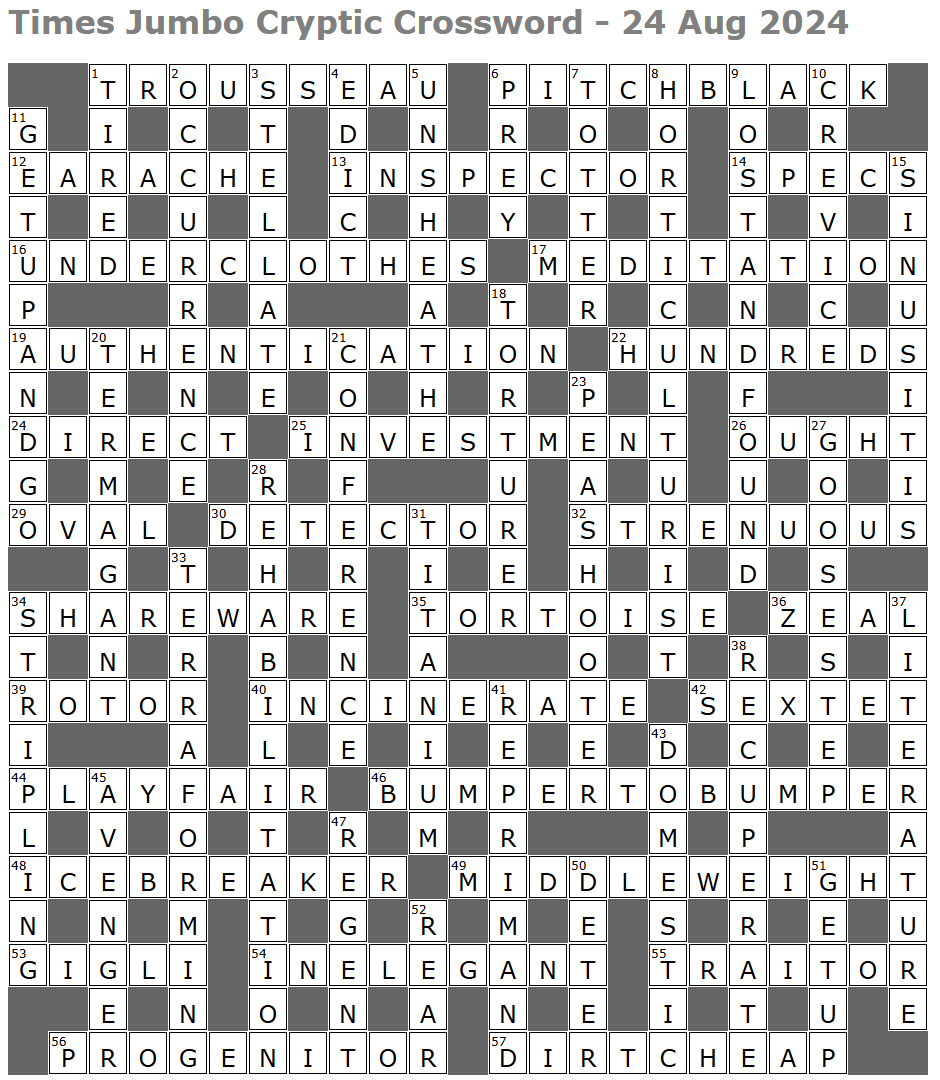
Times Jumbo Cryptic Crossword 1689

A medium-strength Jumbo and one of the better ones thanks to a good helping of creative clues. There was also a refreshing lack of stuffy Times crossword clichés, so I’ll stay the countdown a week, meaning there are still 12 Jumbos to go before I wrap up these posts.

Now that the competition deadline has long since past you can find my completed grid below along with explanations of my solutions where I have them. I hope you find them useful. If a recent Jumbo has dunked its biscuits in your tea then you might find my Just For Fun page of use, where you’ll find links to solutions for hundreds of the things.

Thanks again for your patience and input. Till next time, stay safe out there kids.

LP

The case for the prosecution

Across clues

  1. Tussore worked with gold for the bottom drawer (9)

Answer: TROUSSEAU (i.e. “the bottom drawer” – Chambers makes no mention of this, offering merely: “the clothes … collected by a bride for her marriage”, or “a bundle”). Solution is an anagram (indicated by “worked”) of TUSSORE followed by AU (chemical symbol of “gold”), like so: TROUSSE-AU. Time was I would class this as an exotic solution, or at least certainly not an everyday term. This is the fourth time TROUSSEAU has appeared in Jumbos in four years, however, the last only a couple of months ago, making this an easier get.

  1. Unlit playing area has defender crossing line (5-5)

Answer: PITCH-BLACK (i.e. “unlit”). Solution is PITCH (i.e. “playing area”) followed by BACK (i.e. “defender” in a number of sports) once wrapped around or “crossing” L (a recognised abbreviation of “line”), like so: PITCH-B(L)ACK.

  1. Hear wrongly about account – key problem for the listener? (7)

Answer: EARACHE (i.e. a complaint or “problem for the listener”). Solution is an anagram (indicated by “wrongly”) of HEAR wrapped “about” AC (a recognised abbreviation of “account”) and followed by E (i.e. musical “key” or note), like so: EAR(AC)H-E.

  1. Officer, one sometimes preceding general (9)

Answer: INSPECTOR. Solution satisfies police “officer” and also “one sometimes preceding general”, an Inspector General being an equivalent within the military.

  1. Glasses with bits of dust detected (5)

Answer: SPECS (i.e. “glasses”, short for spectacles). Solution is a homophone (indicated by “detected” – loosely!) of SPECKS (i.e. “bits of dust”).

  1. Dresses too little for what they cover (12)

Answer: UNDERCLOTHES. Clue plays on how “dresses … cover” such things, being one’s smalls. It also playfully satisfies “dresses too little”. Nicely worked.

  1. Thought the settling of disputes is about time (10)

Answer: MEDITATION (i.e. “thought”). Solution is MEDIATION (i.e. “the settling of disputes”) wrapped “about” T (a recognised abbreviation of “time”), like so: MEDI(T)ATION.

  1. A university citation then redrafted a task for a notary (14)

Answer: AUTHENTICATION (i.e. “task for a notary”). Solution is A followed by U (a recognised abbreviation of “university”) and an anagram (indicated by “redrafted”) of CITATION THEN, like so: A-U-THENTICATION.

  1. Attila perhaps reportedly fears veteran divisions (8)

Answer: HUNDREDS (i.e. “veteran divisions”, “veteran” being taken to mean old, a hundred can be “a division of a county in England originally supposed to contain a hundred families” (Chambers)). Solution is HUN (i.e. “Attila perhaps”) followed by a homophone (indicated by “reportedly” of DREADS (i.e. “fears”), like so: HUN-DREDS.

  1. Appalling court order (6)

Answer: DIRECT (i.e. “order”). Solution DIRE (i.e. “appalling”) followed by CT (a recognised abbreviation of “court”). Another nicely worked clue.

  1. Getting into stocks for one in official garment (10)

Answer: INVESTMENT (i.e. “getting into stocks” – “for one” can be read as “for example”, as one can invest in other assets). Solution is IN followed by VESTMENT (i.e. “official garment”).

  1. Nothing once purchased loses billions (5)

Answer: OUGHT (i.e. “nothing once” – a variant meaning of OUGHT is “a non-standard corruption of naught”. And we wonder why English is a tricky language to learn). Solution is BOUGHT (i.e. “purchased”) once the B has been removed (indicated by “loses billions”, B being a recognised abbreviation of “billions”).

  1. Love? Halo? These in essence may appear so (4)

Answer: OVAL. Solution satisfies the clue as a whole if “love” is taken as a zero score in tennis, but the solution also comprises OV and AL, the “essences” or middle letters of LOVE and HALO. Another well-worked clue.

  1. What may track down renegade changing sides in fight? (8)

Answer: DETECTOR (i.e. “what may track down”). Solution is DEFECTOR (i.e. “renegade”) with the F swapped or “changed” for T (i.e. the “sides in fight”, F and T being the left- and right-hand sides of the word “fight”), like so: DE(F)ECTOR => DE(T)ECTOR. Another creative clue. Good stuff!

  1. To us, nurse is working hard (9)

Answer: STRENUOUS (i.e. “hard”). Solution is an anagram (indicated by “working”) of TO US NURSE. Another good un.

  1. No longer watch out after second run for free program (9)

Answer: SHAREWARE (i.e. “free program”). Solution is WARE (i.e. “no longer watch out”, i.e. an archaic word for “to beware”) placed “after” S (a recognised abbreviation of “second”) and HARE (i.e. to “run” around), like so: (S-HARE)-WARE.

  1. Gold found in dry French river, a slow runner (8)

Answer: TORTOISE (i.e. “a slow runner”). Solution is OR (i.e. “gold” in heraldry) placed “in” TT (i.e. “dry”, specifically a recognised abbreviation of teetotal) and followed by OISE (i.e. “French river”), like so: T(OR)T-OISE. I usually grumble when setters stray over the channel, and today is no exception:

  1. Laze about? This can get one fired (4)

Answer: ZEAL (i.e. “this can get one fired” up). Solution is an anagram (indicated by “about”) of LAZE.

  1. Turner starts on representation of rocky hill (5)

Answer: ROTOR (i.e. “turner”). Solution is RO (i.e. “starts on representation of”, i.e. the first letters of “representation” and “of”) followed by TOR (i.e. “rocky hill”).

  1. Commit to fire one new film judge (10)

Answer: INCINERATE (i.e. to “commit to fire”). Solution is I (i.e. “[Roman numeral] one”) followed by N (a recognised abbreviation of “new”), then CINE (i.e. “film”) and RATE (i.e. to “judge”).

  1. Collection including extinct group (6)

Answer: SEXTET (i.e. “group”). Solution is SET (i.e. “collection”) wrapped around or “including” EXT (a recognised abbreviation of “extinct”), like so: S(EXT)ET.

  1. Act decently in drama festival (4,4)

Answer: PLAY FAIR (i.e. “act decently”). Solution is PLAY (i.e. “drama”) followed by FAIR (i.e. “festival”).

  1. Jumbo next to jumbo, very close together (6-2-6)

Answer: BUMPER-TO-BUMPER (i.e. “very close together”). Solution is BUMPER (i.e. “jumbo” or something big) next TO BUMPER again. You get the idea.

  1. What’s useful for getting into cold sheets? (10)

Answer: ICEBREAKER. Solution satisfies the clue as a whole, taking “cold sheets” being ICE. I’m not immediately seeing anything else, but I could be missing something clever.

  1. Part of pop song put round with The Boxer, perhaps? (12)

Answer: MIDDLEWEIGHT (i.e. “boxer”). Solution is MIDDLE EIGHT (i.e. “part of pop song”) wrapped “round” W (a recognised abbreviation of “with”), like so: MIDDLE-(W)-EIGHT.

  1. Italian tenor, large one closing live performance (5)

Answer: Beniamino GIGLI (i.e. “Italian tenor”). Solution is L (a recognised abbreviation of “large”) and I (i.e. “[Roman numeral] one”) both placed after or “closing” GIG (i.e. “live performance”), like so: GIG-(L-I). Theatre and opera stars are ten-a-penny in Times crosswords, so have a demerit.

  1. Awkward lines with elegy – Dante to remove outer parts (9)

Answer: INELEGANT (i.e. “awkward”). “To remove outer parts” indicates the solution is derived by taking the first and last letters away from LINES, ELEGY and DANTE.

  1. Men led by characteristic backstabber (7)

Answer: TRAITOR (i.e. “backstabber”). Solution is OR (i.e. “men”, specifically the Other Ranks of the British Army) placed after or “led by” TRAIT (i.e. “characteristic”), like so: TRAIT-OR.

  1. Programme editor dropping duke in favour of knight’s forebear (10)

Answer: PROGENITOR (i.e. “forebear”). Solution is PROG (a recognised abbreviation of “programme”) followed by EDITOR once the D (a recognised abbreviation of “duke”) has been removed or “dropped” and replaced by (indicated by “in favour of”) N (a recognised abbreviation of “knight” used in chess), like so: PROG-E(D)ITOR => PROG-E(N)ITOR.

  1. Trade chip circuits at a very low price (4-5)

Answer: DIRT-CHEAP (i.e. “at a very low price”). Solution is an anagram (indicated by “circuits”) of TRADE CHIP.

Down clues

  1. Exhausted member of the Dáil broken by Ireland (5)

Answer: TIRED (i.e. “exhausted”). Solution is TD (i.e. “member of the Dáil”, specifically a Teachta Dála or Deputy to the Dáil – hands up anyone else who tunes out the moment a news story strays into Irish politics. Could just be me) wrapped around or “broken by” IRE (a recognised abbreviation of “Ireland” – my Chambers and Oxford don’t want to know, but it’s backed up by my Collins Concise), like so: T(IRE)D.

  1. Company set up a lot of ongoing church event (10)

Answer: OCCURRENCE (i.e. “event”). Solution is CO (a recognised abbreviation of “company”) reversed or “set up” – this being a down clue. This is then followed by CURRENT (i.e. “ongoing”) once its last letter has been removed (indicated by “a lot of”), then CE (i.e. “church”, specifically the Church of England), like so: OC-CURREN-CE.

  1. Measure introduced by country, spreading from the centre (8)

Answer: STELLATE (i.e. “spreading from the centre” – a new one on me). Solution is ELL (i.e. a “measure” we’ve seen a few times in Jumbos now, being “a varying measure of length originally taken from the arm” (Chambers)) placed in or “introduced by” STATE (i.e. “country”), like so: ST(ELL)ATE.

  1. Order used in some dictionaries (5)

Answer: EDICT (i.e. “order”). “Used in” indicates the solution has been hidden in the clue, like so: SOM(E DICT)IONARIES.

  1. Uncover second butterfly in centre of sand hills (9)

Answer: UNSHEATHE (i.e. “uncover”). Solution is S (a recognised abbreviation of “second”) and HEATH (i.e. a type of “butterfly” apparently – the lepidopterist escaped me here) both placed “in” UNE (i.e. “centre of sand hills”, i.e. the middle letters of DUNES), like so: UN(S-HEATH)E.

  1. Be very nosy about closure of stone quarry (4)

Answer: PREY (i.e. “quarry”). Solution is PRY (i.e. “be very nosy”) wrapped “about” E (i.e. “closure of stone”, i.e. the last letter of “stone”), like so: PR(E)Y.

  1. Beginning to turn fish catcher’s reel (6)

Answer: TOTTER (i.e. to “reel”). Solution is T (i.e. “beginning [letter] to turn”) followed by OTTER (i.e. “fish catcher”).

  1. One often on the job in bed? (14)

Answer: HORTICULTURALIST. Taking “bed” to be somewhere to plant flowers and such, the solution satisfies the clue as a whole. I appreciate the naughtiness of this one. Oh-la-la!

  1. Having abandoned property plot located round Old Street (4-3-5)

Answer: LOST-AND-FOUND (i.e. an area “having abandoned property”). Solution is LAND (i.e. “plot”) and FOUND (i.e. “located”) all wrapped “round” O (a recognised abbreviation of “old”) and ST (ditto “street”), like so: L(O-ST)AND-FOUND.

  1. Crack core voice, withdrawing over and over again (7)

Answer: CREVICE (i.e. “crack”). Solution is CORE VOICE with the Os removed (indicated by “withdrawing over and over again” – O being a recognised abbreviation of “over” used in cricket). Another inventive clue. A thumbs-up here.

  1. Drive rig with energy (3-2-3-2)

Answer: GET-UP-AND-GO (i.e. “drive”). Solution is GET-UP (i.e. “rig”) followed by AND (i.e. “with”) and GO (i.e. “energy”).

  1. Source of radiation is up – it’s a problem for airways (9)

Answer: SINUSITIS (i.e. “it’s a problem for airways”). Solution is SUN (i.e. “source of radiation”) and IS all reversed (indicated by “up” – this being a down clue) and followed by IT IS (i.e. “it’s”), like so: (SI-NUS)-IT-IS.

  1. User of rack perhaps right to be fitted in large open-top car (8)

Answer: TORTURER (i.e. “user of rack perhaps”). Solution is RT (a recognised abbreviation of “right”, as in the title Rt Hon) placed or “fitted in” TOURER (i.e. “large open-top car”), like so: TO(RT)URER.

  1. Name a good insect for shrew (9)

Answer: TERMAGANT (i.e. a “shrew” or scolding woman). Solution is TERM (i.e. “name”) followed by A, then G (a recognised abbreviation of “good”) and ANT (i.e. “insect”).

  1. Meeting one against Liszt, perhaps English (10)

Answer: CONFERENCE (i.e. “meeting”). Solution is CON (i.e. “one against”, as in pro and con) followed by FERENC (i.e. “Liszt, perhaps”, being his first name – other Ferencs are available) and E (a recognised abbreviation of “English”).

  1. Exercises with a small warning such as might get child puffing? (10)

Answer: PEASHOOTER (i.e. a toy “as might get child puffing”). Solution is PE (i.e. “exercises” or Physical Education) followed by A, then S (a recognised abbreviation of “small”) and HOOTER (i.e. “warning”).

  1. Parade of geese irregularly chased by returning doggy? (5-4)

Answer: GOOSE-STEP (i.e. “parade”). Solution is GOOSES (i.e. “geese irregularly”, i.e. an incorrect plural of goose) followed by PET (i.e. “doggy”) once reversed (indicated by “returning”), like so: GOOSES-TEP.

  1. Heron with tail and tibia broken gets healing treatment (14)

Answer: REHABILITATION (i.e. “healing treatment”). Solution is an anagram (indicated by “broken”) of HERON, TAIL and TIBIA.

  1. Metal satellite – one with edges of Uranium (8)

Answer: TITANIUM (i.e. “metal”). Solution is TITAN (i.e. moon or “satellite” of Saturn) followed by I (i.e. “[Roman numeral] one” again, again) and UM (i.e. “edges of Uranium”, i.e. the first and last letters of “Uranium”).

  1. Changing environment sounded alarm for old Chinese rulers (12)

Answer: TERRAFORMING (i.e. “changing environment”). Solution is a homophone (indicated by “sounded”) of TERROR (i.e. “alarm”) followed by FOR and MING (i.e. “old Chinese rulers”).

  1. Young one succeeded with expedition over heather (9)

Answer: STRIPLING (i.e. “young one”). Solution is S (a recognised abbreviation of “succeeded”) followed by TRIP (i.e. “expedition”) and LING (i.e. “heather”).

  1. Letters illuminated with tare and rue interwoven (10)

Answer: LITERATURE (i.e. “letters”). Solution is LIT (i.e. “illuminated”) followed by an anagram (indicated by “interwoven”) of TARE and RUE, like so: LIT-ERATURE.

  1. Repeat cure afresh and get better (10)

Answer: RECUPERATE (i.e. “get better”). Solution is an anagram (indicated by “afresh”) of REPEAT CURE. Nicely worked.

  1. Rate of SA currency holding record edge (9)

Answer: REPRIMAND (i.e. to “rate”, a variant meaning to berate or scold). Solution is RAND (i.e. “SA currency”) wrapped around or “holding” EP (i.e. “record”, specifically an Extended Play) and RIM (i.e. “edge”), like so: R(EP-RIM)AND.

  1. Private medics to get new deal (8)

Answer: DOMESTIC (i.e. “private”). Solution is an anagram (indicated by “get new deal”) of MEDICS TO.

  1. Collector of rubbish street cleaner at first missed. Peel, perhaps (7)

Answer: AVENGER (i.e. “Peel, perhaps” – Steed being another, a reference to characters in the old TV series The Avengers). Solution is SCAVENGER (i.e. “collector of rubbish”) once the S and C have been removed (indicated by “street cleaner at first missed”, i.e. the first letters of “street” and “cleaner”).

  1. Rue not seeing later king about name for the future George IV (6)

Answer: REGENT (i.e. “the future George IV”). Solution is REGRET (i.e. “rue”) with the second R removed (indicated by “not seeing later king” – R being a recognised abbreviation of “king” after the Latin Rex) and the remainder wrapped “about” N (a recognised abbreviation of “name”), like so: REG(R)ET => REGET => REGE(N)T.

  1. Prevent wild animals eating them, destroying the border (5)

Answer: DETER (i.e. “prevent”). Solution is DEER (i.e. “wild animals”) wrapped around or “eating” THEM once the HEM has been removed (indicated by “destroying the border”), like so: DE(T)ER.

  1. Outfit with, initially, geese, emus and sheep (3-2)

Answer: GET-UP (i.e. “outfit”). Solution is GE (i.e. “initially, geese, emus”, i.e. the first letters of “geese” and “emus”) followed by TUP (i.e. “sheep”, specifically another name for a ram).

  1. Bring up the tail end (4)

Answer: REAR. Solution satisfies “bring up” and “the tail end”.

Times Jumbo Cryptic Crossword 1688

A toughie Jumbo, one for the Olav Bjortomts than us mere mortals. I did find it amusing that feedback from this Jumbo made it into the main paper today (14 Sept 2024). I’ll quote the article here, guest written by Mick Hodgkin, puzzles editor of The Times:

Plea against polymaths
How wide a vocabulary and how much general knowledge should be expected of a cryptic crossword solver? Geraldine Lloyd cried foul after struggling through Cryptic Jumbo 1688, writing to complain: “Your compiler seems to demand that readers are polymaths who have more than a working knowledge of: 5th-century Roman history (Ostrogoth), biological science (sterol), subclassification of snakes (ophidia), Italian terms for marine phenomena (fata morgana), medical terms (epicardial), turtle shell composition (plastron) and Arab guerrillas (Feyadeen). Phew! That’s just one puzzle.”

I must admit this did tickle me when I read it. I know some of you like it when Jumbos lean hard into general knowledge. I would too if the solutions were interesting. But some of the trash in this grid was beyond dull. “I don’t know how I ever got to this stage of my life without learning the parts of a turtle shell, but I’m so glad I know now. My life is enriched!” …is a phrase nobody is going to say. Ever.

The article continues:

Solvers of advanced cryptics like Mephisto and Listener accept that some answers may be unknown words that they must deduce from the wordplay and confirm in the more obscurity-friendly Chambers Dictionary, but we try to limit such things in regular cryptics.
All seven words can be found in Collins and all have helpful wordplay. But are we guilty of showing off? “May I suggest your compiler rein back the on the fruits of his/her no doubt very expensive private education”, Geraldine continued, “and give us products of a mere grammar school a bit of a chance?”

I think most readers of my recent posts could guess what I thought when Mick asked “are we guilty of showing off?” I wouldn’t be presenting my cases for the prosecution each week if you weren’t, Mick.

As for his wider point I’m going to politely highlight something that seems to have escaped him in that, of the seven words cited by Geraldine, all bar one of them are clumped close together in the bottom-left-hand quadrant of the grid. (And above them is AVOIRDUPOIS – hardly a common-or-garden word itself.) Such a concentration of exotic solutions can make it significantly harder to deduce the others around them from their intersecting letters.

What interests me is how these situations arise. Is this a case of the setter not giving a toss, to hell with solvers, let them gasp at the dexterity of my clueing, let them sweat over my magnificent breadth of knowledge? Or is it something I often call poor grid-awareness, i.e. putting any old trash in there, caring more about achieving a grid-fill than making the puzzle fun? We all know exotic solutions are deployed to fill awkward spaces. What checks and balances exist to rein in a setter who overdoes it?

Mick continues:

I take issue with the assumption that all crossword compilers must have had a privileged education. The compiler of this puzzle told me the closest he got to private school was playing the drums in gigs at Bedales and Winchester College, the latter in a Led Zeppelin tribute band.
A fellow graduate of the comprehensive system, he says that after being “tortured, rather than schooled”, he “started studying off my own bat, having realised that I was headed for the jobcentre long term if things didn’t change. But I did learn to read somewhere along the line, which has helped.”

As a fellow graduate of the comprehensive system too, I’m going to take issue with the setter’s incredibly sniffy attitude to the education they received. Look, I’m not going to pretend that every comprehensive school is A1, but, in the large majority of them, you’re going to get out of an education the effort and degree of interest you put in. “Tortured, rather than schooled”? Jesus wept, just listen to yourself. Fine, so you weren’t interested in the curriculum. You wanted to read wider. It didn’t mean you were on a one-way journey to the dole if you hadn’t. Get over yourself.

To close:

A wide vocabulary does help when solving crosswords, but doing crosswords is also a great way to widen your vocabulary. And we do try to make most answers words most solvers might actually know.

I would generally agree with the first half of this but I would argue the issue isn’t solvers’ vocabularies as such, so much the assumed breadth of their knowledge. One is a significantly smaller pool than the other. A lot more people are going to know about a fata morgana than know its name. And often it doesn’t matter that the word is present in a dictionary. There are probably 300 different varieties of trees dotted throughout Chambers, but 1) I’m only going to know a fraction of them and 2) I’m somewhat unlikely to remember another thanks to some crossword.

As for his closing sentence, I can only refer Mick again to my comments about poor grid-awareness. Yes, you could say if seven solutions were tough bastards then there are still another fifty-odd that are gettable, but your chances of getting them are somewhat lessened by them being connected to a cluster of exotic solutions.

Anyway, an interesting article, I thought. On with the show. Now that the competition deadline is long gone you can find my completed grid below along with explanations of my solutions where I have them. I hope you find them helpful. If a recent Jumbo gave you bother then you might find my Just For Fun page of use, where you’ll find links to solutions for hundreds of the things.

Thanks again for the comments and input. Till next time, stay safe out there kids.

LP

P.S. And oh wow the Times crossword clichés in this one! Perhaps unsurprisingly given all the above. There are now 12 more Jumbos to go before I wrap up these posts.

The case for the prosecution

Across clues

  1. Also chasing university place in Pennines? (6)

Answer: UPLAND (i.e. “Pennines”, one such example of a hilly region). Solution is AND (i.e. “also”) placed after or “chasing” U (a recognised abbreviation of “university”) and PL (ditto “place”), like so: (U-PL)-AND.

  1. Hurried to gobble crackers before a fasting period (7)

Answer: RAMADAN (i.e. Muslim “fasting period”). Solution is RAN (i.e. “hurried”) wrapped around or “gobbling” MAD (i.e. “crackers”, informally) and A, like so: RA(MAD-A)N.

  1. Mushroom where batter needs to stand? (8)

Answer: INCREASE (i.e. to “mushroom”). When written as IN CREASE the solution also satisfies “where batter needs to stand” in a game of cricket.

  1. Flying squadron tutored madmen that needed proving (4,4,13)

Answer: QUOD ERAT DEMONSTRANDUM (i.e. “that needed proving” in Latin, often abbreviated to QED). Solution is an anagram (indicated by “flying”) of SQUADRON TUTORED MADMEN. This has appeared twice before while I’ve been writing these posts, and always in this particular grid layout. In grid 1351 the clue was “It’s evident prison transmuted a modern criminal” i.e. QUOD followed by an anagram of TRANSMUTED A MODERN. When it came to be reprinted in the Times Jumbo Cryptic Crossword Book 21 (puzzle 44) the clue was for some reason changed to “It’s evident prison reformed a modern criminal”. Good luck to anyone trying to solve that one. Also, oh look, a Latin phrase in a Times crossword! You don’t see that every week. Most weeks, yes, but not every week.

  1. Money in undefined amount MI6’s obsession? (8)

Answer: NEUROSIS (i.e. “obsession”). Solution is EURO (i.e. “money”, currency of a number of European countries) placed “in” N (i.e. “undefined amount” in mathematics) and SIS (i.e. “MI6”, or the Secret Intelligence Service), like so: N-(EURO)-SIS.

  1. SLR shot captures wingless bird and those lingering (7)

Answer: LURKERS (i.e. “those lingering”). Solution is an anagram (indicated by “shot”) of SLR wrapped around or “capturing” TURKEY (i.e. “bird”) once its first and last letters have been removed (indicated by “wingless” – nice disguise), like so: L(URKE)RS.

  1. This was capital offence – leader denied motive (6)

Answer: REASON (i.e. “motive”). Solution is TREASON (i.e. “this was capital offence”) with its first letter removed (indicated by “leader denied”).

  1. Circle of PC gurus may form research panel (5,5)

Answer: FOCUS GROUP (i.e. “research panel”). Solution is an anagram (indicated by “may form”) of O (i.e. “circle”) and OF PC GURUS.

  1. Liquid gold is enough for private home (7,5)

Answer: LODGING HOUSE (i.e. “private home”). Solution is an anagram (indicated by “liquid”) of GOLD IS ENOUGH.

  1. German foundation leaving bishop millions (4)

Answer: OTTO (i.e. “German” name – forenames as solutions are ugh; foreign ones are mega-ugh). Solution is BOTTOM (i.e. “foundation”) with the B and M (recognised abbreviations of “bishop” (in chess) and “millions” respectively) removed or “left”.

  1. Solidly-built pupils lacking in academic promise? (5-3)

Answer: THICK-SET (i.e. “solidly-built”). When written without a hyphen then the solution playfully satisfies “pupils lacking in academic promise”.

  1. Gold found in crazily loaded place invading Spaniards sought (2,6)

Answer: EL DORADO (i.e. “place invading Spaniards sought”). Solution is OR (i.e. “gold” in heraldry) placed or “found in” an anagram (indicated by “crazily”) of LOADED, like so: ELD(OR)ADO.

  1. Cheered about one touch from the right for United (12)

Answer: CONSOLIDATED (i.e. “united”). Solution is CONSOLED (i.e. “cheered” up) wrapped “about” I (i.e. “[Roman numeral] one”) and TAD (i.e. a “touch” or hint of something) once the latter has been reversed (indicated by “from the right” – this being an across clue), like so: CONSOL(I-DAT)ED.

  1. Artist returned with long face, related to structure close to the heart (10)

Answer: EPICARDIAL (i.e. “related to structure close to the heart”). Solution is RA (i.e. “artist”, specifically a Royal Academician) reversed (indicated by “returned”) and placed after or “with” EPIC (i.e. “long”). This is all then followed by DIAL (i.e. “face”), like so: (EPIC-AR)-DIAL.

  1. Short story involving short Scottish prosecutor that’s appropriate (10)

Answer: CONFISCATE (i.e. to take or “appropriate”). Solution is CONTE (i.e. “short story” – from the French, apparently) wrapped around or “involving” FISCAL (i.e. “Scottish prosecutor”) once its last letter has been removed (indicated by “short”), like so: CON(FISCA)TE.

  1. For whom getting back to work should be a professional priority? (12)

Answer: CHIROPRACTOR. Clue plays on how they work on people’s backs. Relatively straightforward, but this still raised a smile when I twigged it.

  1. Articles drawn from Cairo and Tehran reversed artificial expression (8)

Answer: RHETORIC (i.e. “artificial expression”). Solution is CAIRO and TEHRAN with the A removed from CAIRO and AN removed from TEHRAN (indicated by “articles drawn from…” – articles being words like a, an or the). The remainder, CIRO and TEHR, is then all “reversed”, like so: RHET-ORIC.

  1. Letters central to belief in tract showing faith (8)

Answer: RELIGION (i.e. “faith”). Solution is LI (i.e. “letters central to beLIef”) placed “in” REGION (i.e. “tract”), like so: RE(LI)GION.

  1. Weak husband opening airtight container (4)

Answer: THIN (i.e. “weak”). Solution is H (a recognised abbreviation of “husband”) placed in or “opening” TIN (i.e. “airtight container”), like so: T(H)IN.

  1. Former empire’s vulgar riches? (12)

Answer: COMMONWEALTH (i.e. “former empire”). Solution is COMMON (i.e. “vulgar”) followed by WEALTH (i.e. “riches”).

  1. Go to bed with upper-class lodger – army officer (10)

Answer: LIEUTENANT (i.e. “army officer”). Solution is LIE (i.e. “go to bed”) followed by U (a recognised abbreviation of the “upper-class”) and TENANT (i.e. “lodger”).

  1. Initially sober, then learning about solid alcohol (6)

Answer: STEROL (i.e. “solid alcohol”). Solution is S and T (i.e. “initially sober then”, i.e. the first letters of “sober” and “then”) followed by LORE (i.e. “learning”) once reversed (indicated by “about”), like so: S-T-EROL.

  1. Sat after collapse in a wine store, choose not to drink (7)

Answer: ABSTAIN (i.e. “choose not to drink”). Solution is an anagram (indicated by “after collapse”) of SAT placed “in” A and BIN (i.e. “wine store”), like so: A-B(STA)IN. Nicely worked.

  1. Goddess to protect party associated with NEC – that’s the narrative (8)

Answer: ANECDOTE (i.e. “narrative”). Solution is ATE (i.e. Greek “goddess” of mischief) wrapped around or “protecting” DO (i.e. “party”) once it has been placed on or after or “associated with” NEC, like so: A(NEC-DO)TE. I’ve been punishing the use of Greek mythology, and today is no different (although ATE is quite often found in cryptic crosswords).

  1. Let shadow cabinet prove corrupt – anxious waiting has no effect (1,7,3,5,5)

Answer: A WATCHED POT NEVER BOILS (i.e. proverb illustrating “anxious waiting has no effect”). Solution is an anagram (indicated by “corrupt”) of LET SHADOW CABINET PROVE.

  1. News boss indeed entering marshy land sees Arab fighters? (8)

Answer: FEDAYEEN (i.e. “Arab fighters”, especially ones involved in the conflict against Israel. Not sure if that’s the setter nailing his colours to the mast there.) Solution is ED (i.e. “news boss”, short for an editor) and AYE (i.e. “indeed”) both placed in or “entering” FEN (i.e. “marshy land”), like so: F(ED-AYE)EN. One worked out from the wordplay for me, perhaps unsurprisingly.

  1. An eminent Florentine’s unhurried pace? (7)

Answer: ANDANTE (i.e. “unhurried pace” in musical lingo). Solution is AN followed by DANTE Alighieri (i.e. “eminent Florentine” – good grief, could you not have just called him a poet?). Dante is well-known so I won’t apply a demerit there, but musical lingo is ten-a-penny in Times crosswords, so here comes angry Beethoven…

  1. Bear in river following death (6)

Answer: ENDURE (i.e. “bear”). Solution is URE (i.e. Yorkshire “river”) placed after or “following” END (i.e. “death”), like so: END-URE.

Down clues

  1. Offence taken: Greek character quite expressing it (5)

Answer: PIQUE (i.e. “offence taken”). Solution is PI (i.e. “Greek character”, specifically the sixteenth letter of the Greek alphabet) followed by QUITE once the IT has been removed or “expressed”, like so: PI-QUE.

  1. Duck, upon removing tail, is around right weight (11)

Answer: AVOIRDUPOIS (i.e. “weight”, specifically one “in which the pound (lb) equals 16 ounces (oz)” (Chambers) and one widely used in English-speaking countries). Solution is AVOID (i.e. “duck”), UPON with its last letter removed (indicated by “removing tail”) and IS. This is all then wrapped “around” R (a recognised abbreviation of “right”), like so: AVOI(R)D-UPO-IS. I’ll admit I’ve never heard the word before, so you can imagine the swearing that spouted forth over here.

  1. Groom on time as horse moves? (8)

Answer: DRESSAGE (i.e. “horse moves”). Solution is DRESS (i.e. “groom”) followed by AGE (i.e. “time”).

  1. Studies concerned with first note from the sign (5)

Answer: READS (i.e. “studies”). Solution is RE (i.e. “concerned with” – think email replies) followed by A (i.e. “first [musical] note”) and DS (i.e. “from the sign” – apparently this is a recognised abbreviation of “dal segno”, musical lingo instructing a performer to return to a specific point). Wait, what was that? Musical lingo again? Good grief, setter, what are you like? Here’s angry Beethoven again.

  1. Spooner’s tide guide that reduces deposits on estate? (7)

Answer: MUDFLAP (i.e. “that reduces deposits on estate” car). Solution is a “Spoonerism” of FLOOD MAP (i.e. “tide guide”). Nicely done.

  1. Dispirited? Practical lesson one’s put into action (11)

Answer: DEMORALISED (i.e. “dispirited”). Solution is MORAL (i.e. “practical lesson”) and I’S (i.e. “[Roman numeral] one’s”) both placed “into” DEED (i.e. “action”), like so: DE(MORAL-I’S)ED.

  1. Present time, or at some time after noon (5)

Answer: NONCE (i.e. “present time”). Solution is ONCE (i.e. “at some time”) placed “after” N (a recognised abbreviation of “noon”), like so: N-ONCE.

  1. Some guts needed to help win Test in England (9)

Answer: INTESTINE (i.e. “some guts”). “Some” also indicates the solution has been hidden in the clue, like so: W(IN TEST IN E)NGLAND. I think “needed to help” is there solely to make the clue scan.

  1. Key locks office (5)

Answer: CHAIR (i.e. “office”). Solution is C (i.e. musical “key”) followed by HAIR (i.e. “locks” or tresses).

  1. Doctor Evadne rued nothing – made determined effort (11)

Answer: ENDEAVOURED (i.e. “made determined effort”). Solution is an anagram (indicated by “doctor”) of EVADNE RUED and O (i.e. “nothing”).

  1. Problem with battle order (7)

Answer: SUMMONS (i.e. court “order”). Solution is SUM (i.e. mathematical “problem”) followed by MONS (i.e. “battle” of the First World War popular with crossword setters).

  1. Theodoric, perhaps ridiculously short, having to go back inside (9)

Answer: OSTROGOTH (i.e. “Theodoric, perhaps”, referring to Theodoric the Great, leader of the Ostrogoths. No, me neither). Solution is an anagram (indicated by “ridiculously”) of SHORT wrapped around or “having…inside” TO GO once this has been reversed (indicated by “back”), like so: OSTR(OG-OT)H. Oh, this very much qualifies for a History Today demerit!

  1. Snakes concealed in ideal state as Roman leaves (7)

Answer: OPHIDIA (i.e. “snakes” – literally all of them). Solution is HID (i.e. “concealed”) placed “in” UTOPIA (i.e. “ideal state”) once the UT has been removed (indicated by “as Roman leaves” – the Latin for “as” being UT), like so: OP(HID)IA. Latin can always get stuffed for my money. Have another demerit.

  1. Indecisive People’s Princess, meeting the syndicate (9)

Answer: DITHERING (i.e. “indecisive”). Solution is DI (i.e. “People’s Princess”) followed by THE and RING (i.e. “syndicate”).

  1. Spirit died, endlessly blessed in churchyard (4,4)

Answer: GOD’S ACRE (i.e. “churchyard”). Solution is GO (i.e. “spirit” or va-va-voom) followed by D (a recognised abbreviation of “died”) and SACRED (i.e. “blessed”) once its last letter has been removed (indicated by “endlessly”), like so: GO-D-SACRE.

  1. Church medic visiting animal to restore to good condition (9)

Answer: CATHEDRAL (i.e. “church”). Solution is DR (i.e. “medic”, short for doctor) placed in or “visiting” CAT (i.e. “animal”) and HEAL (i.e. “to restore to good condition”), like so: CAT-HE(DR)AL.

  1. Harsh one with no heart maybe brought up a name (9)

Answer: DRACONIAN (i.e. “harsh”). Solution is I (i.e. “[Roman numeral] one”), NO and CARD (i.e. “heart maybe” – other playing card suits are available) all reversed (indicated by “brought up” – this being a down clue). This is all then followed by A and N (a recognised abbreviation of “name”), like so: (DRAC-ON-I)-A-N. My copy of the Jumbo also had some trash text after this clue: “avoiding repetition of”. These Jumbos can be difficult enough at the best of times without such shenanigans confusing everything!

  1. Penny possibly closing the show devours rook and turtle part (8)

Answer: PLASTRON (i.e. “turtle part”). Solution is P (a recognised abbreviation of a “penny”) followed by LAST ON (i.e. “possibly closing the show”) once wrapped around or “devouring” R (a recognised abbreviation of “rook” used in chess), like so: P-(LAST-(R)-ON). You must forgive me if I lack intimate knowledge of a turtle’s anatomy. Good grief.

  1. Elemental form is uppermost in Phoebe’s heart (7)

Answer: ISOTOPE (i.e. “elemental form”). Solution is IS followed by TOP (i.e. “uppermost”) once placed “in” OE (i.e. “PhOEbe’s heart”), like so: IS-O(TOP)E.

  1. A small horse gypsies reared under substantial illusion (4,7)

Answer: FATA MORGANA (i.e. “illusion” – over to Chambers again: “a striking kind of mirage seen most often in the Strait of Messina”, the kind that can make it look like a ship is floating some distance above the horizon). Solution is A, NAG (i.e. “small horse”) and ROMA (i.e. “gypsies”) all reversed (indicated by “reared” – this being a down clue) and placed after or “under” – down clue again – FAT (i.e. “substantial”), like so: FAT-(AMOR-GAN-A). One eventually nailed by the wordplay, but it took a fair few intersecting letters to help get it.

  1. Electra and Priscilla are so unsympathetic (4-7)

Answer: COLD-HEARTED (i.e. “unsympathetic”). Clue plays on how C (a recognised abbreviation of “COLD” used on water taps) is at the HEART of “EleCtra” and “PrisCilla”.

  1. Two things hair stylist did as arranged (3,3,5)

Answer: CUT AND DRIED. Solution satisfies “two things hair stylist did” and “as arranged” or decided in advance.

  1. Section’s second district in French city (9)

Answer: CAESAREAN (i.e. “section”, commonly referred to as a C-section). Solution is S (a recognised abbreviation of “second”) and AREA (i.e. “district”) both placed “in” CAEN (i.e. “French city”). Never heard of CAEN, but it looks nice. It’s French, though, of course, and we should know by now that Times setters nurse semis for all things French. Have a meme…

  1. Maiden in a high-pitched voice, quavering lyrically (8)

Answer: ATREMBLE (i.e. “quavering lyrically”). Solution is M (a recognised abbreviation of “maiden”) placed “in” A and TREBLE (i.e. “high-pitched voice”), like so: A-TRE(M)BLE.

  1. Old Tuareg sullied in scandal (7)

Answer: OUTRAGE (i.e. “scandal”). Solution is O (a recognised abbreviation of “old”) followed by an anagram (indicated by “sullied”) of TUAREG.

  1. Large insect regularly nearing light (7)

Answer: LANTERN (i.e. “light”). Solution is L (a recognised abbreviation of “large”) followed by ANT (i.e. “insect”) and ERN (i.e. “regularly nearing”, i.e. every other letter of NEARING).

  1. Philosopher’s topless fellow outside clubs (5)

Answer: John LOCKE (i.e. English “philosopher” of the seventeenth century). Solution is BLOKE (i.e. “fellow”) with the first letter removed (indicated by “topless”) and the remainder wrapped “outside” of C (a recognised abbreviation of “clubs” used in some card games), like so: LO(C)KE. Philosophers are a magnet for Times setters, much like composers. Have a demerit.

  1. One among parrots ascending displays reddish-brown shade (5)

Answer: SEPIA (i.e. “reddish-brown shade”). Solution is I (i.e. “[Roman numeral] one”) placed in or “among” APES (i.e. “parrots” or imitates) once reversed (indicated by “ascending” – this being a down clue), like so: SEP(I)A.

  1. Alpine ridge periodically observed in fair weather (5)

Answer: ARÊTE (i.e. “alpine ridge”). “Periodically observed in” indicates the solution is derived from every other letter of FAIR WEATHER. Easy only if you know it.

  1. Boomerang was tested again? Shocking weapon (5)

Answer: TASER (i.e. “shocking weapon”). Solution is RE-SAT (i.e. “was tested again”) reversed or “boomeranged”.

Times Jumbo Cryptic Crossword 1687

Another late one. (Oops.) This Jumbo was okay, albeit a tad mechanical. I didn’t sense this at the time, to be fair, but writing this post was a bit of a slog, with what felt like a lot of beginning and end letters to document, along with umpteen insertions and deletions. The Times crossword clichés were out in force too, so there are 13 Jumbos to go before I wrap up these posts.

On those clichés, it’s interesting to note that The Times no longer requires people to be dead before they can feature in cryptic crosswords. Apparently this change has been in place a couple of months now, but we’ve yet to see it filter into the Jumbo cryptic. Well, it’s a start. If they’re easing up on that requirement then surely there can be no argument against including more modern cultural references in their crosswords too? We’ll see…

Anyway, now that the competition deadline has long since past, you can find my completed grid below along with explanations of my solutions where I have them. I hope you find them helpful. If a recent Jumbo has kept you up all night then you might find my Just For Fun page of use, where you’ll find links to solutions for hundreds of the things.

Thanks again for your patience and input. I appreciate the desire some have to keep this blog going after I hang up my black biro, maybe with a blank post each week for everyone to comment and collaborate upon, but I’m not sure that that would work in practice. I would imagine there are other sites better suited to that. Whatever happens, till next time, stay safe out there kids.

LP

The case for the prosecution

Across clues

  1. Excellent meal, but requiring no repetition (5)

Answer: SUPER (i.e. “excellent”). Solution is SUPPER (i.e. “meal”) with the repeated P removed (indicated by “but requiring no repetition”).

  1. Money received of those people, having acquired a promenade? (4,3,3)

Answer: TAKE THE AIR (i.e. “promenade” or walk for pleasure). Solution is TAKE (i.e. “money received”) followed by THEIR (i.e. “of those people”) once wrapped around or “acquiring” A, like so: TAKE-THE(A)IR.

  1. Learned person positioned to accept leading figures (6)

Answer: SAVANT (i.e. “learned person”). Solution is SAT (i.e. “positioned”) once wrapped around or “accepting” VAN (i.e. “leading figures”, short for a vanguard), like so: SA(VAN)T.

  1. Ready to accept unimaginative cut in revised course (9)

Answer: CREDULOUS (i.e. “ready to accept”). Solution is DULL (i.e. “unimaginative”) once its last letter has been removed (indicated by “cut”) and the remainder placed “in” an anagram (indicated by “revised”) of COURSE, like so: CRE(DUL)OUS.

  1. Duffers upset with this society after time, old fogeys (7,6)

Answer: STUFFED SHIRTS (i.e. “old fogeys”). Solution is an anagram (indicated by “upset”) of DUFFERS and THIS, followed by S (a recognised abbreviation of “society”) once placed “after” T (ditto “time”), like so: STUFFEDSHIR-T-S.

  1. Club second to enter sports venue beside lake (7)

Answer: ARSENAL (i.e. football “club”). Solution is S (a recognised abbreviation of “second”) placed in or “entering” ARENA (i.e. “sports venue”) and followed by L (a recognised abbreviation of “lake”), like so: AR(S)ENA-L.

  1. Love cricket club to capture trophy, an ultimately quality possession (9)

Answer: OCCUPANCY (i.e. “possession”). Solution is O (i.e. “love”, a zero score in tennis) followed by CC (a recognised abbreviation of “cricket club”) once wrapped around or “capturing” CUP (i.e. “trophy”) and AN. This is all then followed by Y (i.e. “ultimately quality”, i.e. the last letter of “quality”), like so: O-C(CUP-AN)C-Y.

  1. Precipitous cliff alongside right-hand edge of railway – alarming (5)

Answer: SCARY (i.e. “alarming”). Solution is SCAR (i.e. “precipitous cliff”) followed by Y (i.e. “right-hand edge of railway”, i.e. the last letter of “railway”).

  1. Important measures having impact, limiting female work at night (9,5)

Answer: GRAVEYARD SHIFT (i.e. “work at night”). Solution is GRAVE (i.e. “important”) followed by YARDS (i.e. “measures”) and HIT (i.e. “impact”) once wrapped around or “limiting” F (a recognised abbreviation of “female”), like so: GRAVE-YARDS-HI(F)T.

  1. Diplomacy is hedging about means to achieve end (7)

Answer: TACTICS (i.e. “means to achieve end”). Solution is TACT (i.e. “diplomacy”) followed by IS once wrapped around or “hedging” C (i.e. “about”, specifically a recognised abbreviation of “circa”), like so: TACT-I(C)S.

  1. Daring problem linked to uranium, say, on the radio (10)

Answer: METTLESOME (i.e. “daring”). Solution comprises homophones (indicated by “on the radio”) of SUM (i.e. a mathematical “problem”) and METAL (i.e. “uranium, say”). “Linked to” indicates SOME is placed on or after METTLE, like so: METTLE-SOME.

  1. Where doctors work – distribute The Lancet here? Mostly (6,6)

Answer: HEALTH CENTRE (i.e. “where doctors work”). Solution is an anagram (indicated by “distribute”) of THE LANCET HERE once the last letter has been removed (indicated by “mostly”).

  1. One Greek character attached to … a burning wheel, apparently (5)

Answer: IXION. The solution satisfies the clue as a whole. In Greek myth, Ixion was punished by Zeus by being bound to a winged fiery wheel spinning for all time. The solution also comprises I (i.e. “[Roman numeral] one”), XI (i.e. “Greek character”, specifically the fourteenth letter of the Greek alphabet) and ON (i.e. “attached to”). Clever, yes, but Greek mythology is a massive Times crossword cliché, so have a demerit.

  1. Speculative account taking in broadcast media (8)

Answer: ACADEMIC (i.e. “speculative” – Chambers offers “theoretical only, of no practical importance or consequence”). Solution is ACC (a recognised abbreviation of “account”) wrapped around or “taking in” an anagram (indicated by “broadcast”) of MEDIA, like so: AC(ADEMI)C.

  1. Formalities favouring Conservative in contrivance (8)

Answer: PROTOCOL (i.e. “formalities”). Solution is PRO (i.e. “favouring”) followed by C (a recognised abbreviation of “Conservative”) once placed “in” TOOL (i.e. “contrivance”), like so: PRO-TO(C)OL.

  1. Italian composer lost his grip around finale of piece (8)

Answer: Ottorino RESPIGHI (i.e. “Italian composer”). Solution is an anagram (indicated by “lost”) of HIS GRIP once wrapped “around” E (i.e. “finale of piece”, i.e. the last letter of “piece”), like so: R(E)SPIGHI. The wordplay was fairly obvious once you got a couple of intersecting letters, but, let’s face it, you’re only nailing this one if you know the guy. Needless to say, Bradford’s was deployed toot bloody sweet. I’m not willing to waste any more time on clues like this. Also, composers are another massive Times crossword cliché, so let’s say hello to angry Beethoven.

  1. Difficult situation, nothing less, accepted by Athenian soccer team? (8)

Answer: ATHLETIC (i.e. “soccer team” – there are a few Athletic football clubs to choose from. Not quite so many sedentary ones). Solution is HOLE (i.e. “difficult situation”) with the O removed (indicated by “nothing less”) and the remainder placed in or “accepted by” ATTIC (i.e. “Athenian”, referring to an ancient region called Attica), like so: AT(HLE)TIC. More ancient Greek cobblers, so…

  1. No good taking on excellent old New Zealand tree (5)

Answer: NGAIO (i.e. “New Zealand tree”). Solution is N (a recognised abbreviation of “no”) and G (ditto “good”) followed by AI (i.e. “excellent”, i.e. A1 with the 1 written as its Roman numeral equivalent) and O (a recognised abbreviation of “old”). Made to fit, though perhaps made less exotic through novelist Ngaio Marsh. It’d be a bit mean of me to punish exotic solutions that are obviously there to fill an awkward space – it’s a cliché that’s hardly exclusive to Times crosswords. Still, it would have amused me to have the “suits you” tailors from The Fast Show here.

  1. Examine Bill, initially lacking a certain hormone (12)

Answer: TESTOSTERONE (i.e. “hormone”). Solution is TEST (i.e. “examine”) followed by POSTER (i.e. “bill”, ignoring the misleading capitalisation) once its first letter has been removed (indicated by “initially lacking”). This is all then followed by ONE (i.e. “a certain”), like so: TEST-OSTER-ONE.

  1. USA misrepresented by one in individual novel (10)

Answer: PERSUASION (i.e. “novel” by Jane Austen). Solution is an anagram (indicated by “misrepresented”) of USA and I (i.e. “[Roman numeral] one”) both placed “in” PERSON (i.e. “individual”), like so: PERS(UAS-I)ON.

  1. Another artist included in most of Michaelangelo’s work (2,5)

Answer: Leonardo DA VINCI (i.e. “artist”). Solution is INC (a recognised abbreviation of “included”) placed “in” DAVID (i.e. “Michaelangelo’s work”) once its last letter has been removed (indicated by “most of”), like so: DAV(INC)I. Like composers, artists are another whacking great Times crossword cliché, so…

  1. Cinematic illusions in various places retaining one property (7,7)

Answer: SPECIAL EFFECTS (i.e. “cinematic illusions”). Solution is an anagram (indicated by “various”) of PLACES wrapped around or “retaining” I (i.e. “[Roman numeral] one”). This is then followed by EFFECTS (i.e. belongings or “property”), like so: SPEC(I)AL-EFFECTS.

  1. Public meeting supporting everything except the leader (5)

Answer: FORUM (i.e. “public meeting”). Solution is FOR (i.e. “supporting”) followed by SUM (i.e. “everything”) once its first letter has been removed (indicated by “except the leader”), like so: FOR-UM.

  1. Damaging time – very exciting after head quits – finally you will be involved (9)

Answer: TRAUMATIC (i.e. “damaging”). Solution is T (a recognised abbreviation of “time”) followed by DRAMATIC (i.e. “very exciting”) once its first letter has been removed (indicated by “after head quits”) and the remainder has been wrapped around or having “involved” the last or “final” letter of “you”, like so: T-RA(U)MATIC.

  1. Acquire records covering end of Prince with no mention of Queen (7)

Answer: ACHIEVE (i.e. “acquire”). Solution is ARCHIVE (i.e. “records”) with the R removed (indicated by “no mention of Queen” – R being a recognised abbreviation of the Latin Regina) and the remainder wrapped around or “covering” E (i.e. “end [letter] of Prince”), like so: ACHI(E)VE.

  1. Governor having message from bank being put back (13)

Answer: REINSTATEMENT (i.e. “being put back”). Solution is REIN (i.e. “governor” or something that controls) followed by STATEMENT (i.e. “message from bank”).

  1. Sound science? A backing for science entails University investing in expense (9)

Answer: ACOUSTICS (i.e. “sound science”). Solution is A and SCI (a recognised abbreviation of “science”, e.g. in sci-fi), the latter reversed (indicated by “backing”). This is all then wrapped around or “entailing” U (a recognised abbreviation of “university”) once first placed “in” COST (i.e. “expense”), like so: A-(CO(U)ST)-ICS.

  1. Sharpens tip of lancet, to make true (6)

Answer: HONEST (i.e. “true”). Solution is HONES (i.e. “sharpens”) followed by T (i.e. “tip of lancet”, i.e. the last letter of “lancet”).

  1. Stop blokes seizing attention – start of tender message of love (10)

Answer: ENDEARMENT (i.e. “message of love”). Solution is END (i.e. “stop”) and MEN (i.e. “blokes”) all wrapped around or “seizing” EAR (i.e. “attention”). This is all then followed by T (i.e. “start [letter] of tender”), like so: (END-(EAR)-MEN)-T.

  1. Dimension not initially given for cube (5)

Answer: EIGHT (i.e. “cube” of two, i.e. 2 x 2 x 2). Solution is HEIGHT (i.e. “dimension”) with the first letter removed (indicated by “not initially”).

Down clues

  1. Party in charge in Asian country after uprising (6)

Answer: SOCIAL (i.e. an informal “party” or gathering of a club or other organised group). Solution is IC (a recognised abbreviation of “in charge”) placed “in” LAOS (i.e. “Asian country”) and the whole reversed (indicated by “after uprising” – this being a down clue), like so: SO(CI)AL.

  1. Request certain suggestions about river journeys offering a good time (8,5)

Answer: PLEASURE TRIPS (i.e. “journeys offering a good time”). Solution is PLEA (i.e. “request”) followed by SURE (i.e. “certain”) and TIPS (i.e. “suggestions”) once wrapped “about” R (a recognised abbreviation of “river”), like so: PLEA-SURE-T(R)IPS.

  1. Profligate vacation’s ending in French city (5)

Answer: ROUEN (i.e. “French city”). Solution is ROUE (i.e. “profligate”) followed by N (i.e. “vacation’s ending” letter). Times setters can’t help themselves when it comes to anything French. It’s like cocaine for them. Have a meme.

  1. Rocker’s equivalent to this roller? (7)

Answer: TROLLEY. Clue plays on the phrases “off one’s rocker” and “off one’s trolley”, both “equivalent” phrases describing madness. TROLLEYS, meanwhile, can be described as “roller” on account of them having wheels. You get the idea.

  1. Delivery chap who’s peckish? (9,3)

Answer: KISSOGRAM MAN. Clue plays on “peck” being an informal word for a KISS. Another where you get the idea.

  1. It’s provocative carrying stone clubs, for example (4,4)

Answer: TEST CASE (i.e. “example”). Solution is TEASE (i.e. “it’s provocative”) wrapped around or “carrying” ST (a recognised abbreviation of “stone” weight) and C (a recognised abbreviation of “clubs” used in card games), like so: TE(ST-C)ASE.

  1. Prepare Parisian who will cut recording (5)

Answer: EQUIP (i.e. “prepare”). Solution is QUI (i.e. “Parisian who”, i.e. the French for “who”) placed in or “cutting” EP (i.e. “recording”, specifically an Extended Play), like so: E(QUI)P. Mon dieu! More French, eh? Well, have another meme then.

  1. To sum up about computers etc, lately disheartened to a great extent (10)

Answer: INFINITELY (i.e. “to a great extent”). Solution is IN FINE (i.e. “to sum up” – Latin, donchaknow) wrapped “about” IT (i.e. “computers, etc”, short for Information Technology) and followed by LY (i.e. “lately disheartened”, i.e. the word “lately” with all its middle letters removed, like so: INFIN(IT)E-LY. Latin is another big draw for Times setters. One can forgive abbreviations, e.g. R for Rex (king) or Regina (queen), as these are often used in cryptic crosswords, but Latin phrases? Come off it. Latin wonks have got a whole crossword for that in the main paper. Have another classics demerit.

  1. American President initially has reduced chilly reception, being unable to make speech? (7)

Answer: APHASIC (i.e. “unable to make speech”). Solution is A (a recognised abbreviation of “American”) followed by P (i.e. “President initially”, i.e. the first letter of “President”), then HAS and ICY (i.e. “chilly reception”) once its last letter has been removed (indicated by “reduced”), like so: A-P-HAS-IC.

  1. A passion arising in celebrity circus performer (9)

Answer: AERIALIST (i.e. “circus performer”). Solution is A followed by IRE (i.e. “passion”) reversed (indicated by “arising” – this being a down clue). This is all then followed by A-LIST (i.e. “celebrity”), like so: A-ERI-A-LIST.

  1. Impressive tango? Rash going topless (5)

Answer: TASTY (i.e. “impressive”). Solution is T (“tango” in the phonetic alphabet) followed by HASTY (i.e. “rash”) once its first letter has been removed (indicated by “going topless”), like so: T-ASTY.

  1. Comedy film that’ll have you thinking of better activities? (1,3,2,3,5)

Answer: A DAY AT THE RACES (i.e. 1937 “comedy film” starring the Marx Brothers). Clue plays on “betters” being punters at a racecourse. While I’m a fan, it’s not lost on me that ancient movies are another Times crossword staple. Some might say that this is to ensure the puzzle stands the test of time. Setting aside the somewhat grand assertion there, are you seriously telling me the big-hitting Oscar-winning films of the last 25 years are all going to be forgotten within a generation? I doubt it. Have a demerit.

  1. Old film star’s answer provided while tucking into Orvieto? (9)

Answer: Rudolph VALENTINO (i.e. “old film star”). Solution is A (a recognised abbreviation of “answer”, as in Q&A) and LENT (i.e. “provided”) both placed or “tucked into” VINO (i.e. “Orvieto”, a white wine from Italy), like so: V(A-LENT)INO. Fine if you know what an Orvieto is, but then I’m no wine expert.

  1. Not to be swallowed, even after removing first couple of crusts (8)

Answer: INEDIBLE (i.e. “not to be swallowed”). Solution is INCREDIBLE (i.e. also “not to be swallowed” in a different sense) with the CR “removed”, being the “first couple [of letters] of crusts”. For all my grousing, this was nicely worked.

  1. Very absorbed by period leading to spring (10)

Answer: SPELLBOUND (i.e. “very absorbed”). Solution is SPELL (i.e. “period”) followed by BOUND (i.e. to “spring” or leap).

  1. Two were annoying about Frenchmen having moved in (10)

Answer: IMMIGRATED (i.e. “moved in”). Solution is II (i.e. “two” expressed as Roman numerals) and GRATED (i.e. “were annoying”) all wrapped “about” MM (i.e. “Frenchmen”, M being a recognised abbreviation of “Monsieur”), like so: I(MM)I-GRATED. No need for the French meme this time – M is often clued as a Frenchman in cryptic crosswords.

  1. Lots of strands and upturned components in feature of dress (9,5)

Answer: SPAGHETTI STRAP (i.e. “feature of dress”). Solution is SPAGHETTI (i.e. “lots of strands”) followed by PARTS (i.e. “components”) once the latter has been reversed (indicated by “upturned” – this being a down clue).

  1. Excuse an ex-tutee freaking out (9)

Answer: EXTENUATE (i.e. “excuse”). Solution is an anagram (indicated by “freaking out”) of AN EX-TUTEE.

  1. Outcome of trial? Exiled to that place in parts of London (8)

Answer: SENTENCE (i.e. an “outcome of trial”). Solution is SENT (i.e. “exiled”) followed by HENCE (i.e. “to that place”) once the H has been removed (indicated by “in parts of London”, as in ‘ow all ‘em cockneys’re always droppin’ their bleedin’ aitches inney?), like so: SENT-ENCE.

  1. Encouraging to receive a great success in old sport (13)

Answer: CHARIOTEERING (i.e. “old sport”). Solution is CHEERING (i.e. “encouraging”) wrapped around or “receiving” A and RIOT (i.e. “great success”), like so: CH(A-RIOT)EERING.

  1. Expensive rental to secure church? There are obstacles to participating in this (12)

Answer: STEEPLECHASE (i.e. “there are obstacles to participating in this”). Solution is STEEP (i.e. “expensive”) followed by LEASE (i.e. “rental”) once wrapped around or “securing” CH (a recognised abbreviation of “church”), like so: STEEP-(LE(CH)ASE).

  1. Surface on a sea yielding zero for lobster or similar (10)

Answer: CRUSTACEAN (i.e. “lobster or similar”). Solution is CRUST (i.e. “surface”) followed by A and OCEAN (i.e. “sea”) once the O has been removed (indicated by “yielding zero”), like so: CRUST-A-CEAN.

  1. Majestic display fed by complete source of electricity (9)

Answer: SOVEREIGN (i.e. “majestic”). Solution is SIGN (i.e. “display”) wrapped around or “fed by” OVER (i.e. “complete” or finished) and E (i.e. “source of electricity”, i.e. the first letter of “electricity”), like so: S(OVER-E)IGN.

  1. Tyrant upheld nonsense to support suppressing court (8)

Answer: DICTATOR (i.e. “tyrant”). Solution is ROT (i.e. “nonsense”) and AID (i.e. “to support”) all reversed (indicated by “upheld” – this being a down clue) and wrapped around or “suppressing” CT (a recognised abbreviation of “court”), like so: DI(CT)A-TOR.

  1. A lot of fresh confusion after invasion by one deadly opponent (7)

Answer: NEMESIS (i.e. “deadly opponent”). Solution is NEW (i.e. “fresh”) with its last letter removed (indicated by “a lot of”) and the remainder followed by MESS (i.e. “confusion”) once wrapped around or “invaded” by I (i.e. “[Roman numeral] one”), like so: NE-MES(I)S.

  1. Salesman in Florida working at top speed (4,3)

Answer: FLAT OUT (i.e. “working at top speed”). When written as FLA TOUT the solution also satisfies “salesman in Florida” – FLA being a recognised abbreviation of “Florida”.

  1. County’s attraction – cheap accommodation? (6)

Answer: BEDSIT (i.e. “cheap accommodation”). Solution is BEDS (i.e. “county” – short for Bedfordshire) followed by IT (i.e. physical “attraction”).

  1. River mouth pollution requiring switch to other side (5)

Answer: FIRTH (i.e. “river mouth”). Solution is FILTH (i.e. “pollution”) with the L swapped for or “switched to” R (indicated by “to other side”, i.e. from left to right), like so: FI(L)TH => FI(R)TH.

  1. Minute articles from the past? I don’t believe it (2,3)

Answer: MY EYE (i.e. “I don’t believe it”). Solution is M (a recognised abbreviation of “minute” followed by YE and YE (i.e. “articles from the past”, i.e. ye olde form of “the”).

  1. Negative feeling surrounding small expedition (5)

Answer: HASTE (i.e. “expedition”). Solution is HATE (i.e. “negative feeling”) wrapped around or “surrounding” S (a recognised abbreviation of “small”), like so: HA(S)TE.

Times Jumbo Cryptic Crossword 1686

Good grief, this one is rather late, isn’t it? Oops. Sorry about that. As for the Jumbo itself, I can’t say I was a fan. Too many clichés were triggered (though mercifully no Billy Bloody Shakespeares), so there are 14 Jumbos to go before I wind up these posts.

Now that we have (long since) passed the competition deadline here is my completed grid along with explanations of my solutions where I have them. I hope you find them helpful. If a recent Jumbo has flipped you the bird then you might find my Just For Fun page of use, where you’ll find links to solutions to hundreds of the things.

Thanks again for your patience and input. Till next time, stay safe out there kids.

LP

The case for the prosecution

Across clues

  1. Explorer heads across the Atlantic heading for China: boat lost! (4,5)

Answer: JOHN CABOT (i.e. Italian “explorer” gadding about toward the end of the fifteenth century. We saw him used in a Jumbo clue about a year ago (see grid 1624) but his appearance wasn’t especially noteworthy). Solution is JOHN (i.e. “heads across the Atlantic” – slang for a toilet in the US; “head” meanwhile is nautical slang for a toilet, often in plural apparently) followed by C (i.e. “heading for China”, i.e. the first letter of “China”) and an anagram (indicated by “lost”) of BOAT, like so: JOHN-C-ABOT. Wow, a Times cliché straight out the box. I think that’s a new record. Well done, setter! Now, which cliché demerit to apply? History or Who’s Who? History or Who’s Who? Why not both, eh?

  1. Storage space costing this oddly: a hundred (5)

Answer: ATTIC (i.e. “storage space”). Solution is AT (i.e. “costing”) followed by TI (i.e. “this oddly”, i.e. every other letter of THIS) and C (i.e. “a hundred” expressed as a Roman numeral).

  1. Loss is assigned to the past, time and time again (7)

Answer: WASTAGE (i.e. “loss”). Solution is WAS (i.e. “assigned to the past”) followed by T (a recognised abbreviation of “time”) and AGE (i.e. “time” – “again” indicating we’re after a different word this time).

  1. Stunner published, revered work (5)

Answer: KORAN (i.e. “revered work”). Solution is KO (i.e. “stunner”, short for a knock-out) followed by RAN (i.e. “published”).

  1. Game, chirpy little thing (7)

Answer: CRICKET. Solution satisfies “game” and “chirpy little thing”.

  1. Unlikely to chill, no brief garment (9)

Answer: LOINCLOTH (i.e. “brief garment”). Solution is an anagram (indicated by “unlikely” – a bit ropey IMLTHO) of TO CHILL NO.

  1. Value of eg real estate, real precise after negotiation (6,5)

Answer: RESALE PRICE (i.e. “value of eg real estate”). Solution is an anagram (indicated by “after negotiation”) of REAL PRECISE.

  1. Inappropriate as an idle pageboy? (8-3)

Answer: UNCALLED-FOR. Solution satisfies “inappropriate” and, playfully, “as an idle pageboy”.

  1. Music genre, grime about right (6)

Answer: GRUNGE (i.e. “music genre”). Solution is GUNGE (i.e. “grime”) wrapped “about” R (a recognised abbreviation of “right”), like so: G(R)UNGE.

  1. Drawing clear, one clarified originally after publication (8)

Answer: MAGNETIC (i.e. “drawing” or attractive). Solution is NET (i.e. “clear” of tax), I (i.e. “[Roman numeral] one”) and C (i.e. “clarified originally”, i.e. the first letter of “clarified”) all placed “after” MAG (i.e. “publication”, short for magazine”), like so: MAG-(NET-I-C).

  1. Warhol’s colour frames in photos so indistinct? (6)

Answer: GRAINY (i.e. of “photos so indistinct”). Solution is GRAY (i.e. “Warhol’s [hair] colour”) wrapped around or “framing” IN, like so: GRA(IN)Y.

  1. Punch consumed, a drink (5,3)

Answer: CHINA TEA (i.e. “drink”). Solution is CHIN (i.e. to “punch”) followed by ATE (i.e. “consumed”) and A.

  1. Plant can drink gallon that’s drained into land (8,6)

Answer: STINGING NETTLE (i.e. “plant”). Solution is TIN (i.e. “can”), GIN (i.e. “drink”), GN (i.e. “gallon that’s drained”, i.e. the word “gallon” with all its middle letters removed) all placed “into” SETTLE (i.e. to “land”), like so: S(TIN-GIN-GN)ETTLE.

  1. Nectar collector briefly on blossom, perhaps (5)

Answer: MAYBE (i.e. “perhaps”). Solution is BEE (i.e. “nectar collector”) with its last letter removed (indicated by “briefly”) and the remainder placed “on” or after MAY (i.e. recognised shortening of may “blossom”), like so: MAY-BE.

  1. Boy in blue and reddish-brown (6)

Answer: COPPER. Solution satisfies “boy in blue” – both slang for policemen – and “reddish-brown”.

  1. Rabbit and larger animal found on small islands back-to-back, eating tons (7-3)

Answer: YACKETY-YAK (i.e. to “rabbit” or talk a lot). Solution is YAK (i.e. “larger animal”, relative to a rabbit) placed “on” or after CAY and KEY (i.e. “small islands”, both variant spellings for a small island formed on the surface of a coral reef) once these have been placed “back-to-back” and wrapped around or “eating” T (a recognised abbreviation of “tons”), like so: (YAC-KE(T)Y)-YAK.

  1. A grotesque slur, due to cheating (10)

Answer: ADULTEROUS (i.e. “cheating”). Solution is A followed by an anagram (indicated by “grotesque”) of SLUR DUE TO, like so: A-DULTEROUS.

  1. Duty company recalled with dispersal of riot (6)

Answer: OCTROI (i.e. “duty” – over to Chambers: “formerly, and still in some European countries, a commercial privilege, eg of exclusive trade”). Solution is CO (a recognised abbreviation of “company”) reversed (indicated by “recalled”) and followed by an anagram (indicated by “dispersal of”) of RIOT, like so: OC-TROI. Easy if you know it. Made-to-fit trash if you don’t. Guess which pot I fall in? No penalty, though, because at least this is a word and not some obscure port or plant or some such.

  1. Contraption is breaking my back (5)

Answer: GISMO (i.e. “contraption”). Solution is IS placed in or “breaking” OMG (i.e. “my”, both exclamations, the latter short for Oh My God) once this latter has been reversed (indicated by “back”), like so: G(IS)MO.

  1. A rigged trial? (5,9)

Answer: DRESS REHEARSAL. The solution satisfies the clue as a whole, taking “rig” to mean “an outfit; garb” (Chambers).

  1. Big deal in scrap, a dandy cut into it (4,2,2)

Answer: WHAT OF IT (i.e. “big deal”, both dismissive phrases). Solution is WHIT (i.e. “scrap” or tiny amount) wrapped around or having “into it” A and TOFF (i.e. “dandy”) once its last letter has been removed (indicated by “cut”), like so: WH(A-TOF)IT.

  1. Score’s ultimately showing it? (6)

Answer: RESULT (i.e. “score”). “Showing it” indicates the solution has been hidden in the clue, like so: SCO(RE’S-ULT)IMATELY.

  1. Tablets not really working, boy almost entirely covered in spots (8)

Answer: PLACEBOS (i.e. “tablets not really working”). Solution is BOY with its last letter removed (indicated by “almost entirely”) and the remainder placed or “covered in” PLACES (i.e. “spots”, e.g. beauty spots), likes so: PLACE(BO)S.

  1. Stadium reduced to dust? (6)

Answer: GROUND. Solution satisfies “stadium” and “reduced to dust”.

  1. Previously abuse someone applauding Conservative rule (11)

Answer: CLAPPERCLAW (i.e. “previously abuse”, “previously” indicating the solution is an archaic word – over to Chambers again: “(archaic) to claw or scratch; to scold or abuse”). Solution is CLAPPER (i.e. “someone applauding”) followed by C (a recognised abbreviation of “Conservative”) and LAW (i.e. “rule”).

  1. Settler in Croatia upset about Jack residing in Dudley (11)

Answer: ADJUDICATOR (i.e. “settler”, in this case one who settles an argument). Solution is an anagram (indicated by “upset”) of CROATIA wrapped “about” J (a recognised abbreviation of “jack” used in some card games) once this has first been placed “in” DUD (shortened form of “Dudley”), like so: A(D(J)UD)ICATOR.

  1. Skim over a strategy in a crusade that saint’s forsaken (9)

Answer: AQUAPLANE (i.e. “skim over”). Solution is A and PLAN (i.e. “strategy”) both placed “in” A and QUEST (i.e. “crusade”) once the ST has been removed (indicated by “that saint’s forsaken” – ST being a recognised abbreviation of “saint”), like so: A-QU(A-PLAN)E.

  1. European port tastes terrible, no stomach for it… (7)

Answer: TRIESTE (i.e. “European port”). Solution is TRIES (i.e. “tastes”) followed by TE (i.e. “terrible, no stomach for it”, i.e. the word “terrible” with all its middle letters removed). Time was you couldn’t move from week to week in Jumbos without some port or other plugging an awkward gap. Thankfully Jumbos aren’t quite so bad these days, but ports are still a cliché for Times setters, so have a demerit.

  1. …it’s here, it has a lady discontented (5)

Answer: ITALY (i.e. “it’s here”, the ellipses at the beginning of the clue and at the end of the previous clue meaning we are referring to the previous solution, TRIESTE, which is a port in Italy). Solution is IT followed by A and LY (i.e. “lady discontented”, i.e. the word “lady” with all its middle letters removed).

  1. Zero transported by flier from Los Angeles further down the line (5,2)

Answer: LATER ON (i.e. “further down the line”). Solution is O (i.e. “zero”) placed in or “transported by” LA TERN (i.e. “flier from Los Angeles”, tern being a bird), like so: LA-TER(O)N.

  1. Small show, little one (5)

Answer: SPROG (i.e. slang for a child or “little one”). Solution is S (a recognised abbreviation of “small”) followed by PROG (i.e. “show”, informal shortening of programme).

  1. Tree, even hedges run through border (9)

Answer: EVERGREEN (i.e. “tree”). Solution is E’EN (a poetic contraction of “even”) wrapped around or “hedging” R (a recognised abbreviation of “run” used in a number of ball games) once first placed in or “through” VERGE (i.e. “border”), like so: E’(VERG(R)E)EN.

Down clues

  1. Card in card game, jack for opener in pontoon (5)

Answer: JOKER (i.e. playing “card”). Solution is POKER (i.e. “card game”) with the P (i.e. “opener in pontoon”, i.e. the first letter of “pontoon”) swapped “for” J (a recognised abbreviation of “jack” in some card games), like so: (P)OKER => (J)OKER.

  1. I’m hurling insults at one looking in good health! (5,3,2,4,3)

Answer: HERE’S MUD IN YOUR EYE (i.e. “good health” – both toasts). The remainder of the clue plays on MUD being another word for “insult” and an EYE being “one looking”. You get the idea.

  1. Study standard cost for light (11)

Answer: CONFLAGRATE (i.e. “light” or set fire to). Solution is CON (an archaic word for to “study” only ever used in cryptic crosswords these days) followed by FLAG (i.e. “standard”) and RATE (i.e. “cost”).

  1. British venture I set up for powerful contractor? (6)

Answer: BICEPS (i.e. a muscle or “powerful contractor”). Solution is B (a recognised abbreviation of “British”) followed by SPEC (i.e. bet or “venture”, short for speculation) and I once these last two have been reversed (indicated by “set up” – this being a down clue), like so: B-(I-CEPS).

  1. Island where three houses sound upside down (8)

Answer: TRINIDAD (i.e. “island”). Solution is TRIAD (i.e. “three”) wrapped around or “housing” DIN (i.e. “sound”) once reversed (indicated by “upside down” – this being a down clue), like so: TRI(NID)AD.

  1. God knows namesake Thor is furious! (3,2,7)

Answer: ASK ME ANOTHER (i.e. “God knows”). Solution is an anagram (indicated by “is furious”) of NAMESAKE THOR.

  1. No good supporting old king, everyone together expressing disapproval (3-7)

Answer: TUT-TUTTING (i.e. “expressing disapproval”). Solution is N (a recognised abbreviation of “no”) and G (ditto “good”) all placed at the end of or “supporting” – this being a down clue – TUT (i.e. “old king”, short for Tutankhamun) and TUTTI (i.e. “everyone together” in musical lingo), like so: (TUT-TUTTI)-N-G. Musical lingo is another Times cliché, and TUTTI appears a lot, so have an angry Beethoven…

  1. Something painful written up in pencil, occasionally (5)

Answer: COLIC (i.e. “something painful”). “Written in” indicates the solution has been hidden in the clue, while “up” indicates the solution has been reversed – this being a down clue – like so: PEN(CIL OC)CASIONALLY.

  1. Top insect (9)

Answer: WHIRLIGIG. Solution satisfies a toy or spinning “top”, and “insect”, specifically a water beetle.

  1. Green cat set out to get mole (6,5)

Answer: SECRET AGENT (i.e. “mole”). Solution is an anagram (indicated by “out”) of GREEN CAT SET.

  1. Ladies or gents aboard raft when naked, cold (5)

Answer: ALOOF (i.e. “cold”). Solution is LOO (i.e. informal name for a toilet or “ladies or gents”) once placed in or “aboard” RAFT once its first and last letters have been removed (indicated by “naked”), like so: A(LOO)F.

  1. Urge in old flame burning, lover finally bedded (6)

Answer: EXHORT (i.e. “urge”). Solution is EX (i.e. “old flame”) followed by HOT (i.e. “burning”) once wrapped around or “bedding” R (i.e. “lover finally”, i.e. the last letter of “lover”), like so: EX-HO(R)T.

  1. Forget bottom gear trooper, you can do it! (2,8)

Answer: GO COMMANDO. Solution satisfies going out without underwear, or “forget bottom gear”, and, playfully, “trooper, you can do it!”.

  1. I’m into drink, time an illusion (8)

Answer: CHIMAERA (i.e. “an illusion” or any wild or idle fancy). Solution is I’M placed “into” CHA (i.e. “tea”) and followed by ERA (i.e. “time”), like so: CH(I’M)A-ERA.

  1. Like something off the sweet trolley – or off one’s own? (5,2,1,9)

Answer: NUTTY AS A FRUITCAKE (i.e. “off one’s [trolley]”). Solution also playfully satisfies “like something off the sweet trolley”.

  1. Antifreeze essential initially in chopper (6)

Answer: DEICER (i.e. “antifreeze”). Solution is E (i.e. “essential initially”, i.e. the first letter of “essential”) placed “in” DICER (i.e. “chopper”), like so: D(E)ICER.

  1. Take a hike, as might granny? (3,7)

Answer: GET KNOTTED (i.e. “take a hike” – both dismissive phrases). The remainder of the clue plays on “granny” knots.

  1. Pretty tree ahead (6,2)

Answer: SPRUCE UP (i.e. to “pretty”). Solution is SPRUCE (i.e. “tree”) followed by UP (i.e. “ahead”).

  1. Piece to hear when nocturne played? (6)

Answer: KNIGHT (i.e. chess “piece”). Solution is a homophone (indicated by “to hear”) of NIGHT (i.e. “when nocturne played”).

  1. Force not creating a measure of ability to withstand compression (6,6)

Answer: OCTANE RATING (i.e. “measure of ability to withstand compression” – I’ll have to take your word for it, setter; meanwhile Chambers offers: “the percentage by volume of so-called iso-octane in a mixture with normal heptane which has the same knocking characteristics as the motor fuel under test”). Solution is an anagram (indicated by “force”) of NOT CREATING A. I have to admit I laughed my arse off when this one dropped. As readers know, I’m not slow in pulling setters up on the obscure shit they stuff into their grids, but this was another level! Are you seriously suggesting this is knowledge held by a sufficient proportion of solvers to warrant its inclusion here? Like bollocks it is. This smacks of the GridFill™ 4000 dropping something into the grid and the setter saying “oh hell, how am I going to clue that?!” Comical. Have a demerit.

  1. Difficulty with pressure cutting narrow, thin material (6,5)

Answer: TISSUE PAPER (i.e. “thin material”). Solution is ISSUE (i.e. “difficulty”) and P (a recognised abbreviation of “pressure”) both placed in or “cutting” TAPER (i.e. to “narrow”), like so: T(ISSUE-P)APER.

  1. Go and prepare a frittata? (3,8)

Answer: GET CRACKING. Solution satisfies “go” and “prepare a frittata”, or at least it would if you knew a frittata was an Italian dish similar to an omelette. I guess “omelette” was too common for the average Times reader, eh…

  1. A tad wet swimming round river… um – just stay afloat (5,5)

Answer: TREAD WATER (i.e. “just stay afloat”). Solution is an anagram (indicated by “swimming”) of A TAD WET wrapped “round” R (a recognised abbreviation of “river”) and followed by ER (i.e. “um”, both expressions of hesitation), like so: T(R)EADWAT-ER.

  1. Register cheers in delight (9)

Answer: ENTERTAIN (i.e. “delight”). Solution is ENTER (i.e. “register”) followed by TA (i.e. thanks or “cheers”) and IN.

  1. Little piece has nailed simply perfect thing to say (3,5)

Answer: MOT JUSTE (i.e. “perfect thing to say”). Solution is MOTE (i.e. “little piece”) followed by JUST (i.e. “simply”), like so: MOT(JUST)E. It’s a French phrase, and Times setters can’t help themselves when it comes to all things French, so you know what that means…

  1. Sloppily inscribe second stroke (6)

Answer: SCRAWL (i.e. “sloppily inscribe”). Solution is S (a recognised abbreviation of “second”) followed by CRAWL (i.e. swimming “stroke”).

  1. Fresh head on stick (6)

Answer: ADHERE (i.e. to “stick”). Solution is an anagram (indicated by “fresh”) of HEAD followed by RE (i.e. “on” or regarding – think email replies), like so: ADHE-RE.

  1. Mature gorgonzola tempted you all right, every last bit (5)

Answer: ADULT (i.e. “mature”). “Every last bit” indicates the solution is derived from the last letters of GORGONZOLA TEMPTED YOU ALL RIGHT.

  1. United team is a goal up, reportedly? (5)

Answer: LEEDS (i.e. “United team”, in football). Solution is a homophone (indicated by “reportedly”) of LEADS (i.e. “is a goal up”).

  1. Fibre in light illuminated (5)

Answer: RAYON (i.e. “fibre”). Solution is RAY (i.e. “light”) followed by ON (i.e. of a light “illuminated”).