
Another medium strength Jumbo, but at least this one didn’t touch on quite so many Times Crossword clichés. But – and this is a massive but – can you all just stop crowbarring Billy Shakespeare in at every bloody opportunity? Oh my giddy aunt. 16 Jumbos to go.
Now the competition deadline has passed you can find my completed grid below along with explanations of my solutions where I have them. I hope you find them helpful. If a recent Jumbo has you flummoxed then my Just For Fun page might be of use, where you’ll find links to solutions for hundreds of the things.
Thanks again for your patience and input. Till next time, stay safe out there kids.
LP
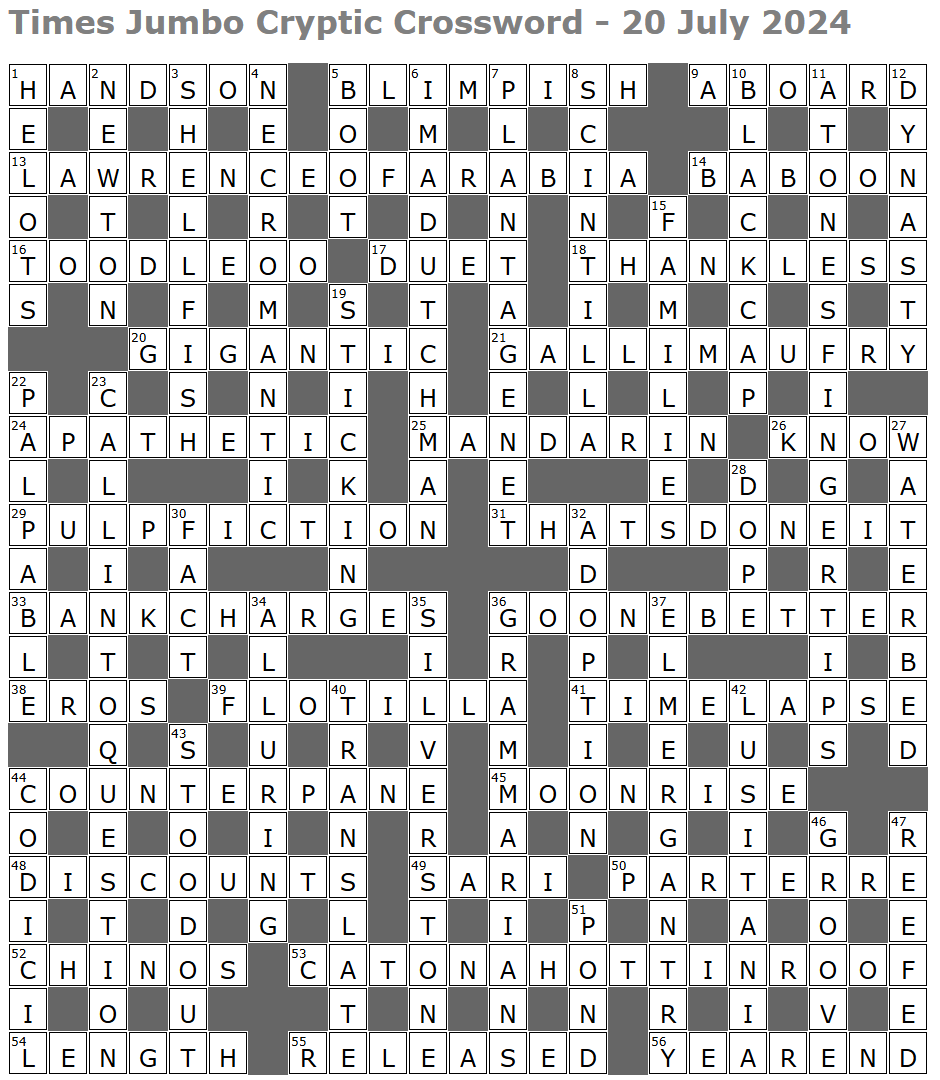
The case for the prosecution


Across clues
- Passes such practical training (5-2)
Answer: HANDS-ON (i.e. “practical training”). When written without a hyphen the solution also satisfies “passes”.
- Mistake to engage feeble reactionary (8)
Answer: BLIMPISH (i.e. “reactionary”, after the uber-conservative character Colonel Blimp, created by cartoonist David Low). Solution is BISH (i.e. a “mistake”) wrapped around or “engaging” LIMP (i.e. “feeble”), like so: B(LIMP)ISH.
- A pig died on the train (6)
Answer: ABOARD (i.e. “on the train”). Solution is A followed by BOAR (i.e. “pig”) and D (a recognised abbreviation of “died”).
- On principle, feigned forbearance with which I answer Middle East expert (8,2,6)
Answer: LAWRENCE OF ARABIA (i.e. “Middle East expert”). Solution is LAW (i.e. “principle”) followed by an anagram (indicated by “feigned”) of FORBEARANCE, then I and A (a recognised abbreviation of “answer”, as in Q+A), like so: LAW-RENCEOFARAB-I-A.
- Book a benefit for stupid oaf (6)
Answer: BABOON (i.e. “stupid oaf”). Solution is B (a recognised abbreviation of “book”) followed by A and BOON (i.e. “benefit”).
- See you as well swallowing endlessly large amounts (6-2)
Answer: TOODLE-OO (i.e. “see you”). Solution is TOO (i.e. “as well”) wrapped around or “swallowing” OODLES (i.e. “large amounts”) once its last letter has been removed (indicated by “endlessly”), like so: T(OODLE)OO.
- Performing couple warmer at night? Not very (4)
Answer: DUET (i.e. “performing couple”). Solution is DUVET (i.e. “warmer at night”) with the V removed (indicated by “not very” – V being a recognised abbreviation thereof).
- Unprofitable? This joint succeeded, for one (9)
Answer: THANKLESS (i.e. “unprofitable”). Solution is THIS with the I (i.e. “[Roman numeral] one”) swapped “for” ANKLE (i.e. a “joint”) and S (a recognised abbreviation of “succeeded”), like so: TH(I)S => TH(ANKLE-S)S.
- For very big performance an endless check (8)
Answer: GIGANTIC (i.e. “very big”). Solution is GIG (i.e. “performance”) followed by AN and TICK (i.e. “check”) once its last letter has been removed (indicated by “endless”), like so: GIG-AN-TIC.
- I am frugally treated in miscellaneous gathering (11)
Answer: GALLIMAUFRY (i.e. “miscellaneous gathering”). Solution is an anagram (indicated by “treated”) of I AM FRUGALLY.
- A touch frantic, not cold and listless (9)
Answer: APATHETIC (i.e. “listless”). Solution is A followed by PAT (i.e. to “touch”) and HECTIC (i.e. “frantic”) once the middle C has been removed (indicated by “not cold”, C being a recognised abbreviation thereof, as used on water taps), like so: A-PAT-HETIC.
- Chap taking a risk cut tongue (8)
Answer: MANDARIN (i.e. “tongue” or language). Solution is MAN (i.e. “chap”) followed by DARING (i.e. “taking a risk”) once its last letter has been removed (indicated by “cut”), like so: MAN-DARIN.
- Be aware of master of trivia’s return (4)
Answer: KNOW (i.e. “be aware of”). Solution is WONK (i.e. “master of trivia”) reversed (indicated by “return”).
- Destroy books, trashy magazines and film (4,7)
Answer: PULP FICTION. A triple-header, this, being to “destroy books”, “trashy magazines” and a 1994 “film”.
- Attend to his desperate cry of failure (5,4,2)
Answer: THAT’S DONE IT (i.e. “cry of failure”). Solution is an anagram (indicated by “desperate”) of ATTEND TO HIS.
- In races on slope beside river these are taken off balance (4,7)
Answer: BANK CHARGES (i.e. “these are taken off balance”). Solution is CHARGES (i.e. “races”) placed “on” or after BANK (i.e. “slope beside river”).
- Sellers say first to engage punter is to gain advantage (2,3,6)
Answer: GO ONE BETTER (i.e. “gain advantage”). Solution is GOON (i.e. Peter “Sellers, say” – other Goons were available) followed by E (i.e. “first [letter] to engage”) and BETTER (i.e. “punter”).
- A little heterosexual love personified (4)
Answer: EROS (i.e. “love personified”). “A little” indicates the solution has been hidden in the clue, like so: HET(EROS)EXUAL.
- Craft group regularly full on up to start of autumn (8)
Answer: FLOTILLA (i.e. “craft group”, basically a bunch of ships). Solution is FLO (i.e. “regularly full on”, i.e. every other letter of FULL ON) followed by TILL (i.e. “up to”) and A (i.e. “start [letter] of autumn”).
- Put out about mistake getting such lengthy exposure (4-5)
Answer: TIME-LAPSE (i.e. photography of “such lengthy exposure”). Solution is EMIT (i.e. “put out”) reversed (indicated by “about”) and followed by LAPSE (i.e. “mistake”).
- It may be on the bed against the window (11)
Answer: COUNTERPANE (i.e. “it may be on the bed”). Solution is COUNTER (i.e. “against”) followed by PANE (i.e. “window”).
- Virtually daily event is no more, sadly (8)
Answer: MOONRISE (i.e. “virtually daily event”). Solution is an anagram (indicated by “sadly”) of IS NO MORE.
- Record increases, not much at first, lead to offers of savings (9)
Answer: DISCOUNTS (i.e. “offers of savings”). Solution is DISC (i.e. “record”) followed by MOUNTS (i.e. “increases”) once the M has been removed (indicated by “not much at first”, i.e. the first letter of “much”), like so: DISC-OUNTS.
- Dress Cleopatra’s maid put back (4)
Answer: SARI (i.e. “dress”). Solution is IRAS (i.e. “Cleopatra’s maid” from Billy Shakespeare’s Antony and Cleopatra. The real-life IRAS seemed to begin with EI-, not I-) reversed or “put back”. These Times setters can’t seem to help themselves when it comes to the bard, can they? Squeezing him in at every opportunity, almost as if it’s the sodding law or something. How utterly dull. Have a Shakespeare demerit.
- Nameless colleague really missing helper to make beds (8)
Answer: PARTERRE (i.e. flower “beds”). Solution is PARTNER (i.e. “colleague”) with the N removed (indicated by “nameless” – N being a recognised abbreviation thereof) and the remainder followed by REALLY once the ALLY has been removed (indicated by “missing helper”), like so: PARTER-RE. Not a word I’m familiar with, but equally not a word I’m liable to remember.
- A sometimes prominent feature too big for trousers (6)
Answer: CHINOS (i.e. “trousers”). Solution is CHIN (i.e. “a sometimes prominent feature”) followed by OS (i.e. “too big”, specifically a recognised abbreviation of “outsize”).
- From censor that “No” outrageous: lid put on popular play (3,2,1,3,3,4)
Answer: CAT ON A HOT TIN ROOF (i.e. 1955 “play” by Tennessee Williams). Solution is CATO (i.e. a “censor” from the Roman empire) followed by an anagram (indicated by “outrageous”) of THAT NO. This is then followed by ROOF (i.e. “lid”) once first placed “on” or after IN (i.e. “popular”), like so: CATO-NAHOTT-(IN-ROOF). Given my gripes about a general aversion to modern culture within Jumbos I perhaps ought to grumble about a near-70-year-old play being in this week’s grid. Weirdly I’m fairly ambivalent about this one.
- Extension – does one go on at it? (6)
Answer: LENGTH. Solution satisfies “extension” and “does one go on at it”.
- Made available free (8)
Answer: RELEASED. Solution satisfies “made available” and “free”.
- With November moving on a bit, longed for December (4,3)
Answer: YEAR END (i.e. “December”). Solution is YEARNED (i.e. “longed”) with the N (“November” in the phonetic alphabet) “moved on a bit”, like so: YEAR(N)ED => YEARE(N)D.
Down clues
- Slaves sneaked up after a horse (6)
Answer: HELOTS (i.e. “slaves” – over to Chambers: “one of a class of serfs among the Spartans, deliberately humiliated and liable to massacre”). Solution is STOLE (i.e. “sneaked”) reversed (indicated by “up” – this being a down clue) and placed “after” H (i.e. “horse”, both slang names for heroin), like so: H-ELOTS. One remembered from its previous appearance (eventually). Hmm. Which cliché to apply? Classics or history? Classics or history?
- Lawgiver’s original weight (6)
Answer: Sir Isaac NEWTON (i.e. “lawgiver”, referring to assorted laws of physics he came up with, e.g. his laws of motion). Solution is NEW (i.e. “original”) followed by TON (i.e. “weight”). I won’t apply a who’s-who demerit here, as I would expect most solvers to know who Newton was.
- Crabby types, drunkenly egocentric in speech (9)
Answer: SHELLFISH (i.e. “crabby types”). Solution is a homophone (indicated by “in speech”) of SELFISH (i.e. “egocentric”) once slurred a bit (indicated by “drunkenly”).
- Devilishly enchanting concertina playing Mike interrupts (11)
Answer: NECROMANTIC (i.e. “devilishly enchanting”). Solution is an anagram (indicated by “playing”) of CONCERTINA wrapped around or “interrupted” by M (“Mike” in the phonetic alphabet), like so: NECRO(M)ANTIC.
- For old chemist, too bad not to have these days back (4)
Answer: John BOOT (i.e. “old chemist”, founder of Boots the Chemist). Solution is TOO BAD with the AD removed (indicated by “not to have these days”, i.e. Anno Domini) and the remainder reversed (indicated by “back”). Again, probably not worth a who’s-who demerit given most solvers will be familiar with Boots.
- Leader of worship welcomes wife with an ironically disbelieving expression (2,1,8)
Answer: I’M A DUTCHMAN (i.e. “ironically disbelieving expression”). Solution is IMAM (i.e. “leader of worship”) wrapped around or “welcoming” DUTCH (rhyming slang for “wife” supposedly after the Dutchess of Fife – we’ve seen this a few times in Jumbos now) and followed by AN, like so: IMA(DUTCH)M-AN.
- The sole catlike creature in the house (11)
Answer: PLANTAGENET (i.e. Royal “house” in England between 1154 and 1485). Solution is PLANTA (i.e. “the sole” of the foot, anatomically speaking) followed by GENET (i.e. “catlike creature”, remembered from its relatively recent appearance in a Jumbo). Ah, history again. Have a demerit.
- Without moving, grabbing a bit of chocolate in a flash (9)
Answer: SCINTILLATE (i.e. “flash”). Solution is STILL (i.e. “without moving”) wrapped around or “grabbing” C (i.e. “bit of chocolate”, specifically its first letter – I wasn’t especially keen on this wordplay) and IN, and followed by A, like so: S(C-IN)TILL-A.
- Winger, British, to go without international selection (8)
Answer: BLACKCAP (i.e. “winger” or bird). Solution is B (a recognised abbreviation of “British”) followed by LACK (i.e. “to go without”) and CAP (i.e. symbolic of “international selection” in sports).
- Where one has a subject mastered, makes up suggestions to drink a measure of spirits (2,4,10)
Answer: AT ONE’S FINGERTIPS (i.e. “where one has a subject mastered”). Solution is ATONES (i.e. “makes up”) and TIPS (i.e. “suggestions”) all wrapped around or “drinking” FINGER (i.e. “a measure of spirits”), like so: ATONES-(FINGER)-TIPS.
- Ruling line under empty diary, not pleasant (7)
Answer: DYNASTY (i.e. “ruling line”). Solution is DY (i.e. “empty diary”, i.e. the word “diary” with all its middle letters removed) followed by NASTY (i.e. “not pleasant”).
- What may be nuclear force covers a great distance to protect island (8)
Answer: FAMILIES (i.e. “what may be nuclear”). Solution F (a recognised abbreviation of “force”) followed by A and MILES (i.e. “great distance”) once wrapped around or “protecting” I (a recognised abbreviation of “island”), like so: F-A-MIL(I)ES.
- Clock sounds after seconds not moving (8)
Answer: STICKING (i.e. “not moving”). Solution is TICKING (i.e. “clock sounds”) placed “after” S (a recognised abbreviation of “seconds”), like so: S-TICKING.
- Obvious mate approaching White capturing bishop (8)
Answer: PALPABLE (i.e. “obvious”). Solution is PAL (i.e. “mate”) followed by PALE (i.e. “white”) once wrapped around or “capturing” B (a recognised abbreviation of “bishop” used in chess), like so: PAL-PA(B)LE.
- Query order to appear for examination (4,4,8)
Answer: CALL INTO QUESTION (i.e. “query”). When written as CALL IN TO QUESTION the solution also satisfies “appear for examination”.
- When initially a peerage cropped up, did one sleep on it? (8)
Answer: WATERBED (i.e. “one [can] sleep on it”). Solution is W (i.e. “when initially”, i.e. the first letter of “when”) followed by A and DEBRETT (i.e. “peerage”) once the latter has had its last letter removed (indicated by “cropped”) and the remainder reversed (indicated by “up” – this being a down clue), like so: W-A-TERBED.
- The lowdown from inside grand opera… (4)
Answer: DOPE (i.e. “the lowdown”). “From inside” indicates the solution has been hidden in the clue, like so: GRAN(D OPE)RA.
- …a piece of information following part of one (4)
Answer: FACT (i.e. “a piece of information”). Solution is F is a recognised abbreviation of “following” followed by ACT (i.e. “part of one” within the context of the previous clue, as indicated by the ellipses – in this case referring to an opera).
- As OAP, I don’t fancy taking on children (8)
Answer: ADOPTION (i.e. “taking on children”). Solution is an anagram (indicated by “fancy”) of OAP I DON’T.
- Everyone you said to call is seductive (8)
Answer: ALLURING (i.e. “seductive”). Solution is ALL (i.e. “everyone”) followed by U (i.e. “you said”, or a homophone of “you”) and RING (i.e. to “call”).
- Put weight behind reflective backing track (11)
Answer: SILVERSTONE (i.e. racing “track”). Solution is STONE (i.e. “weight”) “put…behind” SILVER (i.e. “reflective backing” of a mirror), like so: SILVER-STONE.
- Language students finally losing memory spoil one answer (11)
Answer: GRAMMARIANS (i.e. “language students”). Solution is G (i.e. “finally losing”, i.e. the last letter of “losing”) followed by RAM (i.e. computer “memory”, specifically the Random Access kind), then MAR (i.e. “spoil”), then I (i.e. “[Roman numeral] one”) and ANS (a recognised abbreviation of “answer”).
- Mainly regret I abandoned rewritten film (5,6)
Answer: ELMER GANTRY (i.e. 1960 “film” – can’t say it’s been on my radar). Solution is an anagram (indicated by “abandoned”) of MAINLY REGRET once the I has been removed or “abandoned”.
- Explain reason for delayed arrival? Not I (9)
Answer: TRANSLATE (i.e. “explain”). Solution is TRAIN’S LATE (i.e. “reason for delayed arrival”) with the I removed (indicated by “not I”).
- At uni, sail horribly fateful vessel (9)
Answer: LUSITANIA (i.e. “fateful vessel”, a British ocean liner sunk by a German U-boat off the coast of Ireland in 1915). Solution is an anagram (indicated by “horribly”) of AT UNI SAIL.
- Was not one of the crowd plucky to arrest old con? (5,3)
Answer: STOOD OUT (i.e. “was not one of the crowd”). Solution is STOUT (i.e. “plucky”) wrapped around or “arresting” O (a recognised abbreviation of “old”) and DO (i.e. to “con” someone), like so: STO(O-DO)UT.
- Willing extra fish in frozen condition to be docked (7)
Answer: CODICIL (i.e. “willing extra”, or a supplement to a will). Solution is COD (i.e. “fish”) followed by ICILY (i.e. “in frozen condition”) once its last letter has been removed (indicated by “to be docked”), like so: COD-ICIL.
- Nothing in copse to show track (6)
Answer: GROOVE (i.e. “track”). Solution is O (i.e. “nothing”) placed “in” GROVE (i.e. “copse”), like so: GR(O)OVE.
- Having gathered sail, put off returning across centre of Med (6)
Answer: REEFED (i.e. “having gathered sail”). Solution is DEFER (i.e. “put off”) reversed (indicated by “returning”) and wrapped around or placed “across” E (i.e. “centre [letter] of Med”), like so: R(E)EFED.
- Without hesitation think about garden feature (4)
Answer: POND (i.e. “garden feature”). Solution is PONDER (i.e. “think about”) with the ER removed (indicated by “without hesitation”).
 Lucian Poll's Web Ramblings
As someone who really detests the narrow fixation with ‘classicical’ history/literature and other narrow high-culture totems (eg Shakespeare, composers) generally (and definitely in these crosswords), I do love your sarcastic pisstakes of the Times stuffy clichés btw!
I confess that, although I did set my paper copy aside by the armchair, I cannot now find it. Perhaps “She who must be obeyed” threw it out with other papers, but I doubt it.
But I do have a completed No. 1685 awaiting LP’s comments.
We were not too keen on this one. Several rather thin clues left a bad taste. For example, “in frozen condition“ suggests the adjective icy rather than the adverb icily. And Debretts is the name of the publisher, not a peerage.
But “train’s late” did tickle my sense of humour.
Please do keep up the good work Lucian!
Some witty word play, eg 1a and 33a, but marred by obscurities such as Cleopatra’s maid and horribly bitty clues that involve taking some of a word, not all of it, and putting it around some of another word, then adding a bit of another word. 8d, for example.
I agree with a previous poster that Debrett is not a peerage.
For me the worst clue by a long way was 37d, an anagram leading to a 64-year-old film that I’ve never heard of.